March 21, 1981.
Michael Donald, 19, came from a loving family despite his parents being divorced. He was the youngest of seven sisters and brothers, all born to Beulah Mae and David Donald. A teenager who liked playing basketball with his friends, Donald, dressed in blue jeans, a light-colored shirt and a blue jeans jacket, had no way of knowing what awaited him in the darkness that night as he walked home.
Donald had gone to a neighborhood convenient store to
 |
| Michael Donald |
purchase a pack of cigarettes. His mother said smoking was his only vice. She did not like his smoking, but Michael felt that because he was enrolled in trade school, he was old enough to smoke.
Smoke was coming from a cross burning on the Mobile County Courthouse lawn, March 21, 1981. The Ku Klux Klan was piss hot mad about a verdict that they did not agree with. A "nigger" killing a White cop on their watch? Hell no! That was backwards! There was no way they were going to let that stand! The first trial of Joseph Anderson ended in a mistrial. Angry, the sought revenge.
Fate can sometimes be cruel. It can be sneaky and quiet. That night March each of Michael Donald's steps took him closer to an untimely, horrific death. His family and friends would not see him alive again after that innocent trip to a local convenient store.
Born in Mobile, Alabama, July 14, 1961, Donald was enrolled in a technical college. He wanted to be a mason. He finished high school and was working part-time in the mailroom at the Mobile Press Register before
he was senselessly murdered. His "random" death was later deemed a hate crime. The African American teenager had no way of knowing that he, an innocent
citizen of Mobile, Alabama would become a symbolic target of hate and revenge, randomly selected for execution by U. S. born and raised terrorists living in one of America's the Deep South states.
Between 10:30 and 11:30 P.M., Ku Klux Klan member Henry Frances Hays, 25, and James “Tiger” Knowles, then 17, drove around in the Black community, searching for a single Black person. They were angry and any potential Black victim they came across would satisfy their aim to kill in an act of revenge.
The United Klans of America (UKA) had a notorious reputation for intimidating Blacks in the South long before the lynching of Michael Donald. During the civil rights movement the group beat Freedom Riders in 1961; shot to death civil rights worker, mother and wife Viol Liuzzo in 1965 as she drove down the highway, bombed Birmingham's 16th Baptist Church, killing four little girls and three boys in 1963.
The KKKers tricked Micale Donald, the lone teen into approaching their car, asking him the location of a night club. When he was close to the car, one of them pointed the gun at Donald, ordering him to get into the car. Prior to her son's death Beulah Donald had dreamed about a casket in her living room. The male lying in the casket wore a gray suit. A mother's premonition? Perhaps.
The United Klans of America (UKA) had a notorious reputation for intimidating Blacks in the South long before the lynching of Michael Donald. During the civil rights movement the group beat Freedom Riders in 1961; shot to death civil rights worker, mother and wife Viol Liuzzo in 1965 as she drove down the highway, bombed Birmingham's 16th Baptist Church, killing four little girls and three boys in 1963.
The KKKers tricked Micale Donald, the lone teen into approaching their car, asking him the location of a night club. When he was close to the car, one of them pointed the gun at Donald, ordering him to get into the car. Prior to her son's death Beulah Donald had dreamed about a casket in her living room. The male lying in the casket wore a gray suit. A mother's premonition? Perhaps.
"Mrs. Donald drank two cups of coffee and moved to her couch, where she waited for the new day. At dawn, Michael still wasn't home. To keep busy, she went outside to rake her small yard. As she worked, a woman delivering insurance policies came by. 'They found a body,' she said, and walked on. Shortly before 7 A.M., Mrs. Donald's phone rang. A woman had found Michael's wallet in a trash bin. Mrs. Donald brightened - Michael was alive, she thought. 'No, baby, they had a party here, and they killed your son,'' the caller reported. 'You'd better send somebody over.'
"A few blocks away, in a racially mixed neighborhood about a mile from the Mobile police station, Michael Donald's body was still hanging from a tree. Around his neck was a perfectly tied noose with 13 loops. On a front porch across the street, watching police gather evidence, were members of the United Klans of America, once the largest and, according to civil rights lawyers, the most violent of the Ku Klux Klan organizations.
"Less than two hours after finding Michael Donald's body, Mobile police would interview these Klansmen. Lawmen learned only much later, however, what Bennie Jack Hays, the 64-year-old Titan of the United Klans, was saying as he stood on the porch that morning. 'A pretty sight,' commented Hays, according to a fellow Klansman. ''That's gonna look good on the news. Gonna look good for the Klan'.'' (The New York Times, November 1, 1987)
After beating Donald to death, they showed off his body at the house of the Klan elder Bennie Hays before hanging him from a tree.
The Alabama police
department
conducted an investigation into the lynching. Investigators quickly concluded that the teenager was involved with drugs. He was killed in a drug deal that turned deadly; they postured without proof. Beulah Mae Donald told the police that her son was
not involved with drugs. She even allowed them to search Michael's room. She was not having any of the nonsense talk that her deceased son was involved with drugs.
Beulah, believing that she was not going to
get justice for her
murdered of son, started working Mobile's Black community to organize rallies, hoping to attract attention that finally caught the attention of civil rights activist Jesse Jackson, and some other noted activist came to Mobile to help. Three men were arrested but not charged. They were released with no action pending. The Mobile police department dragged its feet. The case was destined for the cold case file. It took three years to finally arrest the culprits. By then the FBI had begun an investigation.
 |
| Teenage lynching victim Michael Donald |
Thomas Figures was an attorney for United States under the thumb of Republican Jess Sessions. As a senator he represented Mobile.
"As an act of appeasement to me--or to convince me that a second investigation would come to the same conclusion--I was allowed to work with a second F.B.I. agent, James Bod-man," Figures recalls.
"I'll never forget the first things Bodman said. He asked me, 'Why the hell do you want to reopen this can of worms'? But then he got interested in it, and we worked on it every day. We had lunch together, we talked at night--people started calling us 'the odd couple'". (The New York Times)
"In a sense, they were. Both are from the deep South. Figures is Black and Bodman is White".
Figures's insistence paid off. Results was forthcoming. In 1983 James "Tiger" Knowles made a full confession to Bodman. He admitted that he participated in
violating Michael Donald’s civil rights. He rolled on Hays to save himself.
At a March 18, 1981 Ku Klux Klan meeting called by Bennie Jack Hays, the Exalted Cyclops, and the father of Henry Hays. The discussion centered around the random killing of an African American as payback
if Josephus Anderson, a Black criminal, was not found guilty of killing a White policeman.
Hays said to the gathering: "If a nigger can get away with killing a White man, we ought to get away with killing a nigger".
Klans member Frank A. Ginocchio concurred and said, "We gonna kill a nigger!" When the not guilty verdict was announced the Klan stepped into action. They did not wait for the retrial, which subsequently ended with a guilty verdict.
An interracial grand jury of 11 Blacks and one White could not come to a unanimous decision. The trial of Josephus Anderson ended in a mistrial. His trial had been moved to Jefferson County because of a world wind of interest and publicity. Anderson had shot and killed a White cop in Alabama. The prosecutor said there would be a new trial. In 1985 Anderson was convicted for killing the cop after two more mistrials.
June 22, 1983 a special Mobile Grand Jury indicted Henry Hays for the murder of Michael Donald. It took two-and-a-half years to arrest and indict Hays and all others involved with the murder. Hays trial lasted from December 6 through December 10. At his trial the KKK member testified
that when they were scouting for a Black victim, Donald “seemed like a good
victim, and no one else was around. I asked him if he knew where a
nightclub was, and he started to direct me. I asked him to come closer, and I
pulled a gun out. Donald was yelling in the back of the car, acting like a
crazed madman".
After kidnapping Donald by gun point the duo hightailed it to the next county to a desolate area, where they carried out their brutal crime of revenge. During Hays trial it was learned that Donald begged them not to kill him. He attempted to escape but to no avail. Hays said Knowles chased after the scared teenager, hitting him with a tree branch, stunning him, knocking him to the ground. They beat him, cut his throat and strangles him. The teens face was reportedly battered and bloody, his lips swollen beyond their normal size. His clothes were covered in dirt or dry mud.
Hays and Knowles drove to house of Klan elder Bennie Hays to show him the body. During an early morning hour, they hanged
Donald’s body on a camphor tree close to a sidewalk on Herndon Avenue. They used the nylon rope they procured from Frank Cox's mother's house. Knowles tied the hangman's knot at the end of the rope. They had borrowed a gun from Klan member Johnny M. Jones, but they did not shoot Donald.
According to a wrongful death lawsuit filed by Morris Dee of the Southern Poverty Law Center, "Hays and Knowles took the unconscious body of Michael Donald to Henry Hays' house on Herndon Street, showing it to defendant Frank Cox between the hours of midnight and 5 A.M.".
During the joint discussion (March 18), defendant Bennie Hays told James Knowles and Henry Hays not to do anything
 |
| Body of Michael Donald, the noose still around his neck |
until after Friday because he was selling his apart-ment located on the same street. Hays did not want any distractions that would deter the sale of his apartments.
Klan members rejoiced about their achievement. Standing on Hays' porch, Knowles, and Teddy Kysar watched the police collect whatever sparse evidence they could discover at the second crime scene. Kysar said to Knowles, "Good job, Tiger".
The local newspaper headline
read: Man Found Hanged on City Street.
Sam Jones, an African American and mayor of Mobile was on the scene when
Donald’s body was cut down. A collection of people stood by watching until his body
was placed in an ambulance.
In the lawsuit Beulah Donald vs United Klan of America, it was noted that the purpose of the random killing was twofold: "First, to intimidate present and future jurors in Mobile County and Alabama from ruling in favor of Black defendants charged with crimes against Whites, or in favor of Black defendants seeking to recover damages from Whites, thereby denying Black citizens their right to a fair and impartial trial; and second, to show the strength of the [United] Klans, and to show [Blacks] that [the United Klans was] still here in Alabama, thereby intimidating and threatening Black citizens who would attempt to exercise their right to vote, to equal employment, to equal justice, and to life, liberty and the pursuit of happiness as guaranteed by the federal and state laws. These actions on the part of defendants Henry Hays and James Knowles were done to carry out the plan of defendants identified and set forth in paragraph 27 above, to kill a Black person should the jury trying Joseph Anderson not find him guilty."
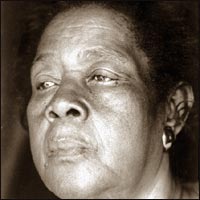 |
| Beulah Mae Donald |
To avoid the death penalty
Knowles rolled on Hays and his fellow Klansmen, cutting a plea deal with the prosecution. He was the D. A’s star
witness against his partners in crime. Though Knowles avoided
“Yellow Mama”, the nickname for Mobile’s electric chair, he was sentenced to
life in prison. However, for the sake of his safety he was put into custody of the United States Justice Department. He agreed to testify against the Klan in upcoming cases.
When Knowles got a chance to address the jury at his trial, he said: "I've
lost my family. I've got people after me now. Everything I said is true. I was
acting as a Klansman when I done this. And I hope people learn from my mistake.
I do hope you decide a judgment against me and everyone else involved."
Turning to face Beulah Mae Donald, Knowles said: "I can't bring your son back. God knows if I could trade places with him, I would. I can't. Whatever it takes - I have nothing. But I will have to do it. And if it takes me the rest of my life to pay it, any comfort it may bring, I hope it will".
Beulah Mae Donald said to Knowles: "I do forgive you. From the day I found out who you all was, I asked God to take care of you all, and he has." It took the jury 30 minutes to award Donald a $7 million judgment against the United Klan of America, including all the property the organization owned.
The grieving mother said she did
not want revenge. She just needed to know the reason for them killing her son. ''I
wanted to know who all really killed my child. I wasn't even thinking about the
money. If I hadn't gotten a cent, it wouldn't have mattered. I wanted to know
how and why they did it.'' In 1987 The New Times named Beulah Donald
"Woman of the Year."
 |
| March 28, 1981 Beulah Donald attends the funeral of her murdered son, Michael. She insisted the casket remain open because she wanted everyone to see what they did to her son. She died in 1988. |
A Mobile Grand Jury composed of 11 whites and
one African American indicted Henry Frances Hays for murder. He pleaded
innocent, saying Knowles “framed him.” At his son’s trial, The
Guardian reported that a defiant Bennie Hays declared, “To get me they got my son. I had
a nigger . . . I mean a black man come up to me and ask why I wear a
cover. He knew I was in the Klan. Everyone in the hall knew I was the Klan. I
don’t hide it. I got nothing to be ashamed of.”
A couple of years later Bennie
Hays was charged with conspiracy to kill Michael Donald. When he went on trial
February 1988, he was 71 years old. He collapsed in the courtroom about 15 minutes after listening to Knowles testify; his second day on the stand. The old man died of a heart attack in a
Biloxi V. A. Hospital before he could be retried.
On December 10, 1983, Henry Hays, the son of Bennie Hays, was
sentenced to life in prison. Judge Braxton Kittrell, Jr. rejected the sentence
in 1984. He ruled that Hays should be executed. In 1986 the Alabama Court of
Criminal Appeals set aside the death sentence.
However, the Alabama Supreme Court upheld Judge Kittrell’s decision. Hays sat on death row for 16 years, appealing his sentence, asking for clemency. He
was executed in Alabama’s electric chair June 6, 1997. It was the first time since 1913 that a White man was put to death for killing a Black
man, and the first Klansman to be executed for killing a Black man in the 2oth century.
Frances Coleman wrote in the Mobile Register, 1997: "June 6 will be a sad day for Alabamians, whether their skins are white, black or brown. On that day -- the previous night, really, at 12:01 a.m. -- the state of Alabama will electrocute Henry Francis Hays for beating a black man to death 16 years ago, and then hanging his body from a tree.
"The execution will rip the scab from the old, deep, nasty wound of racism, which in the 20th-century South alternately heals and festers. It will fester again this week as residents of the Heart of Dixie re-live the brutal death of 19-year-old Michael Donald.
"It is a story of contrasts: The murderer, a white man, grew up in a home filled with hate and violence. The victim was reared by a loving mother and doting older siblings.
"Henry Hays knew what he was about that night, when he and a friend set out to kill a black man. Michael Donald, on the other hand, was innocently walking up the street on a spring evening in Mobile to buy some cigarettes, when fate delivered him into the white men's hands.
"Most vivid, though, is the contrast between fiction and reality. Michael Donald was murdered, beaten to death with a tree limb-- not in the 1930s or '40s, even in the 1960s, but in 1981. Such things weren't supposed to happen almost 30 years after the Supreme Court declared "separate but equal'' unconstitutional, and nearly 20 years after the Civil Rights Act of 1964.
"Nor were they supposed to happen in Mobile, which in the 1960s had somehow managed to avoid the racial violence that erupted in Selma and Birmingham.
"Black men kidnapped and beaten, their bodies strung up in a tree? That was something that happened on the dark back roads of Dallas County or over in the Mississippi Delta, not in Alabama's second-largest city. But hate crimes aren't constrained by time, place or suppositions. The reality is that Michael Donald died just 16 years ago at the hands of two Ku Klux Klansmen. So what if his death came years after lynchings were supposed to have ceased, and in a place not known for such things?"
Beulah Donald sold the Klan headquarters for $52,000 and bought a home. That was all the money she ever received from this homegrown terrorists group, that was more poor than rich. The wrongful death lawsuit bankrupted the United Klan of America, Inc. The lawsuit closed the book on this case February 1987. Beulah Donald died in 1988 of natural causes in a Mobile hospital. She was 67. Her victory was seen as the hammer that nailed shut the coffin of the KKK in Mobile and Tuscaloosa, Alabama.
In 2006 Mobile changed Herndon Avenue to Michael Donald Avenue at the urging of Mayor Jones and the city council. Donald's night of terror was relived in a novel titled Like Tree, Walking by Ravi Howard. Also on National Geographic, Donald's story was revisited in 2008 in a piece titled Inside American Terror.


