Showing posts with label forgotten story. Show all posts

Monday, June 30, 2014

Mexican American zoot suiters in L. A. attacked, called 'unpatriotic' and 'un-American'

During the 1940s the hottest outfit for some African American men and teens to wear were zoot suits. It took a lot cloth to make one suit, but the results was a showcase of “look at me” on parade. The fashion phenomenon eventually caught the attention of Latinos and Italians, each having their own versions of the culturally popular suit.

Musician/actor Cab Calloway
Believe it or not, this flamboyant suit evolved into an object of violence and racism. Those who wore the oversized suits were labeled “zoot suiters”.  The zoot suit, a high fashion tailored wonder, had wide lapels, padded shoulders, tapered cuffs, making the wide legged, high waist trousers resemble a pair of harem pants.  Colors varied according to a wearer’s taste. Zoot suits were accented with a single or double chain attached to the pants, hanging the full length of the suit. Wearing shoes shined to the max, some zoot suiters wore wide rim fedoras accented with long feathers. Fashion minded women wore less severe versions of the zoot suit. They wore mid-calf skirts and vests.

In the 1940s Los Angeles was a hot bed of racism, segregation and racial strife. America was thigh high in World War ll.  In 1942, following President Franklin D. Roosevelt’s Executive Order 9066, the U. S. Army evacuated Japanese nationals and U. S. citizens of Japanese descent. In Los Angeles, Little Tokyo disappeared after thousands of Japanese were interned in makeshift concentration camps in America. The Japanese had struck Pearl Harbor, and all Japanese in this country were suddenly the enemy.

Angry sailors, citizens and Marines on the prowl,
searching for Mexican Americans to attack.
In 1943 all hell broke loose on the streets of L. A., the city of angels.  It was a time when Mexican Americans were forced into street fights with White Marines and sailors.  

“Tensions between servicemen and civilians were on the rise as thousands of military men on leave poured into Los Angeles, seeing the city as a playground for booze, women, and fights. While many civilians tolerated them because of the war effort, others did not. 

"Particularly in the segregated, ethnic enclaves of Los Angeles, unruly servicemen met stiff opposition from young men and women who refused to defer to the presumed prerogatives of white privilege. While white military men and civilian youth of all colors clashed in the streets, confrontations occurred most frequently between white servicemen and Mexican Americans, because they were the largest minority group in Los Angeles.

"White people in general, civic leaders and police departments decided among themselves that zoot suits were un-American and unpatriotic. In the midst of a global war with an uncertain outcome . . . and calls for patriotic loyalty, minimized public tolerance for expressions of soul difference--even sartorial ones-- the zoot suiter tested the political and moral expectations of the moment." kcet.org quoting from Eric Avila essay. 

Whites felt Mexican Americans should have been fighting in the war, not wearing zoot suits and flaunting their racial differences. The fact is Mexican Americans were fighting in World War ll. Racial hatred blinded White people.  The unfortunate internment of thousands of Japanese citizens saved them from experiencing the racial acrimony. America was at war with the Japanese for bombing Pearl Harbor.

“Drunken military men on their way back to base after a night of carousing were often ‘rolled’ by civilian minority youth hoping to teach them proper respect. With equal animosity the sailors would often insult Mexican Americans as they traveled through their neighborhood. In the barrios, rumors spread about sailors searching out Mexican American girls. 

"On the military bases, stories circulated about the violent reprisals suffered by sailors who dared to date Mexican American females. Sailors complained bitterly about their wives or girlfriends being subjected to the sexual taunts of young Mexican Americans. The tension continued to escalate until a street fight between sailors and Mexican American boys sparked more than a week of fighting in June of 1943 known as the Zoot Suit Riots.” The American Experience, PBS

Whites wearing zoot suits were treated differently.
None were taunted, taunted or arrested.
The media and L. A. police fanned the flames, unable or unwilling to disabuse themselves of the animosity they felt toward the zoot suit wearing Mexican Americans, all of whom were called hoodlum and criminals. 

“On the evening of Monday, May 30, 1943 about a dozen sailors and soldiers were walking on a downtown street. After spotting a group of young Mexican American women on the opposite side of the street, the sailors and soldiers changed direction and headed in the direction of the women. Between the military men and the young women stood a group of young men in zoot suits. As the two groups passed each other, Sailor Joe Dacy Coleman, fearing he was about to be attacked, grabbed the arm of one of the zoot-suited young men. Coleman's move proved to be a big mistake. He was almost immediately struck on the head from behind and fell to the ground, unconscious. 

"Other young civilians pounced on the sailors with rocks, bottles and fists. After the ferocious attack, the sailors managed to escape and carry Coleman to the safety of the Naval Armory. 
The fracas lasted little more than a few minutes, but the shock reverberated for days," wrote historian Eduardo Pagán. ‘The details of the fight grew larger and more distorted in each re-telling of the story’. It wasn’t long before sailors organized a retaliatory strike against zoot-suiters.”
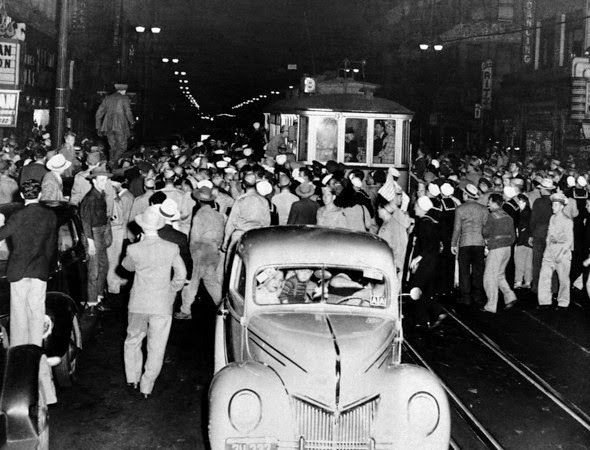

Mob of angry White rioters on the loose in downtown Los Angeles, 1943


The rioting lasted a week. On June 7, a local paper wrote and printed a how- to- guide for soldiers and White citizens to follow if they decided to undress a zoot suiter in public, which was the ultimate humiliation. They were instructed to rip up or burn the zoot suits on the street.  A riot ready crowd of hundreds gathered in downtown L. A. The crowd divided up, some plodding toward Watts, an African American neighborhood, and some headed to East of L.A. where Mexican American resided. Uniformed police officers were part of the melee.
The police made arrests but the majority of those arrested were Mexican Americans.

 “After several days of rioting and assaults by servicemen, more than 150 had been injured and the police had arrested and charged more than 500 Latino youth for rioting or vagrancy, many themselves the victims. ‘Zoot Suiters Learn Lesson in Fight with Servicemen’ the Los Angeles Times wrote. The Los Angeles City Council issued an ordinance banning the wearing of zoot suits. ‘The zoot suit has become a badge of hoodlumism,’ explained Councilman Norris Nelson. 'We prohibit nudism by an ordinance and if we can arrest people for being under-dressed, we can do so for being over-dressed.


Two zoot suiters attacked by mob and stripped naked, forced to lie or sit in the street.


 “Finally, on June 7, military authorities did what civil authorities would not. Navy and Army commanders sought to get control of their men by ordering that the City of Los Angeles be declared off-limits to military personnel. Nonetheless, the official Navy position was that their sailors were acting in "self-defense against the rowdy element. Although the police accompanied the caravan of rioting servicemen, police orders were to let the shore patrol and military police deal with the military men.” Los Angeles Almanac 

“Al Waxman, editor of the Eastside Journal, a small Jewish newspaper, witnessed the chaos. He describes a "mass of humanity locked in violent struggle, arms swinging, legs kicking, shrieking with anger." 

The police were arresting dozens of young Mexican Americans. "Why am I being arrested?" one of them asked. The response was a savage clubbing with a nightstick. Although the boy fell to the sidewalk unconscious, he was kicked in the face by police.” The American Experience, PBS

A special committee formed by the governor of L. A. analyzed the riots and concluded that race was not a factor. No one had discriminated against the zoot suiters, the report concluded.

(right photo) Mexican American teen held at police station, stripped down to his underwear. One cop looks amused by the smiling teen.

Monday, September 5, 2011

Deliberate destruction of an African American community: The 1921 massacre in Oklahoma

A  dead African American man lies on a flatbed truck as one of the "deputized" terrorists stand guard with a shotgun. The goal to destroy Oklahoma's "Black Wall Street" was successful.

Black history was not taught in public schools, private schools or universities. All textbooks were written from White authors points of view and interpretations. Even in all-Black schools' Black history was more mute than loud. All heroes in textbooks were White males, bearing tales of their exaggerated bravery and above average achievements.

In 1998 Hannibal B. Johnson wrote "Black Wall Street", that tells the history of Tulsa's Greenwood District, populated by African Americans. The district was representative of Black Americans who had achieved great wealth, owned businesses of all kinds. Like any normal community, not all Black residents achieved great wealth or lived upper-middle class lifestyles, but they were working class in and out of their community.

The District was its own city within the city of Tulsa. But history books did not reveal this great achievement. It took 100 years for Black Wall Street and its subsequent destruction to become a subject of interest. Suddenly, in 2021, there are panel discussions and documentaries made about the tragedy, as perpetrated by jealous White folks in Tulsa. The year was 1921. An accusation of rape initiated the deadly tragedy-in-waiting.

May 20, 2021, Ms Victoria Flecther, 107, and her younger brother, Mr. Hughes Van Elis, 100, and Ms Lessie Benningfield Randle, 106, testified before the House Judiciary Committee. They recalled the day of the massacre.

Ms Fletcher: "I here seeking justice, and I'm asking my country to acknowledge what happened in Tulsa in 2921. The night of the massacre I was awakened by my family. My parents and five siblings were there. I was told that we had to leave, and that was it.

"We will never forget the violence of the White mob when we left our home. I can still see Black men being shot, Black bodies lying in the street. I still smell smoke and see fire. I still see Black businesses being burned. I still hear airplanes flying overhead. I hear the screams. I have lived through the massacre everyday. Our country may forget this history, but I cannot. I will not. And other survivors do not. And our descendants do not". Ms Fletcher was seven years old at the time of massacre.

Mr Van Ellis: "We live with it every day, and the thought of what Greenwood was, and what is could have been. We aren't just black and white pictures on a screen. We are flesh and blood. I  was three when it happened. I'm still there.

"We are not asking for a handout. We are asking for a chance to be treated like first class citizens, who truly is a beneficiary of the promise that this is a land where there is liberty and justice for a lifetime. Harm is what that caused by the massacre".

Ms Randle: "It seem like justice in America is always so slow or not possible for Black folks. They owe us something. They owe me something. I have lived much of my life poor. My opportunities were taken from me, and my community, North Tulsa. Black Tulsa is till messed up today. They didn't rebuild it. It's empty. It's a ghetto".

Jealousy and rage: any old excuse will do

America has a very dark history created by her White inhabitants. One of the blots in America's past is the wholesale slaughter of African American men accused of raping White women. The accusations did not have to be true. All a White woman had to do was scream rape. Black men knew not to look suggestively at White women, or brush against them. The accuser could have been the town's whore, it doesn't matter to a murdering mob. In their eyesight she was superior to a Black man. Her "virtue" had to be protected from all Black beasts. 

As an extra bonus, angry Whites destroyed Black communities at will, knowing they would not be jailed or prosecuted, even if there were dozens of witnesses, none of whom dared come forward to identify the perpetrators for fear of reprisal. On the reverse side, White males could rape Black women and girls wherever they wanted. They were safe from prosecution and punishment. They could steal Black folks land and personal belongings and run them out of town, warning them not to return.

 In 1919 America witnessed an explosion of violence against African Americans. Realistically, there was never a time when violence against African Americans was less than furious and deadly. So horrific were the attacks by White mobs in 1919 that the NAACP’s James Weldon Johnson labeled it “Red Summer." Race riots were breaking out all over America.

A few years later mob violence destroyed a thriving Black community in Tulsa, Oklahoma. The year was 1921. Some historians said Whites were jealous of successful Blacks and the thriving businesses they owned. Whites hated their independence. They wanted a reason to destroy Oklahoma's Black Wall Street in Tulsa's Greenwood District. Fires and firebombs from planes annihilated the district in less than 24 hours. The attack began on the night of May 31, ending on the morning of June 1.

O.W. Gurley
Greenwood was named after a town in Mississippi, by wealthy businessman, O.W. Gurley, an African American. Upon moving to Tulsa, he purchased 40 acres of land, reserved only for "colored" people. In 1906 Greenwood was developed on Indian Territory when Native American Tribes were forced to relocate, settling in Oklahoma. Some Blacks, who were former slaves of the tribes, integrated into the tribal communities. Tribes were allotted land through The Dawes Act, a U. S. law that gave land to Native Americans. Many Black sharecroppers fleeing from oppression in their home states landed in Oklahoma.

The thought of Blacks seeking a better life did not sit well with White folks. In 1912 the Tulsa Democrat (which later became the Tulsa Tribune) boldly proclaimed: 'Tulsa appears now to be in danger of losing its prestige as the whitest town in Oklahoma.  Does Tulsa wish a double invasion of criminal Negro preachers, Negro shysters, crap shooters, gamblers, bootleglegs (sic), prostitutes and smart elecs (sic) in general'"?
  
"The Tulsa Tribune would later refer to the African American community in Tulsa--this city within a city--by the alternate epithets of 'Little Africa' and 'Niggertown'. Such utter disdain and disrespect for a whole class of individuals would shake any society to its very foundation". Black Wall Street

The great divider--railroad tracks--separated Blacks from Whites. Gurley built three, two story buildings and five residents, bought an 80-acre farm in Rogers County. He founded the Vernon AME Church. When Greenwood began to grow Gurley loaned money to anyone wanting to start their own businesses. Not all residents in the Greenwood District were affluent. Many of them worked as waiters, shoe-shiners, domestics, janitors, dishwashers. However, all of their earnings were spent in Greenwood. The Greenwood District came into being around 1905, starting with a grocery store, owned and operated by Gurley.

Hannibal B. Johnson, author of Black Wall Street: From Riot to Renaissance in Tulsa's Historic Greenwood District, wrote: "In the loss of over 700 homes and 200 businesses the Negroes of Tulsa have sustained a loss of over four million dollars. Two of the finest hotels that the Negro owns in America went up in smoke. The Welcome Grocery Store carried a large stock of groceries as did any retail White store in Tulsa. Mrs. Williams, who owned the Dreamland Theatres in Tulsa, Muskogee and Okmulgee, was perhaps the one of the foremost Negro businesswomen in the United States.

"She has one of three-story brick businesses on Greenwood, which housed her big confectionery, and other floors were used for offices for the professional men of the race. Farther down the street was her theatre, the pride of the Negros of the city. The street had located on it three drug stores and two newspaper plants. The Tulsa Star had a plant worth fully $15,000. Fully 150 business and houses lined this street alone, that required Negro traffic officer to stand in the streets all day long, directing the busy activities".

In a February 2001 report by the Oklahoma Commission to Study the Tulsa Riot of 1921–some 80 years after the race riot, historian Scott Ellsworth wrote: “Tulsa was in some ways, not one city but two. Practically in the shadow of downtown there sat a community that was no less remarkable than Tulsa itself. Some Whites disparagingly referred to it as ‘Little Africa’, but it became known in later years simply as Greenwood. In the early months of 1921, it was the home of an estimated 10,000 African American men, women and children”.

This bustling African American community also included two schools, Paul Lawrence Dunbar and Booker T. Washington, two newspapers, three fraternal lodges, a hospital, two theaters, a public library, 23 churches and a bank. White rioters targeted the businesses and homes that they looted and burned down.

Ellsworth’s report continues: "Significantly, the violence in the state was part of a broader story of national intolerance that followed World War I. Yet the Tulsa riot represented a defining moment in Oklahoma's history, for it forecast the extent to which some White citizens would travel to achieve the ultimate subjugation of Blacks.

"Much like the other riots of the period, the Tulsa disaster developed from a number of immediate and remote causes, among them irresponsible journalism, rumor, racial fears, tensions related to urban migration, and weak law enforcement. Although historians cannot specifically indict the Ku Klux Klan in starting the riot, the organization created a spirit of lawlessness that made it easier for some citizens to engage in mob activity”.

Blacks who had migrated to Oklahoma earlier did not go there in search of mayhem and hang-ready-mobs. In fact, thousands of African Americans, along with southern Whites, journeyed to Oklahoma during the start of a financial boom. It was an era when the population was steadily increasing.  By 1921 Oklahoma was considered the oil capital of the world.  African Americans, plagued by racism and segregation, settled in the northeast section of Tulsa. However, migration did not change the heart and minds of White people who refused to let go of their bigotry, and how they viewed African Americans.

Walter White, Atlanta’s NAACP secretary, was dispatched to Tulsa to cover the riots. White was a light complexioned man with "good hair", who could easily "pass" for a White man. Passing enabled him to walk freely among White folks without harassment or threats. In his report he asked, “What are the causes of the race riots that occurred in such a place"?

He answered his own question: “First, the Negro in Oklahoma has shared in the sudden prosperity in Oklahoma that has not come to many White brothers, and there are some Colored men there who are wealthy. This fact has caused a bitter resentment on the lower order of Whites, who feel that these Colored men, members of an inferior race, are exceedingly presumptuous in achieving greater economic prosperity than they, who are members of a divinely ordered superior race".

Tulsa was not a financial paradise without problems. There was talk of crooked police, political corruption, prostitution, gambling, murder, mob rule and robbery. According to the Oklahoma Historical Society, “. . . [T]ulsa was also a deeply troubled town. Crime rates were sky high, while the city had been plagued by vigilantism, including the August 1920 lynching, by a white mob, of a White teenager accused of murder. Newspaper reports confirmed that the Tulsa police had done little to protect the lynching victim, who had been taken from his jail cell at the county courthouse.”

Historian tells who Dick Rowland was

Dick Rowland, a young African American teen, was the keg of dynamite that ignited the destruction and mayhem in Tulsa in 1921. An accusation of assault of a White woman is the reason for the subsequent burning down of the Greenwood District.

Scott Ellsworth, in an essay titled The Tulsa Race Riot reveals who Dick Rowland was. As Tulsa prepared to celebrate Memorial Day, May 30, 1921, something sinister was in the air. Talk of taking the law into their own hands began circulating among some Whites across the tracks from Greenwood. Blacks were more determined than ever that no African American would fall victim to mob violence. World War veterans and newspaper editors, common laborers and businessmen were just as prepared as they had been two years earlier to make certain that no Black person was ever lynched in Tulsa, Oklahoma.

Precisely at this moment, in the highly charged atmosphere, Dick Rowland and Sarah Page, walked out of the shadows, and onto the stage of history. Although they played a major role in the single event that led to Tulsa's race riot, very little is known for certain about Rowland or Page. Rumors, theories, and unsubstantiated claims have been plentiful throughout the years, but hard evidence has been much more difficult to come by.
.
When dick Rowland was born he was given the name Jimmie Jones. While it is not known where he was born, by 1908 he and his two sisters were orphans living on the streets of Vinita, sleeping wherever they could, begging for food. A Black woman named Damie Ford, who ran a tiny one-room-grocery store, took pity on young Jimmie, taking him in. "That's how I became Jimmie's 'Mama," she said in an interview. 

Approximately one year later, Ford and her adopted son moved to Tulsa, where they reunited with Ford's family, the Rowlands. Eventually, little Jimmie took Rowland as his last name, and chose his favorite first name, Dick. Growing up in Tulsa, Dick attended the city's separate all-Black schools, including Booker T. Washington High School, where he played football.

Rowland dropped out of high school to take a job shining shoes in a White-owned, White-patronized shine parlor located in downtown on Main Street, across from the Drexel Building. Shoeshines cost a dime. Shoe shiners--or bootblacks as they were sometimes called--were often tipped a nickel for each shine; sometimes more. Rowland earned five dollars a week base pay.

What precipitated the Oklahoma massacre?

The Tulsa massacre began several hours after Rowland was accused of attempting to rape a White girl. On Monday, May 30 he stepped into the elevator at the Drexel Building. Sarah Page, 17, was an elevator operator. Reports are she lived in a rented room and was working her way through college.

Dick Rowland rode the elevator many times to get to the “Colored” restroom on the top floor of the Drexel Building.  This arrangement was made by his boss. There was no “Colored” restroom in the building where Roland worked. 

As he stepped inside the elevator it jerked, causing him to lose his balance. Page screamed, thinking Rowland was trying to attack her. Her scream caught the attention of a clerk working at Renberg’s Clothing Store, located on the first floor of the building. He rushed to help Page, and then called police. The clerk told police that he saw Rowland running out of the building after he attempted to rape the teenager. Rowland ran out of fear for his life, well aware of what happens when a Black man is accused of attacking a White woman.

The Oklahoma Historical Society has its version of what happened, as did others writing about the riot. “Eight months later an incident involving Dick Rowland, an African American shoe shiner, and Sarah Page, a White elevator operator, would set the stage for tragedy. It is still uncertain as to precisely what happened in the Tulsa Drexel Building on May 30, 1921".

The Society report further stated: “The next day, however, the Tulsa Tribune, the city's afternoon daily newspaper, reported that Rowland, who had been picked up by police, had attempted to rape Page. Moreover, according to eyewitnesses, the Tribune also published a now-lost editorial about the incident, titled 'To Lynch Negro Tonight". 

Rowland was arrested by the sheriff on Tuesday, May 31, 1921, booked in the city jail and questioned. Hannibal B. Johnson, author of Black Wall Street writes, “Roland’s flight seemed reasonable and rational under the circumstances. Sarah Page had initially accused Rowland of assault, but quickly retreated from the accusation. She told officers that Rowland had come close to her on the elevator, and that he had stepped on her foot. Of her own admission, she had panicked and overreacted. Page told officers that she slapped Rowland, at which time he grabbed her arm to prevent her from slapping him again. She screamed and he fled".

The damage, however, had already been done. Summoned to the jail, Sarah Page provided a statement corroborating Dick Rowland’s account of the incident. She admitted that her encounter with him had been "inadvertent and innocent”.

Robert Fairchild, Sr., who survived the riot, said he worked with Rowland. “Dick was a quiet kind of fella. Never no trouble. The Tribune called him ‘Diamond Dick.’ Me, or nobody in Greenwood ever heard that name for him before. They invented it (the newspaper). Neither one of us probably never saw a diamond”.

Scott Ellsworth wrote: “While it appears that the clerk stuck to his interpretation that there had been an attempted rape, and of a particularly incendiary kind–no record exists as to what Sarah Page actually told police when they interviewed her". Ellsworth noted that whatever Page said, the police did not reach the same conclusion as the clerk. The police initiated a low-key investigation into the affair.

Johnson wrote, "In the immediate wake of the Rowland-Page elevator incident, Sarah Page and Dick Rowland became the talk of the town. An unknown man called the police at about 4:00 p.m. Word on the street, according to the caller, was that a White lynch mob planned to take the matter into their own hands. Indeed, so concerned was Sheriff McCullough that he reportedly telephoned the offices of the Tulsa Star, Tulsa's African American newspaper".

Johnson wrote that McCullough intimated that he might "need the help of local African American men to protect Dick Rowland from certain death at the hands of a lynch mob".

Walter White wrote, “Sarah Page was of an exceedingly doubtful reputation. It seems to never have occurred to the citizens of Tulsa that any sane person attempting criminally to assault a woman would have picked any place in the world rather an open elevator in a public building with scores of people within calling distance”.

Riot survivor Binkey Wright said, “My daddy knew Dick was going with Sarah Page, the young White elevator operator. He met her when he stacked the concession stand where she worked”.

On Tuesday, May 31, without fanfare, Rowland, hiding out in his mother’s home in Greenwood, was arrested by Det. Henry Carmichael, a White officer and patrolman Henry C. Park, a Black officer. Rowland was booked and jailed. Rushing to write a story without the facts, the Tulsa Tribune published an inflammatory story in its afternoon edition. The headline read: "Nab Negro for Attacking Girl on Elevator". An editorial in the same edition suggested lynching Rowland. 

“Talk soon turned into action. By 7:30 p.m. hundreds of Whites had gathered outside the Tulsa County Courthouse, demanding that the authorities' hand over Dick Rowland. The sheriff refused. At about 9 p.m., after reports of the dire conditions downtown reached Greenwood, a group of approximately twenty-five armed African American men, many of them World War I veterans, went down to the courthouse and offered their services to the authorities to help protect Rowland. The sheriff, however, turned them down, and the men returned to Greenwood.

"Stunned, and then enraged, members of the White mob then tried to break into the National Guard armory but were turned away by a handful of local guardsmen. At about 10 p.m. a false rumor hit Greenwood that Whites were storming the courthouse. This time, a second contingent of African American men, perhaps seventy-five in number, went back to the courthouse and offered their services to the authorities. Once again, they were turned down. As they were leaving, a White man tried to disarm a Black veteran, and a shot was fired. The riot was on”. (Oklahoma Historical Society)

“Fearing for the worst,” writes Johnson, “the Tulsa National Guard mobilized at 11 p.m. on the eve of the destruction, Tuesday, May 31. Meanwhile, the Tulsa police began deputizing White men–some of the very same men who had actively participated in the courthouse disturbance only hours earlier. Bands of White men in search of firearms and ammunition for the impending civil war looted hardware stores and pawnshops, seizing some $43,000 in guns and ammunition".

The Chicago Tribune reported that private airplanes were used to drop kerosene fire bombs and dynamite on businesses and homes in Greenwood. Whatever was used to burn down Tulsa’s Black Wall Street, it was evident the next morning. The African American residential and business districts were piles of ashes.  Not one White person was accused of any wrongdoing, much less arrested.

"Governor Robertson declared martial law, and National Guard troops arrived in Tulsa. Guardsmen assisted firemen in putting out fires, took imprisoned Blacks off the hands of vigilantes, and imprisoned all Black Tulsans not already interned. Over 6,000 people were held at the Convention Hall and the Fairgrounds, some for as long as eight days. Twenty- four hours after the violence erupted, it ceased. In the wake of the violence, 35 city blocks lay in charred ruins, over 800 people were treated for injuries and estimated reports of deaths began at 36". (Oklahoma Historical Society)

The sheriff protected them from the mob. Around 9:30 p.m. over 30 armed African American men stepped up to the courthouse, offering to help Sheriff McCullough. Tulsa police convinced the men to return to the Greenwood District. The men were assured there would be no lynching. Months prior to this night a young African American man was jailed for allegedly raping a White woman. He was taken from the jail in Holdenville, Oklahoma. The mob tied him to a telephone pole, hanging him.

Dick Rowland was exonerated. Sarah Page did not file charges, nor would she write or make a statement against Rowland. Despite overwhelming evidence that Whites initiated the destructive riot, none of them were arrested or sent to prison.

Because the 1921 Tulsa massacre was so sparsely covered, information and facts are just as sparse. Decades later when the Oklahoma Commission researched the riot it found that news pages covering the story had mysteriously disappeared from the files of defunct newspaper. The other daily paper did not cover the story in full. The Commission discovered the story in a 1946 master’s thesis written by Loren Grill.

The Greenwood District still exists today, but due to urban renewal and prior neglect, the area's demographics have changed. African American business owners in Greenwood said they want to return it to a thriving district. There is still a search for mass graves that some survivors reportedly said they were aware of.

A lone Greenwood resident walks among the burned ruins, observing the willful destruction of 
his once thriving Black Wall Street community.
African American residents--who were outnumbered by an army of angry White people in and around Oklahoma--are rounded up at gun point, arrested, and held in detention for an indefinite period of time. White looters and terrorists were among those deputized to
 keep the peace and make arrests.


One of many charred bodies of African American
residents that were incinerated during massacre.


           Little girl packs her sister or brother after the
               massacre in which her parents might have
                       been killed by the White mob.

Thursday, April 14, 2011

Lena Baker: Collateral damage victim without fighting an undeclared war

Lena Baker's arrest photo
Lena Baker. An African American woman whose name was hidden in the annals of Georgia’s history. You won’t see her name in history books or history books. On the day she was executed, World War ll was in progress. Major newspapers elected not to cover her trial and execution.

Lena Baker. She had the misfortune of being a Negro, an unnumbered victim of collateral damage, even though she never fought in an official war. Her war was private. Her war, like all African Americans living in the early South, was a civil rights war. Baker's conflict was a human war of trying to survive in an extreme state of segregation, racism and discrimination in the United States of America, her natural place of birth, June 8, 1901.

As a child Baker and her family worked as cotton pickers for a farmer named J. A. Cox. By age 20 Baker and a friend discovered they could earn some easy money by entertaining me. She and her friend turned to prostitution.

"This came to the attention of Randolph County Sheriff as their clientele were White and interracial relations were illegal in Georgia. The two were arrested and spend several months in a workhouse. On release she was ostracized by the Black community, leading her to become and alcoholic". (murdrpedia.org)

Roosevelt Curry, grandnephew to Lena Baker, was quoted in a AJC.com story, June 2011: "The townspeople didn't talk about her, and some members of the Black community and her family were scared to even mention her name. Relatives and members of the church, however, later care for it and placed a small marker there", Curry sad of Baker's unmarked grave. 

"What happened to her is historical and we don't people to forget. A lot of people have never heard of Lena Baker".

Baker was officially killed by the State of Georgia in 1945. Death by electrocution. She was a 43 years old mother of three. She was the first and last woman to die in the electric chair in Georgia. Her state sanctioned death was historical but was not treated as such.

It was author Lela Bond Phillips who came along and plucked Lena Baker out of obscurity. It took three years of intense research before she wrote Baker’s life story in a 120-page nonfiction book, titled The Lena Baker Story: Execution in A Small Town. Baker’s family moved from Cuthbert after the execution, which probably made it difficult for the author to write a larger, more detailed book.

“In 1996 while doing some research about 1940s Cuthbert, Georgia, I ran across some information about Lena Baker. At that time the ordeal and execution of Lena Baker was one of the best kept secrets in town. After reading the Superior Court Minutes of her trial, I knew that Lena needed a voice. Almost sixty years after her tragic death, I knew her story cried out to be told and I was going to tell it.

“Lena Baker had a least four strikes against her when she was born at the turn of the century in Randolph County, Georgia. She was from a small rural southern town; she was a woman; she was poor; and she was black. Lena was born in a former slave cabin, about five miles southwest of Cuthbert. At the age of forty-four in 1944, Lena had never known anything except hard work and the pangs of poverty and despair. She chopped cotton, cleaned houses, and took in laundry to help support her mother and her three children", Phillips wrote in Black Commentator, 2003.

In 1944 Baker was put on trial for killing a White man named Ernest B. Knight, owner of a local gristmill.  A gristmill is a mill for grinding grain. After breaking his leg Knight hired Baker to nurse him until his leg healed. Somewhere along the way a sexual liaison entered the picture. Consensual, interracial hanky-panky in the South was a serious no-no. However, it was accepted so as long it was done behind closed doors, where Black women and young girls were raped by White men, who did not fear prosecution even if they were caught in the act. Knight was at least 23 years older than 42-year-old Baker. Besides being older, Phillips says Knight was a heavy drinker. He was known to pack a gun strapped on his shoulder.

“When she attempted to extricate herself from this relationship, Knight locked her in his gristmill several days at a time, and as a nearby newspaper reported after her execution, kept her there as his ‘slave woman,’” writes Phillips.

 In the movie The Lena Baker Story: Execution in A Small Town, Baker managed to slip away, going home to see her mother and three children. Her escape did not last long. Knight went to her mother’s house and demanded that Baker go home with him. She resisted to no avail. That was on a Saturday, April 29, 1944. Phillips writes that the sheriff had warned Baker to stay away from Knight or she was going to jail. She was scared of Knight. He was very abusive. The sheriff did not consider that fact that old man Knight refused stay away from Baker.

In the Lena Baker story Tichina Arnold plays the role of Lena
In the movie Knight’s son severely beats Baker after discovering Baker and his father were sleeping with each other.  He warned her to stay away from his father. In the meanwhile, Knight was deemed blameless; his hands clean of this southern sin. 

After the beating at the hands of Knight’s son, Baker escaped again. This time she did not go home. She slept in the woods near a convict camp.  Again, her escape to freedom did not last long. Knight caught up with her the next morning when she tried to slip back into Cuthbert.

Phillips writes that Knight took her back the mill and went to a “singing” with his son. Phillips writes that a “singing” is a religious celebration in the South. Baker was locked in a hot room, spending the day on an old bed. Upon his return to the mill Baker informed Knight that she was leaving. In the movie Knight drew his pistol, pointing it at Baker. In a panic to save her own life she struggled with Knight to take the gun. It fired, hitting Knight, fatally wounding him. Baker panicked and ran home. She was later captured and charged with murder.

At her trial 12 White men sat on the jury. Getting true justice was stacked against her. Baker did not have a chance in hell of getting a verdict of innocent. For Blacks in the South a trail was the roll of the one-sided dice. Judge William “Two Guns” Worrill presided over the trial. It's said the judge came to court with two pistols that he sat on the bench, putting them on full display in the courtroom.

Baker’s trial lasted less than a full day. Four hours to be exact. In a half hour or less the verdict of guilty was delivered by the all-White male jury. Worrill sentenced Baker to death in the electric chair, better known as “Old Sparky."

Phillips writes that Baker’s lawyer asked that a new trial be scheduled. He said the verdict “was contrary to the evidence and without evidence to support it . . . and the verdict was contrary to law and the principles of justice and equity". Baker’s lawyer resigned. Governor Ellis Arnail granted Baker a 60-day reprieve. However, the Board of Pardons and Paroles denied her clemency when they heard the case. This left no hope for saving her life. March 5, 1945 was the scheduled day of her execution.

“On February 23 she was signed into one of the worst prisons in the United States, Reidsville State Prison, where she was housed in the men’s section until just a few days before her execution, when she was moved to a solitary cell just a few feet from the execution chamber itself", writes Phillips. 

Baker’s last words were, “What I done, I did in self-defense, or I would have been killed myself . . . I am already to meet my God".

It took six minutes and several shocks of electricity to kill Lena Baker. According to Phillips, the Cuthbert Times had a simple headline: “Baker Burns". For many years Baker's grave was unmarked, forgotten behind Mt. Vernon Baptist Church in Randolph County. The church eventually raised $250 in donations to buy a small marker for her grave. On the 58th anniversary of her death a wreath was placed on her grave by family members, who had come together for the anniversary. They are planning a reunion May 11 on Mother’s Day.

Roosevelt Curry, great-nephew to Lena Baker hold the posthumous pardon. Standing behind him is 10-year-old Treonna McElveen.
On August 2005, the State Board of Pardons and Paroles posthumously pardoned Lena Baker, acknowledging that the 1945 decision to deny her clemency was a “grievous error." The Board said she should have been charged with the lesser crime of voluntary manslaughter, which would have eliminated her death sentence.

Saturday, July 31, 2010

What author Laura Wexler learned about the 1946 lynchings in Walton County, Georgia

Author Laura Wexler
 Chapter One
Excerpt from Laura Wexler's books  
Fire in a Canebrake

"I don't want any trouble," said the white man, Barnette Hester. He stood on one side of the dirt road, and his two black tenants, Roger and Dorothy Malcom, stood on the other side. They were shouting and cursing, their voices echoing through the Sunday-evening quiet. The noise had reached Barnette Hester in the barn. He'd stopped in the middle of milking, run out to the road, and issued his warning.

At twenty-nine, Barnette Hester was tall and thin, so thin he appeared boyish, as though his body hadn't yet filled out. His three older brothers were broad-shouldered men who spoke in booming voices, but he, the youngest, was shy to the point of silence --except on Saturday nights, when he drank liquor and talked and laughed a little. He'd been born in the modest house across the road. When the other men his age went off to the war, he stayed home to help his parents, and his father made him overseer of the family farm. They owned one hundred acres: a few behind the house, and the rest beyond the barn. That afternoon, after returning from church, Barnette had walked through the rows of cotton and corn and reached the same conclusion as many of Walton County's farmers: it was the beginning of lay-by time. The crops were nearly full grown, and fieldwork would be light for the next month or so, until the harvest.

When it was harvest time, Barnette would work in the fields from sunup to sundown, snatching the cotton from the bolls and stuffing it into burlap croker sacks. And Roger and Dorothy Malcom would work alongside him. As children, Barnette and Roger had been playmates. But in January, when Roger and Dorothy moved onto the Hester farm, they'd become Barnette's tenants. Once, earlier in the spring, he'd found them fighting in the road in front of his family's house and told them to go home -- and they'd obeyed. They'd walked to the fork in the road, taken the path down a small hill, and disappeared inside their tenant house. Barnette issued the same warning this evening, and he expected the same reaction.

Instead, across the road, Roger Malcom charged at Dorothy. She dodged him, then ran down the road, into the front yard of the Hesters' house. As she passed, Barnette heard her say, "Roger's gonna kill me."

Roger went after Dorothy. He followed her into the Hesters' yard, and to the big fig tree, where he lunged at her again. Just then, Barnette's wife, Margaret, stepped out the front door of the house onto the porch. She watched Roger and Dorothy in the yard for a moment. Then she looked up and called to Barnette, "He's got a knife, and he's going to cut her."

Barnette crossed the road and entered the front yard. When he neared the fig tree, Dorothy darted onto the porch and she and Margaret rushed inside, leaving only Barnette's seventy-year-old father on the porch. Roger started up the porch stairs, and Barnette hurried to catch up with him. He stepped close, smelling the liquor on Roger's breath. He put his hand on Roger's arm and tried to turn him back toward the road. "Get out of the yard," Barnette said. And then, for the second time: "I don't want any trouble."

Roger Malcom shrugged off Barnette's hand and hunched over. Then he spun around and charged, his arm outstretched. The blade of the pocketknife entered the left side of Barnette's chest, just below his heart. After Roger Malcom pulled out his knife, he threw his hat on the ground. From the porch, Barnette's father heard him say, "Call me Mister Roger Malcom after this." Then he ran away.

When Barnette clutched his side and began stumbling toward the house, his father, Bob, assumed Roger Malcom had hit him hard in the stomach. Neither he, nor anyone else in the Hester family, realized that Roger Malcom had cut Barnette -- not until Barnette collapsed onto the porch. Then Margaret saw the blood and cried out, "Take my husband to the hospital. He's bleeding to death."

With the help of Barnette's eldest brother, who was visiting from next door, Bob Hester carried Barnette out to the car and laid him across the backseat. Pulling out of the driveway, they turned toward the hospital, located nine miles away in the Walton County seat of Monroe.

By then the white people who lived near the Hesters had heard the commotion. These neighbors --whose surnames were Peters, Adcock, Malcom, and also Hester -- were related to Barnette's family and each other by blood or marriage, or both. Their ancestors had claimed farms in this section of the county during the land lottery of 1820, and they'd set their modest frame houses close to each other and to the road, preserving every inch of dirt for cotton and corn. 

The settlement had been dubbed Hestertown in the early days, and the name stuck because the families stayed. In 1946, roughly thirty Peters, Malcom, Adcock, and Hester families still lived along Hestertown Road. Some of the young men drove fifty miles each day to work at factories in Atlanta, and other men and women worked at the cotton mills in Monroe -- but they remained in Hestertown and remained tied to the land and the community. On this July evening, some had been gathering vegetables in their gardens, preparing for the evening meal, when they heard the disturbance at the Hester house. Now they walked out from their farms to see if they could help.

Barnette's cousin Grady Malcom had already reached the road when the Hesters' car passed by. "Get Roger," Bob Hester called out the car window, "because Roger stabbed Barnette."

Grady Malcom, in turn, called to his brother, and together the two men, both in their fifties, ran toward the Hesters' house. When they saw Roger Malcom dart into a nearby cornfield, they followed him to the edge and yelled, "Throw down your knife and come out."

From deep in the cornstalks came the muffled sound of Roger Malcom's voice: "Who are you?" When the brothers shouted their names, Roger Malcom said he wouldn't come out. But then, after a few minutes, he stood, tossed his knife to them, and surrendered.

By the time the brothers took Roger back to the Hesters' front yard, a crowd of neighbors had gathered. One man drove to the closest store to telephone the sheriff. Another man held Roger down while several others bound his hands and feet. Like Barnette, they'd known Roger Malcom for years, and they knew he was a fast runner -- fast as a rabbit, everybody said.

It was nearly dark when Walton County deputy sheriffs Lewis Howard and Doc Sorrells pulled into the yard. They untied Roger Malcom, handcuffed him, put him in the backseat of their patrol car, and drove off in a cloud of dust. The sheriffs retraced the route Barnette Hester's father had taken one hour earlier, driving roughly a mile to the end of Hestertown Road, and turning onto Pannell Road. Heading northeast, they traveled through the heart of Blasingame district, which lay near the southern point of diamond-shaped Walton County and contained the county's richest farmland. In Blasingame, as in the rest of the county, farmers planted corn, small grains, and timber--but their livelihood depended almost entirely on cotton. 

Since the beginning of agriculture in Walton County, cotton had been the major cash crop, comprising roughly 85 percent of the county's total agricultural profits each year. Under the guidance of the local extension agent, farmers planted only certain varieties of cottonseed and used only certain fertilizers, and their care paid off. Year after year, Walton County ranked at the top of Georgia's cotton-producing counties. In 1945, the county's farmers had averaged more than a bale per acre, shattering every cotton record in state history.

By 1946 farmers farther south and west had begun to employ mechanical cotton pickers, which did the work of forty farmhands, more quickly and more cheaply. But the rolling hills of Walton County, which was perched on the midland slope between the flat fields of middle Georgia and the mountains of north Georgia, made mechanical cotton pickers unusable. And so, despite the innovations -- electricity, automobiles, radios -- that had modernized much of rural life in Walton and its surrounding counties, farmers still depended on human labor to pick their cotton. In that respect, the harvest of 1946 would be no different from the harvest of 1846.

Within fifteen minutes of leaving the Hester house, the sheriffs had left the fields of Blasingame behind, passed a small forest known as Towler's Woods, and were entering the outskirts of town. They crossed over the railroad tracks -- where several trains daily made the roughly forty-mile trip between Monroe and Atlanta -- and drove by the town's two cotton mills, hulking brick structures that employed eight hundred white people. At times the mills ran day and night, but it was Sunday evening, and they were still.

A few blocks west, the sheriffs entered Monroe's downtown, a grid of paved streets containing banks, a department store, a hardware store, a pharmacy, and several restaurants. These were the standard establishments found in every county seat or trading center of the day, but Monroe had more to offer than most. It had two public libraries and two public swimming pools -- one for Colored -- as well as a city-owned ice plant, meat locker, and power and light system. Though a small town, with a population just under five thousand, Monroe boasted ten lawyers, fifteen doctors, and more than one hundred teachers. It was known throughout Georgia as a wealthy and progressive community, the first in the state to offer a groundbreaking public health-care program for both white and black citizens. And, as the birthplace of no fewer than six of the state's former chief executives, it had earned the nickname Mother of Governors.

Monroe's prosperity was partly due to the continued success of Walton County's farmers, who drove into town weekly to do their banking and buying. But it was also a result of its location as a midpoint on the highway that connected Atlanta, to the west, with Athens, to the northeast. Since its completion in 1939, the Atlanta-Athens highway had funneled tourists and businessmen through downtown Monroe, where they mingled with locals in the shadow of the town leaders' pride and joy: a stately brick courthouse topped by an elegant four-sided clock tower. Recently, Monroe had also earned bragging rights with its new electric streetlamps, which were aglow as the sheriffs drove through town with Roger Malcom.

Earlier in the day, men, women, and children dressed in their Sunday best, had filled the pews of Monroe's thirty-six churches; the town fathers were proud to report that 95 percent of their citizens belonged to a church. After morning services, the streets emptied, and Sunday evenings, as a rule, were quiet. But on this Sunday evening, downtown was bustling. Groups of white men stood on the street corners and clustered around the Confederate memorial on the courthouse square. Some passed out pamphlets, signs, and bumper stickers; others gave impromptu speeches in support of Eugene Talmadge or James Carmichael. These were the two names on most Georgians' tongues that summer, the two lead candidates in the most hotly contested governor's race in state history. It was July 14. The election would take place in just three days.

The sheriffs turned onto Washington Street, drove two blocks north of the courthouse, and parked in back of the two-story cinder-block jail. Deputy Sheriff Lewis Howard, who served as the county jailer, took Roger Malcom from the car and led him into the group cell on the jail's first floor. After locking him in with two white prisoners -- the county jail wasn't segregated by race -- he walked down the hallway leading to the adjoining brick house where he lived with his family and secured the heavy metal door behind him.

Across town late that Sunday night, two doctors left the operating room and met Barnette Hester's father and brothers in a corridor of the Walton County Hospital. They didn't have good news. The blade of Roger Malcom's pocketknife had sliced through the upper region of Barnette's stomach, lacerating his intestine and puncturing his lung. The doctors had washed the protruding section of intestine and reconnected it. Then they'd inserted a tube to drain the fluid in the lung. The risk of infection was grave, the doctors said. They weren't sure Barnette would live out the week.

Copyright © 2003 by Laura Wexler