Tuesday, November 10, 2015

Government sanctioned racism and discrimination kept Blacks out of White neighborhoods

I often hang out between anger and wanting to laugh out loud when I hear African Americans and White critics say the first Black president, Barack Obama, has not “done enough” for Black people. They regurgitate old talking points about a lack of employment opportunities for Blacks. High unemployment has been a lopsided beast in Black communities for decades.

These critics say that President Obama refuses to address the twin evils sitting on Americans’ dinner tables--race and racism--alongside the apple pie and whipped cream. If truth be told, which I intend to do, Barack Obama is not responsible for high unemployment among Blacks. He has no magic wand to eradicate racism, bigotry, racial hatred, discrimination. Only carriers of these diseases can eradicate their existence.

Had these accusatory African Americans and White critics stepped back to re-exam America’s history they would think twice before talking about high unemployment among African Americans and racism, both of which were deliberately created by the U. S. government to enrich White people. Racism was, and still is, the government's well paid mistress.

TV viewers who watched the recent riots in Ferguson and Baltimore did not make the governmental connection to what was occurring in those states. Prior riots initiated by disenfranchised African Americans in various states were born out of racism and all that's akin to it. African Americans could not acquire bank loans to purchase homes in their  neighborhoods, or to move into all White neighborhoods, that led to white flight.


In areas often designated as neighborhoods for minorities there was a lack of adequate schools, leaving Black students to obtain inadequate educations. There were/are no grocery markets, shopping centers, pharmacies, quality restaurants, movie theaters.  

 The seasons for riots, both past and present, were due to the myriad of opportunities that White folks take for granted every day. None of these career leading opportunities are available to African Americans no matter their qualifications or education. These factors remain true in 2015.

The government was not a friend to Black folks: Redlining and other sanctioned impediments

It took 100 years—from 1865 to 1965--for African Americans to get the right to vote. While White folks climbed the ladder of success, moving from poor to middle-class to upper-middle class to rich, the majority of Blacks were stuck on the bottom rung of the ladder. They were regarded as entry level citizens in the United States. Despite being ready to climb the ladder of success, government hands held back Black folks. No matter the progress being made in America, Black folks lagged behind in employment, personal freedom, education, economic and business opportunities.

The Federal Housing Administration (FHA) was established by the National Housing Act (NHA) in 1934. All subsequent umbrella agencies established thereafter deliberately colluded with White landlords to hold on to housing segregation and discrimination. Redlining was one of many mechanisms employed to hinder African American home ownership. Banks used red relining to deny mortgages and loans to minorities living in all Black or Latino neighborhoods, both of which were considered high risk and low income. In the early 1930s the FHA established standards that significantly discriminated against minorities and minority neighborhoods.

Redlining is the practice of denying or limiting financial services to certain neighborhoods based on racial or ethnic composition without regard to the residents’ qualifications or creditworthiness. The term “redlining” refers to the practice of using a red line on a map to delineate the area where financial institutions refused to invest financially.

“Ferguson is a prime, and egregious, example of discriminatory housing policies and segregation. Out of 50 metro areas across the country, the St. Louis area is where Ferguson is located, is the ninth most segregated between Whites and Blacks. That fact is a result of both White flight and public policy working in tandem. St. Louis began redlining with a ballot measure in 1916, which was won by a substantial majority, creating an ordinance that designated some areas as ‘Negro blocks.’ While it was struck down a year later when a similar ordinance in another area was ruled against by the Supreme Court, realtors were undeterred". (Think Progress, 8/14/2014)


William J. Levitt and Sons, in 1947, with the help of financial backers and the federal government, developed single family homes for World War 11 veterans returning home from the war. There was such a shortage of houses, veterans had a difficult time finding affordable homes and rentals. Many of the veterans found themselves homeless or living with relatives. Levitt stepped in to fill the housing gap. The GI Bill, another piece of government blessed legislation, alleviated all worries and concerns White veterans had about purchasing a first home. The twist was that none of the homes and rentals could be sold or rented to African Americans, whether they were veterans or civilians.
 

“Returning World War II veterans spurred a population and housing boom driven in part by benefits from the GI bill. The economic demands of the post-war boom and the burgeoning Civil Rights movement led to conflicts over discrimination in housing, jobs and education. The Federal Housing Administration, which instituted policies that reinforced patterns of segregation, routinely denied low-interest loans to non-Whites.
 

“The experience of fighting for freedom in Europe and then returning to a country where discrimination and opportunities were limited fostered discontent for returning Black GIs. The legacy of post-war economic discrimination contributed to the wealth gap between Whites and non-Whites that we see today. One of the most important factors that contributed to the wealth gap was the federal housing policy. This policy endorsed redlining and discrimination in sales, financing and homeowners insurance, is reflected in the unequal rates of home ownership even today". (understandingrace.org)

Levittown was the first of its kind in Long Island, New York. The pristine suburbs were a phenomenon at the time. Abraham Levitt, a Jew, admitted that he would not sell or rent to African Americans and Jews. The government, in conjunction with banks, gave concession loans to builders like Levitt. Interest rates were low and sealed with a guarantee. 


"In some ways, Levittown resembled the ethnic composition of the military during World War ll: Jews Italians, Irish and Poles living side-by-side. But also like most of the military, African Americans were not allowed to enter this melting pot. As with many homebuilders in his era, William Levittt didn't question the demands of his financial backers, the FHA, which supported nationwide racial covenants and redlining, or devaluing racially mixed communities". (History Net)

The American Project reveals that “If a Black family could afford to buy into a White neighborhood without government help, the FHA would refuse to insure future mortgages even to Whites in that neighborhood, because it was now threatened with integration. The federal government was determined to prevent school integration as well".
 

The Stepford type homes (rentals with the option to buy) were affordable and identical in appearance. Monthly mortgages were around $60.00; eligible home owners were given 30 year mortgages, and a five percent down payment. Levitt replicated his success in two more states. He stuck to his rule not to rent or sale to African Americans and Jews. He knew if his homes were sold to Blacks and Jews the property values would drop significantly. Whites would refuse to rent or purchase the homes. Levitt justified his racism by declaring that White folks would move rather than live in segregated neighborhoods. And he was right. There were instances when Levittown residents went into a rage upon hearing that Black families might move into their neighbors.

“In the second Levittown, near Philadelphia, angry White mobs threw rocks in 1957 to protest the prospect of Blacks moving in. In response back then, the Levittown Democrats, Jewish War Veterans and a Protestant minister all spoke up for open housing.” (New York Times, 1997) 


A hunt for jobs and opportunities

During the Great Migration from the South to the North between 1914 and 1920 an estimated 500,000 African Americans headed for the promised land up North. They went to New York, Chicago, Cleveland, Pittsburg, Detroit and other Northern states. In some of these states they were greeted with overt hostility from other Black residents, who felt these Southern migrants would take their jobs, none of which were not plentiful. This sentiment is prevalent today among citizens who accuse illegal immigrants of taking their jobs. This is a popular ruse employed by politicians to garner votes, and to arouse fear and racism in White folks.

“Southern migrants did not always find the 'promised land' they envisioned. They frequently endured residential segregation, substandard living conditions, job discrimination, and in many cases, the hostilities of White residents. Older Black residents sometimes resented the presence of the new migrants as neighborhoods became increasingly overcrowded and stigmatized as ghettos". (Africana Age)

Southern Whites, dependent on Blacks to sharecrop their land, predicted the migrating Blacks would fall on their faces in the North. European immigration had dwindled greatly because of the war, leaving open the door of employment opportunities for African Americans. However, the competition for study employment was tough for women seeking domestic work. Black employees were underpaid and overworked compared to White employees. Black women and men, no matter their educational status, were stuck with specific occupations. Many of the became teachers in all-Black schools. They could not teach in all-White schools.

“Aside from competition for employment, there was also competition for living space in the increasingly crowded cities. While segregation was not legalized in the North (as it was in the South), racism and prejudice were widespread. After the U.S. Supreme Court declared racially based housing ordinances unconstitutional in 1917, some residential neighborhoods enacted covenants requiring white property owners to agree not to sell to blacks; these would remain legal until the Court struck them down in 1948.” (History Channel)l)


The notorious discrimination convenant

Nowhere in the United States did Black folks stop staring at the naked face of racism and discrimination. Living spaces were getting tight and crowded. Relief was nowhere in sight. Passage of the Fair Housing Act of 1968 was one sided. Landlords everywhere inserted restrictive covenants to thwart Black occupancy, the same as in the late 1940s.

The covenants were advanced notices to realtors not to sell or rent to Blacks. The practices were, and still are, practiced nationwide. Today it’s called “White flight.” When White home owners feel that too many African Americans and other minorities are moving into their neighborhoods they immediately relocate, rather than live in desegregated neighborhoods. According to a Supreme Court decision the racial covenants were unenforceable. Nevertheless, landlords, developers and realtors managed to hoola hoop around the language in the  covenants. They circumvented the laws and the rules.

A typical covenant included the following clause: “… hereafter no part of said property or any portion thereof shall be… occupied by any person not of the Caucasian race, it being intended hereby to restrict the use of said property … against occupancy as owners or tenants of any portion of said property for resident or other purposes by people of the Negro or Mongolian race.

“The practice of using racial covenants became so socially acceptable that in 1937 a leading magazine of nationwide circulation awarded 10 communities a ‘shield of honor’ for an umbrella of restrictions against the ‘wrong kind of people’. The practice was so widespread that by 1940, 80% of property in Chicago and Los Angeles carried restrictive covenants barring Black families". (The Fair Housing Center of Boston)

“FHA insurance often was isolated to new residential developments on the edges of metropolitan areas that were considered safer investments, not to inner city neighborhoods. This stripped the inner city of many of their middle-class inhabitants, thus hastening the decay of inner-city neighborhoods. Loans for the repair of existing structures were small and for short duration, which meant that families could more easily purchase a new home than modernize an old one, leading to the abandonment of many older inner-city properties”. (FHC)


Government approved housing discrimination against African Americans and Latinos 

Minority Disadvantages

A) Minorities were shown fewer homes and told about fewer listings. 
B) They were asked more questions about their qualifications. 
C) They were steered to lower priced homes or houses in minority communities.
D) They were required to provide 24 to 48 hour notices before viewing houses.
E) Realtors quoted higher loan rates and offered fewer discounts on closing costs.
 

 White Advantages

A) Whites were automatically presumed to be qualified.
B) Whites were given greater access to properties.
C) Whites were given more information.
D) Whites got lower loan rates, better discounts.
E) Whites were more likely to succeed in home buying.
 

Neighborhood Classifications: Home Owner’s Loan Coalition (HOLC) appraisers divided neighborhoods by categories that included occupation, income and ethnicity in an attempt to eliminate subjectivity of appraisers:

A (Green) were new, homogenous areas--American business and professional men--in demand as residential location in good times and bad.
 

B (Blue) were still desirable areas that had reached their peak but were expected to remain stable for many years.

C (Yellow) were neighborhoods that were definitely declining. Generally sparsely populated fringe areas that were typically bordering on all Black neighborhoods.

D (Red) Black and low income neighborhoods were considered to be the worst for lending. There is a general consensus that the HOLC maps set the original precedent for racial discrimination and allowed for it to be an institutional practice.
 

“President Roosevelt had launched a federal agency called the Home Owners Loan Corporation (HOLC), meant to protect struggling homeowners from losing their homes. The HOLC later implemented a system of rating neighborhoods with letter grades to help more systematically discern property values. 

"While racially homogenous and primarily White neighborhoods generally received higher grades, the agency deemed those neighborhoods housing minorities or, “an undesirable element,” in the official language, with its lowest ratings. Later, the Federal Housing Authority continued to use those HOLC standards when issuing mortgages". (ushistoryscene.com/Levittown)

President John F. Kennedy, through an Executive Order in 1962, prohibited racial discrimination in housing developments built or bought with the assistance of the federal government.

2015 Baltimore riots and public housing

The recent riots in Baltimore exposed residential deprivation, poverty, a lack of employment and big business development in predominately African American sections of the state. Absent development in these communities played the role of disenfranchisement long before the riots exposed the rawness of economic inequality, coupled with police brutality, death and harassment. 

African American residents were expected to pull themselves up by their bootstraps and stop complaining. White communities in the same state thrived, pulling themselves up through gainful employment and, in some cases, government assistance. Businesses constantly builds in all White suburban areas, where schools are superior to schools in Black communities.

The American Prospect explained that in the event Black families were financially capable of purchasing homes in all White neighborhoods, the FHA continued its goal of keeping Blacks and Whites living in separate areas. And there was a price to pay if this covenant was broken by landlords.

“ . . . [t]he FHA would refuse to insure future mortgages even to Whites in that neighborhood, because it was now threatened with integration. The federal government was determined to prevent school integration as well. Whole neighborhoods could be deemed ineligible for mortgage guarantees because, as the FHA underwriting manual stated, where children are compelled to attend school where the majority or a goodly number of the pupils represent a far lower level of society or an incompatible racial element, the neighborhood under consideration will prove far less stable and desirable than if this condition did not exist.


“Although the Supreme Court ruled in 1948 that racial restrictions were legally unenforceable, the FHA and VA continued to insure such mortgages. By 1950, the federal agencies were insuring half of all new mortgages nationwide. Many White families, who before the postwar housing boom lived in urban neighborhoods in proximity to African Americans, were relocated to more isolated White racial enclaves, created and promoted by government policy. Thus the racial and social-class homogeneity of Joel Klein's schools in Queens-Public School 151, Junior High School 10, and Bryant High-was created in good measure by public-housing and federal mortgage-guarantee policies that isolated the poor.” (The American Prospect)

The Dallas Morning News, in 1984, dispatched a number of reporters to 47 cities to write about America’s public housing projects. What they found is ten million residents segregated by ethnicity. Public housing occupied by Whites had “superior facilities, amenities, services and maintenance compared to predominately Black projects.”

“The result was a one-two punch. With public housing, federal and local governments increased the isolation of African Americans in urban ghettos, and with mortgage guarantees, the government subsidized Whites to abandon urban areas for the suburbs. The combination was largely responsible for creating the segregated neighborhoods and schools we know today, with truly disadvantaged minority students isolated in poor, increasingly desperate communities where teachers struggle unsuccessfully to overcome their families' multiple needs. Without these public policies, the racial achievement gap that has been so daunting to Joel Klein and other educators would be a different and lesser challenge.” (The American Prospect)

In 1973 President Richard Nixon described public housing as “monstrous, depressing places, run down, overcrowded, crime ridden.”


Public housing in Austin, Texas

In Austin, Texas evidence of the indifference was exposed in 1997 in a Housing and Community Development (HUD) audit. “Even though Projects in general bear the scars of generations of tenant abuse, much of the decrepitude on display was caused by HACA itself. At the Booker T. Washington public housing in East Austin, residents lived for months with gaping holes in their ceilings.

“Other residents heated their units with the kitchen stoves because the furnaces didn't work. Because the back doors had been improperly installed, residents at Booker T., HACA's largest project, had to leave their homes unlocked in a neighborhood filled with crime and vice -- much of it based at Booker T. itself.” (Austin Chronicle)

Congressman Lyndon Johnson was instrumental in getting the first public housing project built in Austin. He did not have an easy road to walk in his effort to get it built. Johnson had to appease local businessmen and strict segregationists.

“Johnson persuaded the United States Housing Authority administrator Nathan Strauss and President Roosevelt that Austin should be the site of the first housing development under the 1937 Housing Act. Only with the support of White business leaders like E. H. Perry, and after contentious town meetings, and an impassioned radio address did Johnson secure enough political support to move forward with the project.

“To accommodate local segregationist desires the first project was actually 3 projects: one for Whites, one for African Americans and one for Hispanics. Each project was located in an existing segregated neighborhood. The housing project for Hispanics-- Santa Rita Courts-- was the first public housing development completed under the 1937 housing act and opened in Austin in 1938.”

The Rosewood Projects in East Austin was the first to be built for African Americans in the United States.

“More than one million Texans have lived in public housing over the past sixty years. Most public housing developments were built in low income, minority neighborhoods, and contribute to the concentration of poor and minority families. Public housing in Vidor, Texas was ordered desegregated to permit Black families to move in. The Ku Klux Klan responded with threats and intimidation which made national news.

“A federal judge ruled that housing authorities and city governments in more than thirty East Texas counties engaged in systematic racial discrimination in the operation of public housing. A federal court in Dallas ordered the Dallas Housing Authority, in response to years of racial segregation in public housing, to build new public housing developments in all White, middle income Dallas suburbs. This court order has resulted in a firestorm of White resistance.” (The Public Housing Debate)

President Obama, earlier this year, addressed fair housing and discrimination in his Weekly Address to the country. He said the work of the Fair Housing Act remains unfinished. He said in some cities kids living just blocks apart lead “incredibly different lives”. He further stated that the Affirmatively Furthering Fair Housing rule will make it easier for communities to implement the Fair Housing Act.

HUD Secretary of State Julian Castro, and former mayor of San Antonio, Texas, said, “I know firsthand that strong communities are vital to the well being and prosperity of families. Unfortunately, too many Americans find their dreams limited by where they come from and by zip codes should never determine a child’s future. The important step will give local leaders the tools they need to provide all Americans with access to safe, affordable housing in communities that are rich with opportunity.”

“With public housing, federal and local government increased African Americans’ isolation in urban ghettos. And with mortgage guarantees, the government subsidized whites to abandon urban areas for suburbs. The combination contributed heavily to the creation of the segregated neighborhoods and schools we know today, with truly disadvantaged minority students isolated in poverty-concentrated schools where teachers struggle unsuccessfully to overcome families’ multiple needs.

“Without these public policies, the racial achievement gap that has been so daunting to educators would be a very different, and lesser, challenge. That gap can’t be addressed by nostalgia for a fanciful past when whites grew up in public housing and succeeded solely by benefiting from good teachers.” (Economic Policy Institute, 2012)

According to the National Fair Housing Alliance, “The Fair Housing Act has two goals: to end housing discrimination and to promote diverse, inclusive communities. The second goal is referred to as Affirmatively Furthering Fair Housing (AFFH), and it embodies our strongly-held American values of fair access and equal opportunity.

"Diverse, inclusive communities with access to good jobs, schools, health care, transportation, and housing are crucial to our nation’s prosperity in the 21st century. A hard-learned lesson from the recent economic crisis is that when some of the communities are targeted for discriminatory practices, all of our communities are harmed. Our global competitiveness is challenged when all of our communities do not have the opportunity to succeed together". 

Sunday, August 23, 2015

Hottentot Venus: American women are buying what came naturally to South African Sara Baartman

In 1992 there was a song titled “Baby Got Back” by rapper Anthony Ray, better known as Sir Mix-a-Lot. In the song he confesses: “I like big butts and I cannot lie . . .” It was a number one hit on the Billboard. No one is lying about not liking big behinds anymore. Ironically, long before “big butts” were hyped and popularized by the media, White folks ridiculed, made fun of, and told racist jokes about Black women’s ample butts, large lips, and kinky hair.

In the movie “10” starring Bo Derek, a White actress, became a hair setting sensation in the 1979 movie, because she wore her hair in a combination of cornrows and braids, decorated with beads. In that her natural hair was not coarse, or kinky enough to hold the braids in place, the braids and corn rows was kept in place with Elmer’s glue. Movie critics suggested that cornrows, braids and beads were a new hairstyle phenomenon created exclusively for Derek. That was a lie. African Americans knew it. The “phenomenon” was a joke.

The Jheri Curl, created by a White chemist named Jheri Redding, became the must wear “curly” look for Black folks. When White people decided they liked the style it took off in a different direction. White women, more than White males, adapted the Jheri Curl look. You would think that no one other White people ever wore the curly look. It was if Black folks stole a hair style from them. Some African American men are so fond of the look they still wear it today.

Thieves in the beauty industry high jacked large lips when White women discovered that fuller lips are an enhancement rather than a hindrance. Larger lips found new life when White women discovered them. “Big lips” as they were formally labeled, evolved into “full lips.” Lo and behold! Enhanced lips are now the new rave, along with high cheeks. They are now a must have among White women. Collagen and fatty injections are in hot demand. I recall the time Black women were laughed at and ridiculed for having full lips.

After the media discovered that Jennifer Lopez has a substantial butt, Black women wondered what the fascination was about. Anthony Ray said it was Lopez’s butt that inspired his “Baby Got Back” hit. Suddenly big butts were stylish and highly desired. Fatty injections inflated flat derrieres, giving them curvature. The “make my booty bigger” business is shooting through the roof. Big asses are now as common as false nails, weaves, hair extensions and eye lashes. No creditable mention has been given to Black women for the abundant butts they were born with, passing the gene onto their daughters, granddaughters, even their sons. I would be remiss if I failed to mention that some White and Latino women have big butts they did not pay to get. But my limited knowledge tells me that big butts are prevalent and more noted among African women and Black women in America.

Kim Kardashian’s butt is also a new sensation. A magazine recently compared her protruding ass to that of the Hottentot Venus, an African woman who lived centuries ago. In the magazine Kardashian’s behind is photo-shopped, uplifted and shiny smooth. I strongly suspect that her backside is the results of fatty injections, unlike the naturalness of the Hottentot Venus. Prior photos will show that her rear-end is less protruding.

Bust of Sara (Saartije) Baartman, 
Hottentot Venus


The Hottentot Venus, a member of the Khoikhoi (Khoisan) culture, was a young South African woman named Sara Baartman (her first and last names are spelled in a variety of ways.) No one knows her actual African name. Cartoon images of Baartman are visually abusive, degrading and disrespectful. Her ample butt is deliberately exaggerated and protruding. She is pictured smoking a pipe, holding a staff, fully dressed, or half dressed. The size of her behind and overstated height gives the impression that she was a giant woman, towering over European men and women. Her elongated genitalia (labia), a common oddity among Khoisan women, was covered with a cloth or some sort of fringe.

Harvard paleontologist, Stephen Jay Gould, in his book The Menace of Man 1980s, explains that “The labia minora or inner lips of the ordinary female genitalia are greatly enlarged in Khoi-San women, and may hang down three or four inches below the vulva when women stand, thus giving the impression of a separate and enveloping curtain of skin.” This curtain of skin that looks like a shield is also called the “Hottentot Curtain.

Khoisan women had a condition called steatopygia, described as a high degree of fat that accumulates around the women's buttocks. The amassed fat expands to the outside, and front of their thighs. Steatopygia is not limited to women. Khoisan men are also known to have this condition. It has been found in Pygmies in Central Africa, and among Andaman Islanders in Southeast Asia, even among American women.

Steatopygia is a sign of beauty in the Khosian culture. The fat accumulation begins in infancy. It is fully developed by child bearing age, or after a woman gives birth to her first child. The fatty tissue produced the formation of an elongated labia. Baartman’s labia and large buttocks were the main attractions that Europeans paid to see.

Photos of Khoisan women reveals that their butts—ranging from slim to ample—resembles those of African American women everywhere. However, South African women did not wear clothes as was the custom, leaving their breasts and derrieres exposed.

In all of the many cartoons of Baartman, her butt protrudes, sometimes getting measured by European males. Curios audiences of men and women gawk with glee at the dishonorable exploitation of this young woman. In cartoons Sara's butt was compared to European men and women, whose asses were comically enlarged and uplifted to match hers. These negative images were intended to be funny, and an incentive to go to the freak show. After reading several articles about Sara Baartman I found that some authors suggested she was naked when showcased like a circus act.

“At the New York Film Festival of 2010, one of the more unusual selections being introduced to the attendees was a French film titled ‘Venus Noire’, or in English, ‘Black Venus.’ It was unusual in the sense that the film had even been considered for a screening before American audiences, whose familiarity with history’s darker chapters is often of the most basic sense, especially in matters where race is concerned. 

"The story of South Africa’s most famous Khoisan woman who went by the name Saartije, was not the only African exploited and exhibited as if she were caged animal during the 19th century. The film’s opening scene shows a respected French scientist of the early 19th century by the name of George Cuvier presenting to his colleagues a plaster cast of Saartije’s body along with two jars: one containing Saartije’s genitalia and the other her brain”. (John Hopkins Magazine)

George Cuvier was a professor of comparative anatomy at the Museum of National History. When Baartman died he got permission from the police to take her body. He dissected her body, and put her brains and genitals on exhibit for years at the museum. Prior to her death it was arranged to have Baartman visit Cuvier at the museum. Reportedly, he offered to pay to examine her genitalia with the intent to prove his theory about sexuality. Cuvier theorized that the more primitive the mammal, the more pronounced the sexual organs and sexual drive. Supposedly, Baartman refused be examined by Cuvier. He somehow concluded that the Hottentots were more akin the great apes than to humans.

When young Saartije (Sara) Baartman was swooshed from South Africa she had no way of knowing if she would ever see her place of birth again. In her new environment The Hottentot Venus did not live a happy life. Stories written about her indicates that she did not have a happy life in her homeland.

"To mark her first menstruation, she was given a tortoise shell necklace. She kept the piece with her until her death, but the way of life it represented was violently disappearing. She was born at a time when the Gonaqua were losing their independence as a people and effectively being hunted out or subjugated and turned into indentured laborers on white farms," Crais says. (John Hopkins Magazine)

“Sara grew up on a colonial farm where her family most probably worked as servants. Her mother died when she was two years old; her father died when she was an adolescent. Baartman married a Khoikhoi man, they had one child together, but it died shortly after birth.


Life size sculpture and skeleton Sara Baartman, the Hottentot Venus, on exhibit in Paris' Musee de L'Homme Museum until 1974. She was on display in life and in death.
“Due to colonial expansion, the Dutch came into conflict with the Khoikhoi. As a result people were gradually absorbed into the labour system. When she was sixteen years old Sara’s fiancé was murdered by Dutch colonists. Soon after, she was sold into slavery to a trader named Pieter Willem Cezar, who took her to Cape Town where she became a domestic servant to his brother. It was during this time that she was given the name ‘Saartjie’, a Dutch diminutive for Sara”. (South Africa History online)

Reportedly, the young woman signed a contract presented to her by a surgeon named William Dunlop. He was a friend to Pieter Cezar (also spelled Cesars) and his brother Hendrik. In the contract it was agreed that Saartije (or Sara) Baartman would go to England with them, and onto Ireland to work as a domestic servant. Combined with her domestic duties she would also be a source of entertainment.

Baartman was supposed to get paid for being the main and only attraction in the scheduled sideshows. The contract supposedly stated that she would be free to return to South Africa after five years of performing in England. There was one little kink in the link that made her signature on the dotted line appear somewhat doubtful. Baartman was illiterate. She could not read or write. She came from a cultural tradition that did not write or keep records. It seems the Cezar family was having financial difficulties, and she was their means of getting out of debt. 

She headed for London with Dunlop and Cesars, a free Black man, and servant to Dunlop. They intended to make money showing off her unusual body to Europeans, all of whom were catering to their own sexual fascination with aboriginal peoples. England had a ballooning stage trade in “human scientific curiosities.”

Baartman’s first performance was held at 225 Piccadilly in London, where the audience paid two shillings to see the new human curiosity. Piccadilly is where the African wonder was first introduced as the Hottentot Venus, September 24, 1810. The word “Hottentot” was created by the Dutch, and first was recorded in the late 17th century. Hottentot is no longer acceptable among the cultures that were previously identified with the term. The word is viewed as offensive.


The Hottentot Venus, Sara (Saartije) Baartman of South Africa is often characterized as a freak of nature in cartoons and bios on her life.


“To London audiences, she was a fantasy made of flesh, uniting the imaginary force of two powerful myths: Hottentot and Venus. The latter invoked a cultural tradition of lust and love; the former signified all that was strange, disturbing and - possibly - sexually deviant. Almost overnight, London was overtaken by Saartije mania. Within a week, she went from being an anonymous immigrant to one of the city's most talked-about celebrities. Her image became ubiquitous: it was reproduced on bright posters and penny prints, and she became the favoured subject of caricaturists and cartoonists.” (The Guardian) 

“Prancing in the nude, with her jutting posterior and extraordinary genitals, she provided the foundation for racist and pseudo-scientific theories regarding black inferiority and black female sexuality. The shows involved Saartje being ‘led by her keeper and exhibited like a wild beast, being obliged to walk, stand or sit as ordered. Saartje's predicament drew the attention of a young Jamaican, Robert Wedderburn, who agitated against slavery and racism. Subsequently, his group pressured the attorney general to stop this circus. Losing the case on a technicality, Saartije spent four years in London and then went to Paris where she was exhibited in a travelling circus, and seen frequently controlled by an animal trainer in the show." (black history pages) 

"People came to see her because they saw her not as a person, but as a pure example of this one part of the natural world," Crais says. “The earliest broadsheet announcing the show portrays her mostly nude but for an animal skin draped over one shoulder. Her accessories include a pipe, a staff, and a bold-patterned head wrap. That public image was likely one she helped fashion — her costume was a rough composite of Gonaqua customs, which Dunlop and Cesars would have known little about. "That knowledge would have to reside in Sara Baartman and her childhood living among the last of the Gonaqua", says Crais. (John Hopkins Magazine)

Steatopygia: sign of beauty
A month after her first appearance as sideshow entertainment, British abolitionists, in a quest to save Baartman from her captors, were convinced that she was brought to London against her will. They believed that she was being held as a slave. The abolitionists commenced a lawsuit on her behalf. However, the case was dismissed, because they could not prove that Baartman was forced to work as a sideshow freak against her will. 

Dunlop and Cezar produced a contract that “had allegedly been signed by Baartman, and her own testimony suggested that she was not being mistreated. Her ‘contract’ was amended and she became entitled to ‘better conditions’, a greater profit share and warm clothes.” (South African History online) Authors and writers of books and articles have parted with a variety of observations regarding Sara Baartman’s appearance, and the exploitation of her naïvete. 

M. Chauveau, Tilburg University, wrote in a 2012 thesis that Baartman wore an outfit that matched her skin tone. He noted that the dress was so tight “her shape above the enormous size of her posterior parts are as visible as if the said female were naked . . . the dress is evidently intended to give the appearance of being underdressed”. 

black history pages notes that she was completely nude. Because the life and times of the Hottentot Venus occurred a couple of centuries ago it is difficult to tell if authors are writing from facts, or embellishing imaginations intertwined with threads of truth. 

There is a general consensus that Sara Baartman lived in Europe from 1810 to 1815. She died at age 26. Researchers Crais and Pamela Scully, a husband and wife team, went on an extensive journey to discover who the Hottentot Venus was. They wanted to know more about her life, eventually writing a book titled “Sara Baartman and the Hottentot Venus: A Ghost Story and a Biography”, Princeton University publications. 

Crais and Pamela Scully parted with details that paint a different picture of the mysterious Sara Baartman. They wrote that she was born in the 1770s — at least a decade earlier than previously thought. During their journey of discovery who she was, the couple write that she had a “series of masters". In Cape Town she gave birth to three babies that died. These children were born to her before she was 20. The writers suggests that Baartman was “married” to a Dutch drummer, rather than a to a Khoikhoi man.

“Crais and Scully's research enabled them to re-create the Cape Town Baartman would have lived in. ‘When the ships came in, the population of Cape Town would literally double with men, with sailors who would have a break before getting back in their boats and heading back to Europe', Crais wrote. A large military presence added to the city's masculine atmosphere, and prostitutes were in great demand. ‘Our position,’ Crais writes, ‘is that Sara Baartman, while in Cape Town, was basically a cosmopolitan woman who had a great deal of information on European men, including their interest in black women's bodies.’”

Hottentot woman with child on her hips
  
Eventually Baartman wound up in Paris in 1814 after the death of William Dunlop. Her already worse life turned into a bigger nightmare. 

“The year 1815 brought rapid changes to the city. Crops failed and food prices climbed. Napoleon reclaimed power and then lost it at Waterloo in June. As the country sank into a depression, the public had less to spend on such amusements as the Hottentot Venus. Baartman's promoter was reduced to showing her at lesser venues, including a brothel, where she may also have been prostituted. The winter of 1815, the researchers discovered, was especially cold and harsh for Paris' poor. Baartman died, possibly of pneumonia, by year's end. ‘She seems to have been alone when she died," (John Hopkins Magazine)

Rumors had it that Sara Baartman died of smallpox, syphilis, alcoholism or pneumonia. Each writer of her bio settles on the disease that best suits their stories. Baartman's remains were eventually returned to South Africa after years of negotiating and wrangling about who had the right to retain what was left of her. 

Once forgotten, Sara Baartment's life was brought alive again in 1981 by palentologist Stephen. President Nelson Mandela, in 1994, had requested that the French government return the remains of Baartman --now is jars -- so that she could be properly buried and put to rest. The request took eight months to complete. On March Sara Baartman's came home to South Africa, where she was buried on Women’s Day, August 9, 2002, a public holiday in South Africa. She is lying to rest at Henkey in the Eastern Province. A refuge for survivors of domestic violence—The Saartjie Baartman Center for Women and Children—opened in Cape Town in 1999.

Monday, June 15, 2015

Emmett Louis Till visits Money, Mississippi and loses his life because of a ‘wolf whistle’

2018 Update on the death of Emmett Louis Till---The federal government is reopening the Emmett Till murder that occurred in Money, Mississippi in 1955. Reportedly the justice department has received new information on the case that was officially closed in 2007. Two White males charged with Till's murder, but they were found not guilty by an all White male jury. Carolyn Bryant, who lives in North Carolina, recanted her testimony in 2008, and confessed that she lied on the witness stand in 1955. With the speculation of reopening the case, Donham, 86, is now refusing to cooperate with investigators. Roy Bryant and  his half-brother J.W. Milan are deceased. No date for further action has been set
 
"With his body water-soaked and defaced, most people would have kept the casket covered. [His mother] let the body be exposed. More than 100,000 people saw his body lying in that casket here in Chicago. That must have been at that time the largest single civil rights demonstration in American history."--- Jesse Jackson

Parents send their children to visit out-of-state family members all the time when school lets out for the summer. Summertime is supposed to be filled with fun activities unrelated to school. But sometimes an innocent summer can evolve into a dreadful tragedy that is  mind boggling and history making. Such is the case of an cocky kid from Chicago, who visited his family in Money, Mississippi, a state that was hotbed of racism and violence towards Blacks.

At the time of his birth Emmett's mother had no way of knowing that he would one day become famous, his name and face secured in national history. Books would be written about him, documentaries produced. Countless newspaper and magazine articles would cover his story. She had no way of knowing that Emmett's name would slide off  the tongues of ordinary citzens and scholars studying and discussing his life. There would be public and private conversations about him, and how his life was savagely taken from him. 

Emmett Louis Till was born 74 years ago, July 25, 1941 in Chicago’s Cook County Public Hospital. He was raised by his mother and grandmother after his parents separated in 1942. Mamie Bradley and Louis Till married in 1940 when both were 18.  Fourteen-years-old Till grew up in a middle class neighborhood on the south side of Chicago, where he attended desegregated schools.  He was a student at  James McCosh Elementary.

14-years-old Emmett Till
Till was described as a responsible, funny, high spirited kid. At five he was stricken by polio, from which he recovered, but was left with a slight stutter when he talked. His mother thought he would grow up to be an attorney or a politician because of his outgoing personality. His classmate and childhood pal, Richard Heard, recalled that Emmett was funny all the time. He liked telling jokes and listening to others tell jokes. His nickname was Bobo. Heard said Till was a “chubby kid”, the majority of his friends were skinny.  

Mamie Bradley Till was born in a small Delta town in Webb, Tallahatchie County, Mississippi.  Her family moved to Illinois when she was two-years-old during the Great Migration that lasted from 1900 to 1960. The migration was a time when Black folks were leaving the South in attempts to escape severe racism, a life of share-cropping and poverty. The migrants were in search of economic opportunities, educations and a better life.

Bradley thrived in Illinois. She was the fourth African American to graduate from Argo Community High School, where the majority of students were White. She was the first African American student to get on the A-Honor Roll. Emmett Till’s father, Louis Till, was a private in the U.S. Army. While stationed in Italy he raped two women, murdering a third. He was court martialed and executed by the U. S. Army July 2, 1945. His execution was verified by The American Battle Monuments Commission. He was buried in the Orsne-Aisne Cemetery in Fore-en-Tardenois, France. Louis Till was assigned to the 177th Port Company, 37th Port Battalion.

In 1955 Emmett's great uncle Mose Wright, traveled from Money, Mississippi to the big city of Chicago to visit relatives. When Wright was ready to leave, Wheeler Parker, a cousin to Till, was going back to Money with him. Till begged to go with them.  Mamie had a road trip planned to Nebraska, but she gave in, and let Emmett go to Money. The day before they left Mamie gave Emmett his late father’s signet ring inscribed with the initials “L. T.” She admonished her fun loving son that Mississippi was a world apart from Chicago. She warned him to behave himself around White people. The warning was necessary to save his life. Mose Wright, Till and Parker took a train to Money, Mississippi, August 19.

The Mississippi Delta was segregated in the 1950s. African Americans knew their place, and dared not stray from the rules. Jim Crow laws, Black Codes, Sundown Towns and the Klu Klux Klan made sure they knew who was large and in charge in the South. There were strict rules of etiquette Black folks knew to follow when talking to White folks. They were addressed as: “Mr., Miss, Mrs., Sir, Ma’am.” Blacks were expected to say “Yes, Sir, No, Sir, Yes, Ma’am and No, Ma’am". Blacks could not shake hands with Whites. Touching was not permitted. 

Although many Whites in Mississippi were unemployed and lived in poverty, African Americans were stuck at the bottom of the ladder. Poor is poor. Destitute is destitute but poor Whites in the deep South felt they were better off than poor African Americans. They did not speak to White folks unless they were spoken to. They used back doors to enter White folks’ houses. They talked to them with their eyes looking downward in a subservient posture.

Blacks in Money, Mississippi worked as tenant farmers, living on plantations or property owned by the Whites they worked for. They grocery shopped at one of the three stores in the area. Food items were limited in choices and supply. Blacks were not allowed to put money directly in the hands of White cashiers. Money was laid on the counter to avoid skin-on-skin contact. African Americans populated three Delta counties in 1955, but they owned nothing of value.

The Kidnapping/Murder of Mamie Till's Son
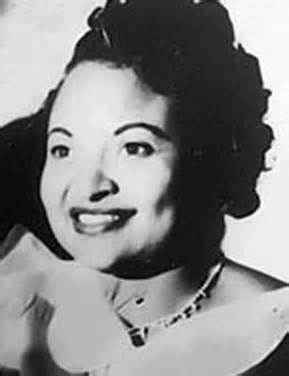
Mamie Till

Mamie Till, 33, testified at the trial of the White males who kidnapped and murdered her only child. One defense attorney was disrespectful towards her when she took the witness stand. He implied that Till was only interested in collecting on the insurance policies that she had on her son. The attorney, one of four representing J. W. Milam and Roy Bryant, pro bono, demanded to know if she had contacted the insurance company. Q. To whom were those policies made payable? Who was the beneficiary in those policies?

A. I was the beneficiary on one and my Mother on the other.

Q. Were they both for four hundred dollars each?

A. Well, one was for a hundred and ninety-three dollars. I think, and one was a little bit more. It was approximately four hundred dollars on the two of them.

Q. And have you collected on those policies?

A. No, Sir.

Q. Have you tried to collect on those polices? (the question was asked again because the prosecution objected to the line of questioning)

A. I have been waiting to receive a death certificate.

The attorney showed Mamie photos of her son’s mutilated body, asking if it was her son, and how she knew it was him. He asked Till if she had warned her son about his behavior before coming to Money, Mississippi. Till said she had. She told the court what she said to her son before allowing him to come to Mississippi:

A. I will give you a liberal description of what I told him. I told him when he was coming down here that he would have to adapt himself to a new way of life. And I told him to be very careful about how he spoke and to whom he spoke. And to always remember to say “Yes, Sir” and No, Ma’am” at all times. And I told him that if ever an incident should arise where there would be any trouble of any kind with White people, then if it got to a point where he even had to get down on his knees before them, well, I told him not to hesitate to do so. Like, if he bumped into somebody on the street, well, and then they might get belligerent or something, well, I told him to go ahead and humble himself so as not to get into any trouble of any kind. And I told him I told him to be very careful how he walked in the streets at all times.

Q. And did you direct his attention as to how to act around White people, and how to conduct himself about a White man? The paper says that you cautioned him about his behavior before any White men. Did you call his attention to that?

A. Yes, Sir.

The attorney did not listen to Till’s answer. He referred to a news story in The Chicago Defender, a Black newspaper that interviewed Till about her son, whose life was snatched from him August 24, 1955, just days after he entered a local store to buy some bubble gum. The White cashier said Emmett grabbed her around her waist and made inappropriate advances towards her before leaving the store. She got angry when he whistled at her. A cousin confirmed that Emmett  “wolf whistled” at her outside the store.

On A Wednesday evening, August 24, Till, a few of his cousins and friends went to Bryant’s Grocery Store and Meat Market in Money. Mose Wright and his wife had gone to church, leaving the boys at home. Roy Bryant’s wife, Carolyn Donhan Bryant, was the store’s cashier. Bryant was not in the store when Till “flirted” with his wife. A couple of days later, Saturday, August 27, a Black teenager entered the store, and was immediately corned by Bryant, demanding to know if he was from Chicago. Bryant's wife told him that was not the “nigger” that came in the store and flirted with her. If all the Black men and boys in Money had to be stopped and interrogated by Bryant and his half-brother J. W. Milam, they were prepared to take on the task, and no one would stop them.

On Sunday, August 28 Bryant and Milam swat-teamed Mose Wright’s house around 2:30 a.m. Milam was armed with a pistol and flashlight. Wright, a self-ordained preacher testified that he heard knocking on his door, yelling: “Preacher! Preacher!” When he asked who was at the door, the voice said, “This is Mr. Bryant. I want to talk to you and that boy that did all the talking”.

Milam asked Wright is he had “two boys there from Chicago.” Wright responded, “Yes, Sir". Milan said, “I want that boy
Mose Wright hold pair of Till's pants
that done the talking down at Money". They found Till asleep, and  ordered him to get dressed.  Wright said Till took his time to get dressed, insisting on putting on his shoes and socks.


Milam, sounding angrier than Bryant, asked Wright if he recognized him or Bryant. Wright said, “No, Sir. I don’t know you. And then he said to me, ‘How old are you?’ And then I said, ‘Sixty four.’ And then he said, ‘Well, if you know any of us here tonight, then you will never live to get to be sixty five". He told Mose "If this is not the right boy, then we  gonna to bring him back and put him in the bed".

As Milam, Bryant and Till exited the house they walked through Wright’s bedroom, where his wife Elizabeth was standing. Milam said to her: “You get back in the bed, and I mean, I want to hear the springs".

Elizabeth Wright tried to bargain with the kidnappers. Elizabeth attempted to bargain with the pair.  "She said that we would pay them for whatever he might have done if they would just let him go", Mose testified. Milam and Bryant did not respond to his wife.  Approaching the car with Till in tow, Wright said, “They asked if this was the boy, and someone said, ‘Yes.’ When asked by the defense attorney if the voice was that of a man or a woman, Wright replied, “It seemed like it was a lighter voice than a man’s".

Wright said there was another man with Milam and Bryant, but it was too dark to recognize him. He  could not see the model of truck or car they were driving. Wright said the other man with them stood by “the screen door. He was standing kind of with his head down like this here (he demonstrates). He was trying to hide it looked like. He acted like a colored man".  Wright said they stood on his porch after the pair left with Till. Asked if he turned on the lights in his house, he said he did not. The only light was from Milam’s flashlight.

Three Days Later, Identifying A Corpse

Mose Wright testified that he did not see his nephew again until he was asked to identify a body that was found in the Tallahatchie River. Till’s decomposing remains were discovered by Robert Hodges, who was fishing when he spotted “two knees and feet” in the river about a mile from his house, “on the left side, going down river, in Tallahatchie County. The body was hung upon a snag of debris", he testified.

Hodges told his father about the body. His father reported the discovery to the land owner B. L. Mims about 6:30 or 7:00 A.M. Later that day Hodges, Deputy Sheriff Melton, B. L. Mims, Charlie Fred Mims and Hodges’ father went to the crime scene location in two boats. “Then they brought the rope back there, and then me and this other boy was in the boat, and Mr. Melton was there, and they had the rope around the boy’s legs and then they hung it on there, and they had it on this other boat, and then they carried it down the river and took it out on the other side there".

Emmett Till’s cousin, Simeon Wright, wrote in his 2010 book “Simeon’s Story: An Eyewitness Account to the Kidnapping of Emmett Till”, that the story of Till’s kidnapping and murder is not completely true as reported and written about in prior books and news articles. A case in point is that Milam and Bryant knew exactly who they were looking for when they came to Mose Wright’s house. Simeon said Milam and Bryant looked at Wheeler Parker and said, “This is the wrong boy. We looking for that fat boy from Chicago. I weighed 90 pounds and Emmett weighted about 140".

Gin fan attached to Emmett Till's neck
When Emmett Till’s body was evacuated from the river, a gin fan weighing over 70 pounds was attached to his body with barbed wire wrapped around his neck, holding the fan in place. Hodges testified that the body was “beaten pretty bad in the back and hips, and the head was also gashed in on the side".

Chester Miller, an African American mortician, was summoned to the scene. Hodges testified that he observed the undertaker place the body in a box, and put it in the coach (hearse). Hodges said he saw a silver ring on one of Till’s fingers. A police officer took photos of the deceased's body. Miller, preparing to bury Till in Money, took the body to a local cemetery, but there was a sudden plan change. The body was taken to Greenwood, Mississippi, after which Miller moved it again to a funeral home in Tutwiler, Mississippi.

Miller testified that Till was naked when he saw the body on a boat. He said the corpse looked “to be that of a colored person, and the flesh in the palm of the hand, well, it looked like it was the body of a young person". Miller described the condition of the body: “The crown of his head was just crushed out and in, you know, and a piece of the skull just fell out there in the boat; maybe three inches long or maybe two and a half inches wide, something like that. I saw a hole in the skull. Oh, about  . . . maybe a half inch square, something like that, located about three-quarters of an inch above the right ear. The other side of the head was crushed on the other side. You couldn’t tell too much it was crushed so. And it was all cut up and gashed across the top there".

Upon returning to the funeral home in Tutwiler, Mississippi, Miller was told by the undertaker that he had soaked the body in fluid to preserve it. Emmett Till’s remains was shipped to Chicago for burial at the request of Mamie Till. His remains were put in rubber pouches, placed in a casket,  the remains taken to Clarksdale to the train.

Because everyone who saw the disfigured, decomposed body described it in their own terms, the descriptions varied, but basically sounded the same in details. John Ed Cothran, deputy sheriff with the Leflore County Sheriff’s Department, witnessed the body being transferred from the boat to a box. Simon Garrett, an assistant to Chester Miller, removed a silver ring from Till’s finger, giving it to Mose Wright. He later handed it over to Cothran. It was one of the exhibits at the trial.

When Mose Wright arrived at the river he said he believed the disfigured, puffed body was Emmett Till. No medical examiner autopsied the body until it arrived in Chicago. The mortician at A. A. Rainer and Sons Funeral Home said he could not recognize the corpse because “the body had been in the water and when a body’s in the water, it becomes swelled, disfigured, you can hardly tell who the person is". Till’s body had been submerged in the Tallahatchie River for three days.

Mamie Tiller testified that the mother of Curtis Jones, Mrs. Willa Mae Jones, called her by phone, informing her that Emmett  had been killed.

The defense attorney cross examining Till asked how she knew that the decomposed body was that of her son. “I positively identified the
Emmet Till in death
body in the casket and later on when it was on the slab as being my son, Emmett Louis Till". He told Till to tell the jury “how you looked at the body and how you identified it". She  first observed body in a casket before it was placed on a slab at the Chicago funeral home. She described  how she identified her son.

A. I looked at the face very carefully. I looked at the ears, and the forehead, and the hairline, and also the hair; and I looked at the nose and the lips, and the chin. I just looked at it all over very thoroughly. And I was able to find out that it was my boy. And I knew definitely that it was my boy beyond a shadow of a doubt.

Emmett's Funeral Attended By Thousands

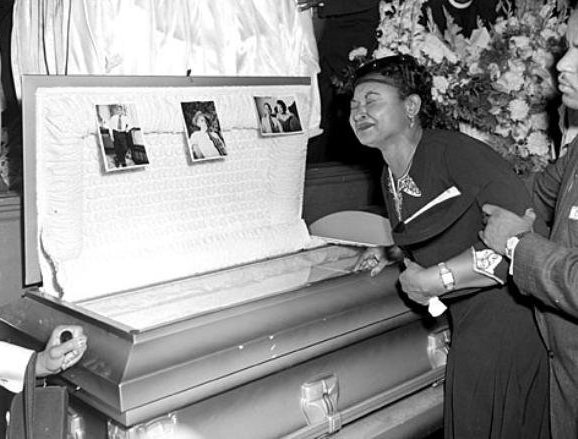
Emmett Till’s funeral/memorial was held in Chicago at Roberts Temple Church of God in Christ. It was estimated that 10,000 or more people attended. Sidewalks and streets in front of the church were packed with people wanting to view Till’s body. Mamie Till insisted on an open casket. She wanted the world to see what the two White murderers in Money, Mississippi had done to her son for no reason. She did not allow the mortician to make the body presentable, a decision the mortician disagreed with. Till was dressed in a suit, the only change allowed. His casket was glass-topped because of  the decompositon. Jet, an African American magazine, was the first publication to post photographs of Till’s mutilated body as it appeared at the memorial service.

Simeon Wright says the glass-topped casket was made because, “Well, an open casket is a common thing in African American tradition. But the reason they didn’t want her to open the casket as because of the stench, because of the smell. They designed the casket with the glass over it and what not".

The casket was donated to the Smithsonian National Museum of African American History and Culture, where it was put on display despite its state of disrepair. It was discovered in a shed on the grounds of the Burr Oak Cemetery, “during a police search last month (July 2009) following the arrest of cemetery employees accused of digging up more than 300 graves and reselling the plots. Till’s plot was undisturbed". (Smithsonian’s Newsdesk)

Thousands of mourners line up on both sides the streets in front of the
church to attend or view the body of Emmet Till, who was murdered
by two White males in Mississippi.

Mamie Till leans over casket bearing her only child
Milam and Bryant Arrested for Kidnapping, Charges Dropped; Indicted for Murder and Then Acquitted

On Sunday, August 28 Roy Bryant was questioned by Leflore County Sheriff George Smith about the kidnapping. Bryant admitted to taking Emmett Till from Mose Wright’s house, but later dropped him off at Bryant’s grocery store in Money. He thought Till would find his way back home. Bryant was placed under arrest. On the 29th J. W. Milam went to talk Cothran. He admitted to taking Till from Wright’s house. They later took him back to Money, Mississippi where they let him go. Milam was also placed under arrest. The two killers repeated the same story.

J. W. Milam and Roy Bryant were indicted by a Grand Jury in Tallahatchie County on September 5, 1955 on counts of kidnapping and murder; however, the prosecution dropped the kidnapping charge. The murder trial was held in Sumner, Mississippi from September 19 through September 23. Neither Bryant, 24, nor Milam, 36, testified. They were acquitted of the murder charge. African Americans nationwide did not expect justice done in the case.

Carolyn Bryant, 21, testified that she did not want to tell her husband what happened at the store, fearing of what he might do. Word traveled quickly in the neighborhood. Bryant learned what occurred. When he asked her if the story was true she confessed that it was. When she testified the jury of 12 White males was dismissed. The judge barred them only during her testimony. It seems the court did not want them to hear the highly offensive language Till supposedly used in the presence of a White woman.

Q. Just tell the Court what happened there at that time, please, ma’am.
Carolyn Bryant

A. This nigger man came in the store and he stopped there at the candy case.

Q. When this Negro man came in the store, where you in the store?

A. I was farther back in the store, behind the counter.
Bryant said she did not remember what Till purchased, but did remember what he said. She said when she held out her right hand to collect money for Till’s purchase, he did not pay her. Instead he grabbed her hand, holding on with a “strong grip.”

Q. Just what did he say when he grabbed your hand?

A. He said, “How about a date, baby.”

Q. When you freed yourself, what happened then?

A. I turned around and started to the back of the store.

Q. You say he caught you?

A. Yes.

Q. How did he catch you?

A. well, he put his left hand on my waist, and he put his other hand on the other side.

Q.  Did he say anything to you then at the time he grabbed you there by the cash register?

A. He said, “What’s the matter, baby? Can’t you take it?

Carolyn Bryant testified that Till told her, “You needn’t be afraid off me". She said he used language that she did not use. The defense attorney asked her to tell the court what “that word begins with, what letter it begins with". Bryant did not answer the question verbally but “shook her head negatively". Asked if it was “an unprintable word” she said yes. She said Till told her that he had been with White women before. Breaking free of his grip him, Bryant said, “Then this other nigger came in the store and got him by the arm". She said Till was reluctant to leave. The “other negro” pulled him out of the door.

Bryant said about eight or nine “colored” people lingered outside, all of whom were with Till. A cousin with Till that evening said there were five of them at the store.  Bryant said when Till walked out the door he turned and said, “Good-by". After he left she told Milam’s wife to watch when she ran to the car to get a pistol under the driver’s seat. The gun and car belonged to J. W. Milam. His wife was watching the two couples’ four children in “the living quarters” connected to the store. She was not called on to testify. Bryant and his wife were too poor to own a car or TV despite owning a grocery store that catered to Black sharecroppers.

Sheriff H. C. Strider testified for the defense.  A headline in the Memphis Commercial Appeal, 4 September 1955: Charleston Sheriff Says Body in River Wasn’t Young Till:  “Sheriff H. C. Strider said yesterday he doesn’t believe the body pulled from the Tallahatchie River in Mississippi was that of a Negro Boy who was whisked from his uncle’s home accused of whistling at a white woman.

“The body we took from the river looked more like that of a grown man instead of a young boy", the Tallahatchie County Sheriff said in Charleston, Miss.  “It was also more decomposed than it should have been after that short stay in the water".  Strider believed Till was alive and hiding out in Chicago or some other state with relatives.

Strider was asked about the body’s smell. A. It was so bad that we couldn’t examine the body until the undertaker got there, and then he opened a deodorant bomb. And even then he couldn’t get too close, and he had to use a quart of some kind of liquid. I didn't ask him just what it was. And he covered the entire body with that then, and then we were able to get up to where we could tell something about the body.

Simeon Wright, turned preacher since growing up and leaving Mississippi, refuted Carolyn Bryant’s testimony. During an interview with CNB News (1/21/2012) Wright said, “Emmett and I, we had walked out. We were in the store together; we had walked of the store. Mrs. Bryant came out behind us and she walking towards her car and Emmett whistled at her and it scared us to death". Wright said Till begged them not to tell his Uncle Mose, because he would have sent him back to Chicago before their vacation ended. “A Black boy whistled at a White woman? In Mississippi? No".

Wright recalled, “You know, we were almost in shock. We couldn’t get out of there fast enough, because we have never heard of anything like that before". He wrote that Till was trying to make them laugh, given he was always joking around. Wright described Till’s loud wolf whistle as a “a big city” whistle that caught them by surprise. He said his cousin was “risky, but not frisky". Frisky meaning Till would not have done all the things Bryant said.

“The whistle at Carolyn Bryant, Roy Bryant's wife, was a joke to the 14-year-old from Chicago. Emmett was always trying to make his cousins laugh. But he also did not understand the unspoken rules of the segregated south during the Jim Crow era. Color didn't mean anything to him," Wright explained. "You are a human being. We are all the same. So he grew up like that".
 

Wright, the son of Mose Wright, estimated how long it would have taken for Till to do all the things Bryant testified to: “And none of the things she would later allege, he insists, could have happened in the short time --- less than a minute --- that Till was alone with her before Wright walked into the store. It couldn’t have happened, Wright said, without Till jumping over a counter that was separating him and her, then jumping back before Wright came inside the store". (Chicago Tribune)

More misinformation written about Till was also cleared up by Wright: a) Till’s wallet did not contain a photo of a White girl; b) he never spoke to out of line to Carolyn Bryant; c) Emmett was not castrated, e) he was not tortured with s drill bit.

Mose Wight Points at J.W. Milam in Court

In what was called an unprecedented move in the south, Mose Wright testified in court against two White men. He was not expected to appear, let alone testify. Wright knew it was not safe, so did his family, so did every Black person living in Mississippi and surrounding counties.  Elizabeth begged
Mose Wright points at J. W. Milam
him not to testify, but he felt compelled to tell what he knew. Wright shocked everyone in the segregated courtroom when he stood up, pointed at Milam, and said: “There he is"!

During cross examination one of the murderers’ attorneys attempted to confuse Wright about the true identity of Till.

Q. Isn’t it true that you said because the body didn’t have any whiskers and was smooth faced, and because Emmett was missing, then you identified that body there in the boat as being Emmett Till was because he was missing? Isn’t that correct?

A. I didn’t mention no missing.

Q. Mose, do you deny that you made this statement to Mr. Breland, Mr. Henderson,  Mr. Kellum and me that the only reason you could identify that body in the boat as being Emmett Till was because he was clean faced or smooth faced, and because Emmett Till was missing,

A. I did not say it.

Q. You did not make that statement?

A. No, Sir, I did not make it.

J.W. Milam and Roy Bryant were acquitted of the murder charge. It was another slap in the faces of Black folks in Mississippi. It took the jury 67 minutes to return with the not guilty verdict. One of the jurors joked that had they not stopped to drink bottles of soda the verdict would have come in sooner. In 1955 African Americans were not allowed to vote, rendering them ineligible to sit on a jury or grand jury in the South.
  
After testifying Mose Wright moved his wife and sons to Chicago out of fear for his life. Willie Reed, an 18-years-old sharecropper, testified to what he saw. He also left Mississippi. None of them ever returned. According to court transcripts, Reed testified that he saw a “1955 Chevrolet truck passed him. Reed testified he saw four White men in the cab of the truck, and three Black men on the sides of the truck and a Black boy sitting down in the bed of the truck. Reed identified Till as the boy in back of the truck from a photograph he saw in the newspaper and which he was shown at trial".

18-years-old sharecropper Willie Reed
Reed later saw the truck parked at a barn where he heard “hollering and it sounded like someone was whipping someone in the barn. After passing the barn, Reed went to Mandy Bradley’s house and told her what he had heard".

In addition to Sheriff Strider, the four attorneys representing Milam and Bryant, pro bono, all of them suggested that the body pulled from the Tallahatchie River was not that of 14-years-old Emmett Louis Till. No positive identification had been made in Mississippi, except for the one made by Mose Wright and Mamie Till. 

FBI Reopens Till Case

The Justice Department reopened the Emmett Till murder case in 2004 to determine if someone other than Roy Bryant and J.W. Milam were involved in the kidnapping and murder of Till. Investigators needed to put several issues to rest, including claims about who was actually buried; who was murdered in Mississippi. Exhuming Till’s remains, and performing a DNA test would debunk the myth that someone else had been buried in Till's coffin.

Till’s body, buried at Burr Oak Cemetery, was exhumed June 1, 2005. The remains were transported to the Cook County Medical Examiner’s Office. A “Anatomic Diagnosis” concluded Till suffered a (1) gunshot wound of the head, (2) multiple comminuted skull fractures, (3) multiple lead fragments recovered from the head and skill, (4) fractures of the right and left wrist bones, (5) fractures of the distal left femur, (6) embalmed body with numerous venting incisions in the skin and floor of the mouth, and (7) missing left upper central incisor with open socket. The medical examiner concluded that Emmett Louis Till died of a gunshot wound to the head, deeming his death a homicide.

The case was turned over to the local prosecutor. The FBI suggested they take another look at Carolyn Bryant, then 73. A Mississippi Grand Jury that included a majority of African Americans, concluded there was not sufficient evidence to indict her. The book on the case was permanently closed.

In a 1965 interview with Look magazine, Milam and Bryant, unafraid of double jeopardy, told the reporter a story that did not jibe with courts transcripts. The duo was paid for the interview. They admitted to going to Mose Wright’s house to kidnap Till. Milam, supposedly the most “articulate” of the duo, said they only wanted to “whip him and scare some sense into him". He said they got angry because they could not scare the defiant 14-year-old, who repeated that he had been White women before. That sent them into a tizzy. No Black male has ever talked to them in such a tone, admitting that he had been with a White woman. Till, his life hanging on a thread, broke all the rules he was supposed to follow.

Killers Confess to Murdering Till In Magazine Interview

Roy Bryant (left) and J. W. Milam
In the Look magazine interview conducted by William Bradford Huie, 1956, J. W. Milam said: “Well, what else could we do? He was hopeless. I'm no bully; I never hurt a nigger in my life. I like niggers -- in their place -- I know how to work 'em. But I just decided it was time a few people got put on notice. As long as I live and can do anything about it, niggers are gonna stay in their place. Niggers ain't gonna vote where I live. If they did, they'd control the government.

“They ain't gonna go to school with my kids. And when a nigger gets close to mentioning sex with a white woman, he's tired o' livin'. I'm likely to kill him. Me and my folks fought for this country, and we got some rights. I stood there in that shed and listened to that nigger throw that poison at me, and I just made up my mind. 'Chicago boy,' I said, 'I'm tired of 'em sending your kind down here to stir up trouble. Goddam you, I'm going to make an example of you -- just so everybody can know how me and my folks stand".

Milam and Bryant pistol whipped Till. They took him back the truck, and went looking an object heavy enough to weigh down his body. They found a trashed gin fan that they attached to his neck. Till was ordered to strip naked, which he did slowly. And then the taunting begin, with Milam taking charge, as usual.

Milam: “Are you still as good as I am.”
Bobo: Yeah.”
Milam: “You still ‘had’ White women?”
Bobo: “Yeah.”

Emmett Till
Huie wrote: “That big .45 jumped in Big Milam's hand. The youth turned to catch that big, expanding bullet at his right ear. He dropped. They barb-wired the gin fan to his neck, rolled him into 20 feet of water. For three hours that morning, there was a fire in Big Milam's back yard: Bobo's crepe soled shoes were hard to burn. Seventy-two hours later -- eight miles downstream -- boys were fishing. They saw feet sticking out of the water. Bobo". The murderers were paid to do the interview.

Simeon Wright said he disagreed with the Mississippi Grand Jury decision not indict Carolyn Bryant, “What I saw, I think they had evidence to indict. Every last person up to now has gotten away with murder". (USA Today, 3/30/2007)

“If there were others involved, as Willie Reed and Moses Wright had testified under oath, Milam and Bryant did not name them. Mamie Till went to Washington to press the Federal Government to re-open the case. Despite thousands of letters protesting Mississippi's handling of the murder, President Dwight Eisenhower and FBI Director J. Edgar Hoover ruled out a federal investigation. Eisenhower didn't even answer Mamie Till's telegram.

“No one ever did time for the killing of the 14 year-old black boy from Chicago. But his murder, and the trial and acquittal of his killers, sent a powerful message: If change was going to come, people would have to put themselves on the line. Contributors to civil rights groups soared. And one hundred days after the death of Emmett Till, Rosa Parks refused to give up her seat to a white person, and the Montgomery bus boycott began". (The American Experience, PBS)

Mamie Till-Mobley died of cardia arrest in a Chicago hospital June 6, 2003. She was 81. J.W. Milam died of bone cancer in 1981. He was 61. Roy Bryant, suffering back problems and legally blind, died of cancer in 1994. He was 63.