Saturday, April 25, 2015

‘Girl Frenzs’ author fights her way out of hell storms to find happiness and self-love through God


 Girl Frenzs is not a misspelling. The book’s title is deliberate. Bridgette Billingsley, a native of Austin, Texas, and first time author, said she wanted a catchy title to attract attention to her book.  Girl Frenzs is not a novel, poetry or a series of short stories. The 286-page book is not about a group of female “frenzs” sitting around talking about their relationships—good, bad or indifferent. Billingsley covers those subjects, basing her personal advice on her personal experiences.

Intermingled Bible verses, words of wisdom, her rocky roads life, her relationship with God, Girl Frenzs reveals truths about Billingsley’s marriages and relationship that went terribly wrong. She writes that having God in her life facilitated her knocking down the stumbling blocks she was forced to jump over.

Rolling into her spiritual realm, Billingsley advises: “Girl frenzs, life is general is full of bumps in the road we’re traveling down. Oftentimes, those bumps and bruises are hard to go away. Especially when we have conditioned our minds to be a constant reminder of our past by dwelling on our past, day in and day out. Don’t go through life holding on to those unpleasant memories. They are like bleeding wounds; they never stop hurting. Some people have been known to go into deep depression holding on to things from their past.”

She reveals that growing up without a father in their home left a void in her life. “There were many incidents in my life as a child and adult that should have been life threatening. I would always think to myself after the situation, ‘How did I survive that?’ I didn’t know that it was God protecting me.” She was still a young child when her father walked out on her mother, and her memory of his is faint. However, she finally saw him again when he was in his seventies, and she was fully grown. By this time she had learned to forgive him and others who caused her pain.

Billingsley writes that despite her mother being married, she was still a single parent. Subsequently, she and her sisters became single parents before marriage. She writes that becoming a single mother was not a proud moment in her life, “but it’s something that can happen to anyone at any time in your life.”

A physically and verbally abused woman for many years, Billingsley said she often felt that she was the only person in the world being abused. She felt that no one cared about her. She was so downtrodden she didn’t even care about herself. She didn’t want anyone to know how miserable she was. She writes that the father of her first child was “nice” in the beginning, but his street ways and thirst for drugs didn’t stay dormant very long.

She recalls another relationship that took a near violent turn. “At one point he was so abusive and crazy, he was going to stab me with a knife in front of my three children, because I went to nephew’s graduation. My first born son, Dennis, was about thirteen years old when he got on his bicycle and went to the store and called the police.” The first time author admits that she was involved in other relationships that were just as abusive.

“Many nights I laid in my bed and cried for God to stop him from hurting me. God did. One day when my estranged husband was at work I packed up all my things and left. I never came back. When I went back home I didn’t talk about the abuse. I acted as if I was fine, but inside I was bruised and I was hurt from all the degrading verbal abuse I endured for years.”

When her son was six years old she met “Willie” in Lawton, Oklahoma. He was in the military. At some point in the relationship Billingsley found that she was scared of Willie, and with good reason. She doesn’t mention if there were warnings of what was to come in the relationship.

Bridgette Billingsley
“I was so young and unlearned about life and men. Willie was so abusive all the time I didn’t know that to say to him ever. We lived in a trailer home together and never once did he sit down and have a conversation with me. When he cooked, he would give us food he wanted us to have and threatened me not touch the rest of it until he came home that evening. So we literally went all day without food all day. And when I did warm up food he had left in the ice box for us to eat, he would get so angry and hit me so hard I thought many times I was taking my last breath.”

Billingsley writes that Willie, who was seldom intimate with her, threatened her with bodily harm if she tried to leave him. When the physical abuse started, she notes that she felt like a punching bag. “I was made to iron his uniform daily, clean house, and shine his military boots. I was stressed out, depressed, and lonely as I could be.”

She writes about the time she was ready to pack it in. There was no light at the end of life’s dark tunnel. She describes that time: “Girl frenzs, I recall many times during life’s struggles, I cried ‘Abba Father, please take me home, I’m ready to be with you and Jesus!’ Living life was so difficult. I didn’t have any joy in my life. I cried all the time. I was lonely and withdrawn from my family. I felt no life in my spirit.”

And then she got the courage to look for a job, intent on leaving Willie. She found a job as a baker, working on the base. Building and gaining confidence in herself, Billingsley began making plans to leave. She packed clothes for herself and her son, Dennis, leaving everything else behind. “I didn’t leave a note or nothing. I left, never to be seen again. I stayed in Lawton another year at my friend’s home and I went to home to Austin.”

Returning home to Austin allowed Billingsley room to collect herself and start a new life. She was determined to put the past behind her. “God had me in a place where I was comfortable for once in a long time. Girl frenzs, you know, every time God make a move in our life the devil gets angry and try to destroy what God has done.”

Under a chapter titled “Forgiveness” Billingsley writes about a close friend that she has known for years. One day the friend confided in her, telling her a dark secret that she buried within herself for decades. The secret ordeal began when her friend was eight years old. It turns out that she had been molested by her biological father.  

“She remembered her mother being admitted to in hospital overnight with kidney problems and was eight months pregnant. She stated he came to her bedside that same night and awakened her. He knew her mother was in the hospital, and the other children were asleep. He woke her up out of her sleep and brought her to his and her mother’s bedroom. He then undressed her and began to touch her and fondled her body and molested her.

“He touched her in a way no man should never touch a child. She stated she was so scared she closed her eyes and pretended it was not happening. After he molested her, he took her to the stove and turned on the gas. He was trying dissolute her mind so she would become hallucinatory and not remember what had happened to her.”

Billingsley marks that two weeks after the molestation her friend’s father left her mother and them. Her friend wanted to tell her mother what her father had done to her, but she was scared. She didn’t think her mother would believe her. So her friend said nothing, keeping the secret to herself. Over the years her friend kept diaries that no one as allowed to read. She writes that her friend was unable to function in relationships. One day her father called after decades of not hearing from him. Her friend was 19. She refused to talk to her father but she could not tell her mother why she refused to talk to him.

Billingsley writes, “She said she had absolutely no trust in men, and she felt dirty and ashamed like she had something wrong all the time growing up. In her first marriage, she had two children. She had so much pain, hurt, and trust issues in her marriage she ended up getting a divorce because the marriage didn’t work out.”

Her friend finally met a man that she trusted and they have been married for 35 years. He helped her gain trust in men again. He taught her how to love. Billingsley said for years her friend was racked with anger and hatred before she became a Christian.

“Girl frenzs, my dear friend that I spoke about in this chapter was my eldest sister Jim Ella. She confided in me last year and asked me to write about her abuse. I met my father for the first time in my life last year, March 26, 2011 on my mother’s birthday. I really don’t have any recollection of him in my lifetime. He was a stranger to me. I pray for my father that he repents for his wrongdoings and let God and Jesus come into his life.”

Upon meeting their father, who was in jail, Billingsley writes, "He was a stranger to me. I asked him with should I call him dad or Billy.  He replied, 'Billy.' That's what I called him. He tried to explain to me why he didn't come and about his alcohol problems. I keep starring, trying to see if I had any of his resemblance or if any of my sisters look like him. My older brother look like him the most."

In another chapter titled “Marital Bliss and the Pain of Divorce” Billingsley parts with her feelings about marriage, a wife’s place in the marriage and that of the husband. She tells readers that married couples cannot live their lives Hollywood style, where relationships and marriages are often short lived.

“We must learn to love and be committed to our own husbands and take our marriage seriously,” Billingsley writes. She admonishes husbands that committing adultery has serious consequences. She explains: “When you lose your wife due to your cheating, your wife is going to meet someone later in life who treasures her ways, and her quietness.  . . . Then you’ll realize what you let go. You don’t miss a good things until it’s gone.” 

“GIRL FRENZS” is full of spiritual and personal advice from the author. It is replete with scriptures on how to arrive at the peace Brigettte Billingsley has found with her current husband and their five children. The book is on sale on Amazon.com.

Monday, January 19, 2015

My locked up tears flowed again April 4, 1968


My locked up tears flowed again

I was standing in my kitchen ironing
When the news flash interrupted the
Regular programming on TV

The date was April 4, 1968

When I heard
Martin Luther King's name
I stopped ironing
Nervously whispering under my breath
Putting it and my brain on hold

Oh, God. No! Not again!

But it was again!
And another assassination!

My locked up tears started flowing
Again!
I cried and cried and cried
Only God and me know how I cried

I cried easier during those youthful days
My heart was not hard and cold
Those days were full of patriotic
Protests and honest marching
In the streets of America
I understood the politics of freedom
But the politics of death was what
I wanted to run from

That's not to say I don't understand
Death or painful crying
I am not personally acquainted with death
However, I did have a close encounter
But I don't count that incident because 
I survived the foolish dare

I don't cry so easily these days
My tears have gotten selfish
They have gotten harder and
Tougher to arouse out of their sleep
Violence has a way of
Draining the body and soul when it
Occurs too soon, too often

Nonetheless, I still get misty eyed
And sentimental when
I hear one of Martin's speeches 
Especially the one in which he talks about
Little black girls and boys walking
Hand-in-hand with little
White girls and boys
Little black children who should be
Judged for the content of their character
Not the color of their skin

Martin had a dream
Mahalia Jackson reminded him of it
One August day in Washington:
"Tell them about your dream, Martin!
Tell them about your dream!"
Mahalia encouraged
And Martin revealed his dream
Making America dream with him

Parting with a different speech in Memphis, Tennessee
Martin told us about sick
Whitemen wanting to
Kill him for no logical reason
Other than to shut down his dream 
He had no right to demand a fair and just America
These sick Whiteman wanted to shut down
His ideology, his politics, his righteousness
Their dry White hate wanted to still his voice
 
 I've Been To The Mountaintop
Is not repeated as often as
I Have A Dream
But the speech was just as memorable 
It had an important message  

Martin was in Memphis to march and protest
With striking sanitation workers
They wanted recognition for their worth
As working men
As human beings

Their posters screamed:
I AM A MAN!
I AM A MAN!

They walked and walked and walked 
Justice was just around the corner

Martin requested one of
His favorite Mahalia Jackson songs
I think it might have been
Precious Lord, Take My Hand
No one could sing it like Mahalia
It's one of those old Negro
Tear-jerking spirituals
The song wrapped itself around Martin

And then Martin Luther king told us that he
Just wanted to do God's will
He said he had
Gone to the Mountaintop
God allowed him to
 See the Promise Land

Did you really see it, Martin?
What did you see?

My heart swelling with the hallelujah of God
I felt empowered to
Understand what Martin was saying
Nevertheless, I wanted to know what the
Promise Land looked like 

Not everyone is permitted to
Climb to the mountaintop
To see what Martin saw

I vividly remember
The glow on Martin's face that night 
His face had a shiny halo
Must be the glow of God 
I thought to myself

Near the end of the speech
Martin said:

And then I got to Memphis
And some began to say the threats
Or talk of threats were out.
What would happen to me
From some of our sick White brothers.
Well, I don't know what will happen now.
Because I have been to the
Mountaintop. And I don't mind.
Like anybody I want
To live a long life. 
Longevity has its place.
 And I am happy tonight.
I'm not worried about anything.
I'm not fearing any man!

Martin said his eyes had seen the
Glory of the coming of the Lord 
I envied him because my eyes
Were not open enough to see God
And the coming of His glory

When Martin said: I may not get there with you
I wondered why would God
Show him the Promise Land
And not let him cross over 
Perhaps God explained the journey 
To him as he did with Moses  

The Book of Deuteronomy says:

Then Moses went up from the plains of Moab
To Mount Nebo, to the top of Pisgah,
Which is across from Jericho.
And the Lord showed showed him all 
Land of Gilead as far as Dan,
All Naphtali and the land of
Ephraim and Manasseh, all the land
of Judah as far as the Western Sea,
The South, and the plain of the Valley
of Jericho, the city of palm trees
As far as Zoar. Then the Lord said to him,
This is the land of which I swore
To give to Abraham, Isaac, and Jacob,
Saying, I will give it to your descendants.
I have caused you to see it with your own eyes,
But you shall not cross over there.

Martin was graced to see what we could not
 He did not live in fear of dangerous Whitemen
Hyper hound dogs and water
Spraying hoses held with hateful hands

The prospect of death
Did not scare him, but still
He knew that longevity has it place
He preferred it to death
But God's will had to be done

I learned from Martin that
A man or woman cannot achieve 
The complete art of living
While stuck in the concrete fear
Unlike Martin, I was straddling the fence
My false bravery was too fearful of dying
I was not ready for the mountain walk

Drum majors are destined to stand
Out front for justice
 Refusing to be intimidated
 Strutting and marching toward
Gun fired bullets and
Fast thrown bricks and
Bottles and race tinged words

I wish I could have known Martin
I would have asked him to
Show me how to dream about
Real freedom and peace of mind
How to be nonviolent when
Starring violence in the face

I would have asked him to hold my hand so that his
Strength could surge through my body
 Like a bolt of lightning
Energizing my weaknesses and fears
That were choking the free life
I should have been living
My fearful spirit could not pull 
My feet out of the concrete

I would have asked Martin to show
Me how to look over the mountaintop
And not be scared if I was not
Destined to make it to the Promise Land 
To walk and talk to God

Standing in my kitchen
Trembling and crying, the iron in my hand
I wondered if my eyes would  ever
See the coming of the Lord

(C) by dorothy charles banks

An up close and personal interview with Dr. Martin Luther King, jr.

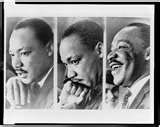
Dr. Martin Luther King, Jr.
There are many people in ancient and contemporary history that I would have loved to interview. One of the individuals  is Dr. Martin Luther King, Jr.  But he was not the first on my list. I would have been overcome with joy to interview Jesus the Christ one-on-one! I would have asked him about his childhood, his dreams, his future goals. I would have asked if he felt that his destiny was out of his control. I would asked his mother, Mary, what kind of son he is. I would have asked her if she feels her son is a special kid who is destined for greatness? I would have asked  Mary if she sensed her son's life would be short, but forever lasting. I would have asked what her dreams were for her son.

No, I would not be crass and ask The Virgin Mary if she was a virgin when she gave birth to her son Jesus.

Because there are no magical time or travel machines, and no way to communicate with the deceased–except in the movies and on TV–I had to find a way to bring Dr. King to me for an interview. Jesus is too large for me to imagine what he would say to direct questions.
I racked my brain about 10 minutes, maybe 15, trying to make magic happen without abracadabra incantations that would not solve my dilemma. Then lightening struck. My brain jumped into action. My plan: Read Dr. King’s speeches and quotes to fit the questions I want him to answer. Using his own words, I prepared my chance of a lifetime “interview” with Dr. Martin Luther King, Jr.

The more things change, the more they stay the same. That adage is true. Forty-four years after he was assassinated, but Dr. King's words are just as relevant and forceful today as they were when he first spoke them during his lifetime. Even though he is gone his words are still repeated and recited by the young and old, Blacks and Whites, and foreigners.


Dr. Martin Luther King, Jr. was born January 15, 1929. He was fatally shot by James Earl Ray as he and a few friends stood on the balcony of the Lorain Hotel in Memphis, Tennessee, April 4, 1968. He was in Tennessee to march with sanitation workers, whose incomes and working conditions were far below those of Whites working the same jobs. The workers and supporters carried signs that said: I AM A MAN TOO! For clarity, this "interview" will not focus on the protest in Memphis.

Dorothy: Dr. King if you could step back into history, mentally or physically, what time period  or time periods would you return to?

Dr. King:
I would take my mental flight by Egypt through, or rather across the Red Sea, through the wilderness on toward the promised land. And in spite of its magnificence, I wouldn't stop there. I would move on by Greece, and take my mind to Mount Olympus. And I would see Plato, Aristotle, Socrates, Euripides and Aristophanes assembled around the Parthenon as they discussed the great and eternal issues of reality.

But I wouldn't stop there. I would go on, even to the great heyday of the Roman Empire. And I would see developments around there, through various emperors and leaders. But I wouldn't stop there. I would even come up to the day of the Renaissance, and get a quick picture of all that the Renaissance did for the cultural and esthetics's life of man. But I wouldn't stop there. I would even go by the way that the man for whom I'm named had his habitat. And I would watch Martin Luther as he tacked his ninety-five theses on the door at the church in Wittenberg.

But I wouldn't stop there. I would come on up even to 1863, and watch a vacillating president by the name of Abraham Lincoln finally come to the conclusion that he had to sign the Emancipation Proclamation. But I wouldn't stop there. I would even come up the early thirties, and see a man grappling with the problems of the bankruptcy of his nation. And come with an eloquent cry that we have nothing to fear but fear itself.


But I wouldn't stop there. Strangely enough, I would turn to the Almighty, and say, "If you allow me to live just a few years in the second half of the twentieth century, I will be happy." Now that's a strange statement to make, because the world is all messed up. The nation is sick. Trouble is in the land. Confusion all around. That's a strange statement. But I know, somehow, that only when it is dark enough, can you see the stars.


Dorothy: That sounds like an eye opening journey. When did you decide the direction your life might go?

Dr. King: I decided early to give my life to something eternal and absolute. Not to these little gods that are here today and gone tomorrow; but to God who is the same yesterday, today, tomorrow and forever.


Dorothy: How would you, a widely known leader, measure the spirit of man, being a spiritual man yourself?


Dr. King: The ultimate measure of a man is not where he stands in moments of comfort and convenience, but where he stands in times of challenge and controversy.


Dorothy: Can what affects one race of Americans, not affect another race, especially in the realm of justice?


Dr. King: Injustice anywhere is a threat to justice everywhere. We are caught in an inescapable network of mutuality, tied in a single garment of destiny. Whatever affects one directly, affects all indirectly.


Dorothy: Politicians talk a lot about science and its relationship to religion. What is your opinion? Are the two connected?


Dr. King: Science investigates, religion interprets. Science gives man knowledge, which is power; religion gives man wisdom, which is control. Science deal mainly with facts, religion deals mainly with values. The two are not rivals. They are complimentary. Science keeps religion from sinking into the valley or crippling irrationalism and paralyzing obscurantism. Religion prevents science from falling into the marsh of obsolete materialism and moral nihilism.


Dorothy: Dr. King, everyone is aware that you are nonviolent. But realistically, wouldn’t you achieve your goal for justice much faster by employing a hint of violence?


Dr. King: Violence as a way of achieving racial justice is both impractical and immoral. It is impractical because it is a descending spiral ending in destruction for all. It is immoral because it seeks to humiliate the opponent, rather than win his understanding. It seems to annihilate rather than to convert. Violence is immoral because it thrives on hatred rather than love. At the center of non-violence stands the principle of love. Love is not emotional bash; it is not empty sentimentalism. It is the active outpouring of one's whole being into the being of another.


Dorothy: How do you feel about discrimination?


Dr. King: Discrimination is a hellhound that gnaws at Negroes in every waking moment of their lives to remind them that the lie of their inferiority is accepted as truth in the society dominating them.


Dorothy: Once again America is at war after the 9/11 terrorists strike. We went to war in Iraq and Afghanistan, where we stall are fighting. But these wars different from Vietnam. Will there ever be peace in the world?


Dr. King: Sooner or later all the people of the world will have to discover a way to live together in peace, and thereby, transform this pending cosmic elegy into a creative psalm of brotherhood. I refuse to accept the view that mankind is so tragically bound to the starless midnight of racism and war that the bright daybreak of peace and brotherhood can never become a reality.


I refuse to accept the cynical notion that nation after nation must spiral down a militaristic stairway into the hell of nuclear annihilation. I believe that even amid today's mortar bursts and whining bullets, there is still hope for a brighter tomorrow. I still believe that one day mankind will bow before the altars of God and be crowned triumphant over war and bloodshed.


Dorothy: Did America damage its image with its involvement in the Vietnam war?

Dr. King: It is curious that Americans who calculate so carefully on the possibilities of military victory, do not realize that in the process, they are incurring deep psychological and political defeat. The image of America will never again be the image of evolution, freedom and democracy, but the image of violence and militarism.


Dorothy: How do you feel about defense spending as opposed to spending on programs to help America’s poor?

Dr. King: A nation that continues year after year to spend more money in military defense than on programs of social uplift is approaching spiritual death. The curse of poverty has no justification in our age. It is socially as cruel and blind as the practice of cannibalism at the dawn of civilization, when men ate each other because they had not yet learned to take food from the soil or to consume the abundant animal life around them. The time has come for us to civilize ourselves by the total, direct and immediate abolition of poverty.


Dorothy: Today many people appear to be brain dead, and willing to accept whatever is told to them without question. Why do you think that is?

Dr. King: Nothing in all the world is more dangerous than insincere ignorance and conscious stupidity.


Dorothy: Explain what the "drum major instinct" means.


Dr. King: Now the presence of the drum major instinct is why so many people are "joiners." You know, there are some people who just join everything. And it's really a quest for attention and recognition and importance. And they get names that give them that impression. So you get your groups, and they become the "Grand Patron" and the little fellow who is henpecked at home needs a chance to be the "Most Worthy of the Most Worthy" of something. It is the drum major impulse and longing that runs the gamut of human life. And so we see it everywhere, this quest for recognition. And we join things, over join really, that we think that we will find that recognition in.


Dorothy: How can America reroute the revolution of values in the midst of war?

Dr. King: America, the richest and most powerful nation in the world, can well lead the way in this revolution of values. There is nothing except a tragic death wish to prevent us from reordering our priorities so that the pursuit of peace will take precedence over the pursuit of war. There is nothing to keep us from molding a recalcitrant status-quo with bruised hands until we have fashioned it into a brotherhood.


Dorothy: In Birmingham you decided to take nonviolent "direct action". What was the purpose?


Dr. King: Nonviolent direct action seeks to create such a crisis and foster such a tension that a community which has constantly refused to negotiate is forced to confront the issue so that it can no longer be ignored. My citing the creation of tension as part of the work of the nonviolent--resister may sound rather shocking. But I must confess that I am not afraid of the word tension. I have earnestly opposed violent tension, but there is a type of constructive, nonviolent tension which is necessary for growth.


Dorothy: Were any of your direct-action campaigns ever well timed? Many whites feel they were not.


Dr. King: Frankly, I have yet to engage in a direct-action campaign that was well timed in the view of those who have not suffered unduly from the disease of segregation. For years now I have heard the word ‘wait.’ It rings in the ear of every Negro with piercing familiarity. This ‘wait’ has almost always meant ‘never.’


Dorothy: In your own words, describe what is it like to be black and living in America.


Dr. King: Being a Negro in America means trying to smile when you want to cry. It means trying to hold on to physical life amid psychological death. It means the pain of watching your children grow up with clouds of inferiority in their mental skies. It means having your legs cut off, and then being condemned for being a cripple. It means seeing your mother and father spiritually murdered by the slings and arrows of daily exploitation, and then being hated for being an orphan.


Dorothy: When you hear people say you are breaking the law in some instances when you hold demonstrations or marches, what is your response?


Dr. King: The answers lies in the fact that there are two types of laws: just and unjust. One has not only a legal but a moral responsibility to obey just laws. Conversely, one has a moral responsibility to disobey unjust laws. I would agree with St. Augustine that an unjust law is a human law that is not rooted in eternal law and natural law. Any law that uplifts human personality is just. Any law that degrades human personality is unjust.


Dorothy: During the early days of the bus boycotts, you received a threatening call around midnight, in which the caller said, ‘Nigger, we are tired of you and your mess now. If you don’ get out of town in three days, we’re going to blow up your house.’ Was that frightening for you and your family?


Dr. King: I could hear an inner voice saying to me, ‘Martin Luther, stand up for justice. Stand up for truth. And lo I will be with you, even until the end of the world.’


Dorothy: Does the prospect of death frighten you?


Dr. King: Death comes to every individual. There is an amazing democracy about death. It is not aristocracy for some of the people, but a democracy for all of the people. Death is the irreductible common denominator of all men.


Dorothy: How do you want to be remembered? What do you people to say at your funeral?


Dr. King: If any of you are around when I have to meet my day, I don’t want a long funeral. And if you get somebody to deliver the eulogy, tell them not to talk too long. And every now and then I wonder what I want them to say. Tell them not to mention that I have a Nobel Peace Prize—that isn’t important. Tell them not to mention that I have three or four hundred other awards—that’s not important. Tell them not to mention where I went to school. 'd like somebody to mention that day that Martin Luther King, Jr., tried to give his life serving others. I'd like for somebody to say that day that Martin Luther King, Jr., tried to love somebody.

 
The Lorrain Hotel turned into a Civil Rights Museum
Dorothy: If I was slated to speak at your funeral, what would you like me to say?
 
Dr. King: I want you to say that day that I tried to be right on the war question. I want you to be able to say that day that I did try to feed the hungry. And I want you to be able to say that day that I did try in my life to clothe those who were naked. I want you to say on that day that I did try in my life to visit those who were in prison. 

I want you to say that I tried to love and serve humanity. Yes, if you want to say that I was a drum major, say that I was a drum major for justice. Say that I was a drum major for peace. I was a drum major for righteousness. And all of the other shallow things will not matter. I won't have any money to leave behind. I won't have the fine and luxurious things of life to leave behind. But I just want to leave a committed life behind. And that's all I want to say.
 
Dorothy: Thank you, Dr. King. I enjoyed the interview.


Dr. King: You're quite welcome.

Wednesday, December 3, 2014

Ferguson, Missouri 2014 started many decades ago

A cop wrestles a U. S. flag out of the hands of a struggling, determined elementary aged kid at a protest rally. The fully grown cop took the kid's sign that said: "No More Police Brutality" in Mississippi, 1965. A female teacher or stranger walks to the crying youngster. walking him away from the group of abusive White cops, all of whom observed one of their own go after the child like he was an adult. They appear to be very relaxed with his actions.

Recently,  Bill de Balsio, mayor of  New York, said he's had "that talk" with his teenage son. Police associations and cops went ballistics, accusing him of calling them racist. But the Mayor knows what time it is, and his biracial son (and daughter) are subject to abuse  or death at the hands of some over zealous cops when he is out of  their sight.

At a press conference Blasio said: "I had to worry over the years, Chirlane had to worry if  Dante is safe each night.  There are so many families in this city who feel that way each and every night. Is my child safe? And not just from some of the painful realities--crime and violence in some of our neighborhoods--but are they safe from the very people that they want to have faith in as their protectors.".

Having “those survival talks” with their sons is a common ritual in the homes of African American parents. The talks are necessary. They are supposed to help their sons survive when they are stopped by a cop.  You would think that “those talks” would be about the birds and the bees, but Black parents have to put that discussion on the back burner. Surviving the threat of death by a cop is more important than talks about sex.   

Several years ago while researching police brutality in the U. S., I read horror stories of Black mothers and fathers talking about the deaths of their sons [and daughters] at the hands of police officers. Mothers said they were sorry they had given birth to sons. Each time their sons stepped out the door to go anywhere, they wondered if they would see them again. Alive. The hearts of parents should never be wrapped in terror 24 hours a day, seven days a week, 365 days of the year.

"Hands Up, Don't Shoot", LA riot in Watts, 1965
In instances where their sons, husbands, boyfriends, dads, grandfathers, uncles were killed by police, none of the cops were brought to trial. There was no justice, but somehow they had to find peace of mind. Cops were no billed by grand juries. They were backed by their respective police chiefs and police associations. In 2014 it is impossible to get a grand jury to indict a policeman, no matter what the physical evidence shows, or what witnesses say.

From the day Black slaves were emancipated, little value have been placed on their lives and well-being. The more things change for African Americans, the more the stay the same.

"Hands Up, Don't Shoot" in Ferguson, Missouri, 2014
Every 1o to 20 years there is a case of police brutality, or a shooting death by police that arouses the ire of African Americans. Anger and frustration forces them to protest the "legalized" or "good shooting"  by  white cops. These labels always assure that cops will walk free. They can kill Blacks without fear of repercussions.

August 9, 2014 in Ferguson, Missouri, Michael Brown, 18, became the source of anger and frustration. He was shot and killed by a local White policeman, Darren Wilson, who was recently no billed by a grand jury.

Riots, looting and protests hit the ground running within days after Brown was killed. His death sparked nationwide protests, that included young people, children, senior citizens. The protesters, which are ongoing, are representative of America’s melting pot.  ‘Hands Up, Don’t Shoot’ has become a symbolic gesture of support to stop police brutality.  Adding the chokehold death of Eric Garner, another symbolic chant emerged: "I Can't Breathe",  the final words uttered by Garner as he  was held down by  police.

Michael Brown, 18

Witnesses to the shooting said Brown had his hands up when he was shot by Wilson.  After the grand  jury failed to indict Darren Wilson, testimony from some witnesses clashed with those who said Brown's hands were not up. It was learned earlier this week (12/16) that witness #40, Sandra McElroy, a 45-year-old White woman, testified to the grand jury that she witnessed Michael Brown charging towards officer Wilson before he was shot. She said his hands were not up. The problem is, McElroy, an admitted racist, did not witness the shooting. Her testimony was straight out of newspapers.

The district attorney in charge of the case, Bob McCulloch said he knew that  McElroy was lying to the grand jury, as were other witnesses,  but he accepted the testimonies anyway. When he announced the grand jury's decision he did not mention that his main witness, McElroy, had lied. The Smoking Gun revealed that she has a record and has injected herself into two prior high profile cases. However, her version of what happened in those cases was rejected by investigators. 

 Delving into the history of police brutality, comparing it to 2014, it seems that nothing has changed. The protests and protesters look the same. People grieving the deaths of their sons and daughters look the same. The signs they carry look the same. The victims were Black (and Hispanic), ranging in ages from 12 years old to adults. Some of the deaths made national news, but the majority were mere thumbnails in the media.

The purpose of this post is to show that police officers have been getting away with the shooting deaths African American men, teens and (children). This is not a new phenomenon. Last week I discovered a list of Black men shot by the police, starting in 1952. Called "The Forgotten List", it briefly describes the circumstances of the deaths. Not one sheriff, White citizens or cop was charged with their deaths, all of  which were deemed justified. In some instances the deaths are still unsolved mysteries.

‘The Forgotten' List
 
Listed below are the names of 74 men and women who died between 1952 and 1968 under circumstances that suggests they were the victims of racially motivated violence. The information was gathered by The Southern Poverty Law Center as it planned a timeline of killings and other civil rights era events for the Civil Rights Memorial. The Memorial, dedicated in 1989, includes the names of 40 civil rights martyrs who were slain during that era. A few names were not inscribed on the Memorial because there was insufficient information about their deaths when the Memorial was created. They are, however, identified in a display at the Civil Rights Memorial Center as "The Forgotten."

**Anderson, Andrew Lee - Marion, Arkansas, 1963: Anderson was slain by a group of Whites and sheriff's deputies after a white woman said he had molested her 8-year-old daughter. A coroner's jury ruled justifiable homicide, and no arrests were made.

**Andrews, Frank - Lisman, Alabama, 1964: Andrews was shot in the back by a White sheriff's deputy. The county solicitor said the victim was attacking another deputy, and no arrests were made.

**Banks, Isadore - Marion, Arkansas, 1954: Banks' charred corpse was found chained to a tree. Black press reports speculated he was killed by Whites who wanted his land. His property was later rented by White farmers.

**Bolden, Larry - Chattanooga, Tennessee, 1958: Bolden, 15, was shot by a White policeman. No arrests were made.

**Brazier, James - Dawson, Georgia, 1958: Brazier was beaten to death in front of his wife and children by two police officers. County Sheriff Z. T. Matthews was later quoted in the Washington Post saying, "There's nothing like fear to keep niggers in line."

**Brewer, Thomas - Columbus, Georgia, 1956: Brewer was instrumental in forming a local chapter of the NAACP in 1937. He was shot seven times outside his office by White politician Lucio Flowers. A grand jury failed to indict.

**Brooks, Hilliard - Montgomery, Alabama, 1952: Brooks was shot by a police officer after initially refusing to get off a city bus when the driver claimed he had not paid his fare. A coroner said the murder was justified because Brooks resisted arrest.

**Brown, Charles - Yazoo City, Miss., 1957: A White man shot Brown, who was visiting the White man's sister. The Justice Department handed the case over to the state.

**Brown, Jessie - Winona, Mississippi, 1965: The 1965 NAACP annual report claimed White farmer R.M. Gibson killed Brown.

**Brumfield, Carrie - Franklinton, Louisiana, 1967: Brumfield was found shot to death in his car on a rural road. He was shot once in the chest with a .22-caliber revolver.

**Brumfield, Eli - McComb, Mississippi, 1961: Police officer B.F. Elmore alleged self-defense after shooting Brumfield. Police claimed Brumfield jumped from his car with a pocket knife after police pulled him over for speeding.

**Caston, Silas (Ernest) - Jackson, Miss., 1964: Caston was shot by a local police officer. CORE and NAACP filed a civil suit against Deputy Sheriff Herbert Sullivan. The result of that suit is unknown.

**Cloninger, Clarence - Gaston, N.C., 1960: Cloninger died while incarcerated. Authorities denied him medical attention after he suffered a heart attack.

**Countryman, Willie - Dawson, Georgia, 1958: Police officer W.B. Cherry was cleared of murder charges after police said he shot Countryman "in self defense in the line of duty."

**Dahmon, Vincent - Natchez, Mississippi, 1966: Dahmon, 65, was shot in the head around the time of a march in support of James Meredith.

**Daniels, Woodrow Wilson - Water Valley, Mississippi, 1958: Sheriff Buster Treloar, identified by four witnesses as the man who beat Daniels to death in a prison, was freed after 23 minutes of deliberation by an all-white jury. "By God," Treloar said after the trial. "Now I can get back to rounding up bootleggers and damn niggers."

**Dumas, Joseph Hill - Perry, Fla., 1962: Florida Governor Farris Bryant suspended constable Henry Sauls in connection with the shooting of 19-year-old Dumas. Sauls was indicted by a federal grand jury. The result of indictment is unclear.

**Evans, Pheld - Canton, Mississippi, 1964: Charles Evers, the brother of slain NAACP official Medgar Evers, identified Evans as having been killed under mysterious circumstances.

**Evanston, J.E. - Long Lake, Mississippi, 1955: Evanston's body is fished out of Long Lake in December. Evanston was a teacher in the local elementary school.

**Greene, Mattie - Ringgold, Georgia, 1960: Greene is killed when a bomb explodes under her house.

**Greenwood, Jasper - Vicksburg, Mississippi, 1964: Greenwood was found shot to death near his car on a rural road. Police said the slaying was not racially motivated.

Eric Garner, 43, was put in chokehold by officer Daniel Pantaleo in July on a New York street, where he was selling untaxed cigarettes. The coroner ruled his death a homicide. A grand jury has not made a decision to charge or not to charge the cop. **Update: the New York grand jury did not indict Pantaleo for Garner's death.
**Griffin, Jimmie Lee - Sturgis, Mississippi, 1965: Griffin was killed in a hit-and-run accident. A coroner's report revealed Griffin was run over at least twice.

**Hall, A.C. - Macon, Georgia, 1962: Hall was shot and killed after a White woman claimed he stole a pistol from her car. He was shot by police as he ran away.

**Hamilton, Rogers - Lowndes County, Alabama, 1957: Hamilton, 19, was taken from his home by a group of White men and shot to death. Hamilton was allegedly warned to stay away from Black girls in the town of Hayneville. No charges were brought in the case.

**Hampton, Collie - Winchester, Kentucky, 1966: Hampton was shot by police officers after allegedly threatening a police officer.

**Harris, Alphonso - Albany, Georgia, 1966: Harris, a member of SCLC, died after allegedly organizing a walkout by Black students at a school in Grenada, Mississippi. He was killed in Georgia in response to previous civil rights activity there.

**Henry, Izell - Greensburg, Louisiana, 1954: Izell was brutally beaten a day after voting. He suffered permanent brain damage and died five years later.

Newark, New Jersey, 1967, a protester is put in a chokehold
**Hill, Arthur James - Villa Rica, Georgia, 1965: Hill was shot during an argument with Whites. One suspect was held on voluntary manslaughter charge.

**Hunter, Ernest - St. Mary's, Georgia, 1958: Hunter was shot and killed while in jail following an arrest on charges he was interfering with an officer.

**Jackson, Luther - Philadelphia, Mississippi, 1959: Jackson was killed by police after he and his girlfriend were found talking in their car, which was stalled in a ditch. Police claim Jackson attacked them.

**Jells, Ernest - Clarksdale, Mississippi, 1964: Jells was accused of stealing a banana from a grocery and pointing a rifle at pursuing police officers. The officers were exonerated.

**Jeter, Joe Franklin - Atlanta, Georgia, 1958: Jeter was killed by police in front of his family, who were also arrested and convicted in connection with a gathering that police said turned into a melee. A grand jury found the slaying was justified.

**Lee, John - Goshen Springs, Mississippi, 1965: Lee's body was found beaten on a country road.

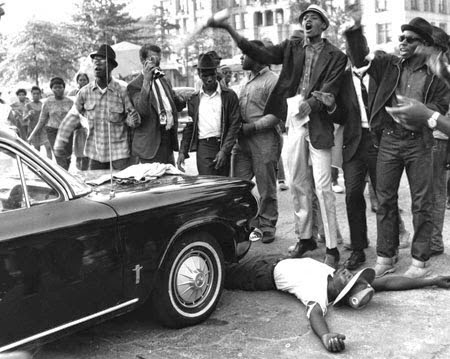
Saint Louis County, 1965, a man lies down in front of car, staging a"die in" to protest police brutality.

**Lee, Willie Henry - Rankin County, Mississippi, 1965: Lee, who was known to have attended civil rights meetings, was found beaten on a country road. An autopsy revealed he died by strangulation from gas.

**Lillard, Richard - Nashville, Tennessee, 1958: Lillard died after a beating from three White guards  at a local workhouse. All three were acquitted of murder charges.

**Love, George - Indianola, Mississippi, 1958: Love was killed in a gun battle with police who believed he was responsible for a murder and arson. He was later cleared of any connection to the murder.

**Mahone, Maybelle - Molena, Georgia, 1956: Mahone was killed by a White man for "sassing" him. The man was initially found guilty, but later found not guilty by reason of insanity.

Santa Clara University students stage a "die in" to protest police brutality in 2014.

**Maxwell, Sylvester - Canton, Mississippi, 1963: Maxwell's castrated and mutilated body was found by his brother-in-law less than 500 yards from the home of a White family.

**McNair, Robert - Pelahatchie, Mississippi, 1965: McNair was killed by a town constable.

**Melton, Clinton - Sumner, Mississippi, 1956: Elmer Otis Kimbell was cleared in Melton's death. Kimbell claimed Melton fired at him three times before he returned fire with a shotgun. No gun was found in Melton's car or on his body.

**Miller, James Andrew - Jackson, Georgia, 1964: Miller was shot by Whites a few days after being beaten. A suspect was cleared after the coroner ruled he fired in self-defense.

**Mixon, Booker T - Clarksdale, Mississippi, 1959: Mixon's body was found lying on the side of the road, completely nude. Police claimed it was a hit-and-run, though family members cited his naked body and the extensive amount of flesh torn from his body as evidence of murder.

**Montgomery, Nehemiah - Merigold, Mississippi, 1964: Montgomery, 60, was shot by police after allegedly refusing to pay for gas. Police were acquitted, and the shooting was called justifiable homicide.

14-year old Joseph Williams was Tased by police in Bucks County, Pennsylvania after he and two friends were accused of shoplifitng at a Walmart. He was caught and handcuffed. Police claimed they Tased him so he wouldn't run into traffic. The officers who arrested  Williams said he fell on his face when he was Tased, causing the facial injuries. At the police station his mother was not allowed to see him for three days. She said she talked to him through a closed door at the police stationon. Police told his mother that Williams was eating pizza and was happy. The youngster said the police Tased his face.

**Morris, Frank - Ferriday, Louisiana, 1964: Morris, who owned a shoe store, was killed when a gas stove exploded during an arson. Morris, who lived in a room adjoining the store, was ordered to return to his room by the men who started the fire. An extensive Justice Department investigation was conducted, but the outcome is unclear.

**Motley, James Earl - Wetumpka, Alabama, 1967: Elmore County Deputy Sheriff 

**Harvey Conner was cleared in the death of Motley, who died in prison after suffering three severe blows to the head.

**O'Quinn, Sam - Centreville, Mississippi, 1959: O'Quinn, derided by some local whites for being "uppity," was shot after joining the NAACP.

**Orsby, Hubert - Pickens, Mississippi, 1964: Orsby's body was found in the Black River. It was reported that he was wearing a t-shirt with "CORE," written on it, representing the Congress of Racial Equality.

**Payne, Larry - Memphis, Tennessee, 1968: Payne, 16, was killed by a shotgun blast fired by a patrolman as he emerged from a basement in a housing development.

**Pickett, C.H. - Columbus, Georgia, 1957: The part-time minister was beaten to death while in police custody.

**Pitts, Albert, Pitts, David, Johnson, Marshall

**McPharland, Ernest - Monroe, Louisiana, 1960: A White employer was arrested and then released in the shooting of five of his employees, four of whom died. The victims were accused of making threats. The employer was never charged.

**Powell, Jimmy - Brooklyn, New York, 1964: Powell, 15, was fatally shot by a Brooklyn police officer. The officer's exoneration by a grand jury sparked riots in Harlem.

**Prather, William Roy - Corinth, Mississippi, 1959: Prather, 15, was killed in an anti-black Halloween prank. One of eight youths involved was indicted on manslaughter charges.

**Queen, Johnny - Fayette, Mississippi, 1965: A White off-duty constable was named in the pistol slaying of Johnny Queen. The shooting was not connected to any arrest.

**Rasberry, Donald - Okolona, Mississippi, 1965: Rasberry was shot to death by his plantation boss.

**Robinson, Fred - Edisto Island, South Carolina, 1960: Robinson's body was found washed ashore on August 5. His eyes were reportedly gouged out and his skull crushed.

**Robinson, Johnny - Birmingham, Alabama, 1963: Robinson, 16, was shot in the back by a policeman on the same day as the 16th Street Church bombing. Police said the victim had thrown stones at White youths driving through the area.

**Sanford, Willie Joe - Hawkinsville, Georgia, 1957: Sanford's naked body was raised from the bottom of a creek where it had been wired to undergrowth in the water. The result of a grand jury investigation is unknown.

**Scott Jr., Marshall - New Orleans, Louisiana, 1965: Scott was put into solitary confinement in a New Orleans jail. He died without receiving any medical attention. There were no arrests in the case.

**Shelby, Jessie James - Yazoo City, Mississippi, 1956: Shelby, 23, was fatally wounded by a police officer who claimed he shot Shelby because he resisted arrest.

**Singleton, W.G. - Shelby, N.C., 1957: Singleton died from third-degree burns suffered in an explosion and fire.
  
July 2013 in Orange County, Anaheim, California, hundreds of Latino protesters marked the anniversary of the death of Latino James Earl Rivera, Jr. who was shot  by Anaheim police.
**Smith, Ed - State Line, Mississippi, 1958: A grand jury refused to indict L.D. Clark in the death of Smith, who was shot in his yard in front of his wife. Clark later reportedly bragged about the killing.

**Stewart, Eddie James - Crystal Springs, Mississippi, 1966: Stewart was reportedly beaten and shot while in police custody. Police claimed he was shot while trying to escape.

**Taylor, Isaiah - Ruleville, Mississippi, 1964: Taylor was shot by a police officer after allegedly lunging at him with a knife. The shooting was ruled a justifiable homicide.

**Thomas, Freddie Lee -LeFlore County, Mississippi, 1965: Federal investigators looked into the death of Thomas, 16. Thomas' brother believed he was murdered as a warning against Black voter registration. The result of the investigation is unknown.

**Triggs, Saleam - Hattiesburg, Mississippi, 1965: The body of Mrs. Triggs was found mysteriously burned to death.

**Varner, Hubert - Atlanta, Georgia, 1966: Varner, 16, was killed when a gunman fired into a group of Black teenagers. The gunman allegedly believed the teenagers made a comment to his White companion. The result of a federal investigation is unknown.

**Walker, Clifton - Adams County, Mississippi, 1964: Walker was killed by a shotgun blast at close range. The result of a federal investigation is unknown.

Killed by police: Anthony Baez, 29, December 22, 1994, Bronx, New York was put in chokehold by police officer; Amadou Diallo, 23, was shot at 41 times by New York police two officers, 19 bullets hit their mark; Gidone Busch, 31, a mentally challenged Jew, was shot to death by police May 30, 1999 in Brooklyn Park, New York. The cop who killed Baez was finally sentenced to seven years in prison. He was released in 2005.
**Waymers, James - Allendale, South Carolina, 1965: A White man is acquitted in the shooting death of Waymers after entering a plea of self-defense.

**Wilder, John Wesley - Ruston, Louisiana, 1965: A White policeman was accused of Wilder's death, and a coroner's jury ruled the slaying was justifiable homicide.

**Williamson, Rodell - Camden, Alabama, 1967: Williamson's body was recovered from the Alabama River after it snagged on a fisherman's line. Williamson was active in the Wilcox Country branch of the NAACP, but local sheriff P.C. Jenkins said there were no signs of foul play.

**Wooden, Archie - Camden, Alabama, 1967: Wooden, 16, bled to death after either jumping or falling onto a sapling in a ditch. The cut sapling severed an artery. A newspaper report said the Mobile office of the FBI made a civil rights violation inquiry into the incident. The results of that inquiry are unknown

"A Stop Police Brutality" rally was held in Chicago, October 2011. January 7, 2011 police shot Darius Penix 16 times during a traffic stop; June 7 a Flint Farmer was killed by Chicago while he held a cell phone. A news report says Farmer was shot in the back three times as he lay on the grass. The policeman that shot him had already shot three people, two of them fatal, one survived. He was not indicted in any of the shootings; July 25, 13-year-old Jimmy Cannon was shot four times by Chicago police, no indictment; October 5, Amit A. Patel, 31, was chased to Lake Michigan by police. He died hours later. There was no indictment.