Saturday, August 2, 2014

Lonnie Franklin: The infamous 'Grim Sleeper' who took a 14 year hiatus from murder and rape


Lonnie Franklin's appearance at his arraignment
One victim that survived Franklin's attack spoke at the sentencing phase of his trial. Enietra Washington  said, "You are truly a piece of evil. You're right up there with Manson." 

Charles Manson is a mass murderer, and cult leader, along with his followers, killed pregnant actress Sharon Tate and a few other celebrities in 1969.

Franklin will join the 750 inmates on San Quentin Prison's death row in Los Angeles.
 
Lonnie David Franklin, Jr. aka the “Grim Sleeper” was a serial killer who lived-in South-Central Los Angeles, California. He committed an estimated 10 murders and rapes during the 1980s, a time when riots and unrest was prevalent among African Americans.  Black-on-Black crimes were not immediately investigated or resolved by the Los Angeles Police Department. Crime in Black communities was considered a norm. 

"That's the way they are," an outside observers concluded. Some news reports revealed that South Central residents were not alarmed by the murders, because of who was killed: drug addicted prostitutes.

Statistics shows that Lonnie Franklin is listed among some of Los Angeles's most notorious African American serial killers, which is a new phenomenon among Black males. Serial killers have always been identified as White males in their early 30s 0r older. Black serial killers nationwide, none of whom were identified by a particular modus operandi. They were simply branded spree killers. Spree killers are tantamount to drive by shooters. 

Serial murders and rapes committed by African American males were initially viewed as individual acts committed by more than one killer. With the discovery and sophistication of DNA technology, many of the cold cases have been reopened, investigated and resolved.

According to background information, Lonnie Franklin had a long criminal record. Like a number of African American serial killers nationwide, Franklin went undetected for more than a decade. He was 33 years old when he commenced his travel to the dark side. Police suspect, but have no proof, that Franklin also killed one man.

“Aside from the 10 murder charges, police suspect Franklin killed a man who may have discovered he was a killer. They are also reviewing whether Franklin was involved in about 30 other homicide cases. He has not been charged in those cases.

“Franklin was arrested at least 15 times for investigation of burglary, assaults and other crimes but avoided state prison. He is alleged to have killed one of his victims in July 2003, a time when he should have been in county jail but was released early because of overcrowding.” (Huffington Post, July 2009)

All of Franklin’s victims lived-in South-Central L.A. When the community learned that a serial killer was their neighbor, living freely in their midst, they were shocked, surprised visibly shaken and angry. Then Chief of Police William Bratten intentionally withheld information regarding the suspected serial killer. One irate woman said had their community been White they would have been notified.

“The mayor and chief never issued a press release, nor warned the South Los Angeles community of the killer’s continuing activities. In some cases, the alternative newspaper was the first to inform the families that their daughters had been confirmed as victims of a serial killer.” (Wikipedia.org) The alternative newspaper was the Los Angeles Weekly. 

Prosecutors have alleged that Franklin, a former LAPD garage attendant and city garbage collector, sexually assaulted and then killed women on the margins of society — including some prostitutes and drug addicts — over nearly a quarter century. Seven of the women he is accused of killing died between 1985 and 1988 and the others between 2002 and 2007. That apparent dormant period led the L.A. Weekly to dub the killer the 'Grim Sleeper', although the detectives investigating the case have long been skeptical of the idea that the killer had taken a break. 

“Police at first speculated the killer may have been in prison during the gap in the known killings, but that theory was tossed out when Franklin was arrested, and investigators realized that he had not been behind bars. That spurred them to launch the review of unsolved cases and missing person reports in search of victims that had gone unconnected to Franklin.” (LA Times, 2011)

Franklin was born in Los Angeles on August 30, 1952. Contrary to many news reports not all of his victims were drug addicts and prostitutes. 

“Many of the victims had been just going out to run an errand or had been on their way to a party or a quick stop somewhere. Bernita Sparks, 23, had run out to grab some cigarettes on April 15, 1987, and never came home. She was found in the dumpster on Western Avenue the next day. Sparks' cigarette run turned into a beating, strangulation and death by shooting.” (crimelibrary.com)
 
Franklin pleads not guilty 
One victim, Enietra Washington, survived to tell about her near date death experience. She  identified Franklin as her attacker. In the TV movie “Grim Sleeper” her character was portrayed by singer/actress Macy Gray.

One night in 1988 she was on her way to a friend's house when saw Franklin's car, an orange Pinto with a white racing stripe. He was parked on the side of the road, waiting for her to pass his parked car. Franklin asked her if she wanted a ride. She said no at first, but Franklin was persistent. She finally said yes and got into the car.

Before driving Washington to her friend's house, Franklin said he had to make a stop, which was in a residential area. He went to into a home. When he returned to the car, Washington said he was a bad mood. At some point Franklin shot Washinton in the chest. She said she did not realize that she had been shot.

Enietra Washington in 1988.
After a long ordeal in an effort to escape her potential killer, as she traveled from semi-consciousness to having the instinct to survive, Washington managed to open the car door in an attempt to escape. Franklin pushed herself on to the street. She ended up in the hospital with doctors trying to save her life. She said Franklin took a photo of her before pushing her out of the moving car.

Another victim that was not a prostitute was not lucky.  Mary Lowe, a 26-year-old receptionist, last seen on Oct. 31, 1987, at a Halloween party at the Love Trap Bar 10 blocks from Franklin's home. She was discovered dead in a nearby alleyway the following day, shot in the chest.

Franklin, living on disability, was arrested after his DNA connected him to multiple unsolved rapes and murders. Similar to a scene straight out of a TV crime show, namely CSI, detectives used a tactic termed familial DNA to nail the suspect. According to a number of news reports, Franklin’s son was arrested for an unrelated incident and questioned. The Los Angeles Times reported that Franklin’s son “fingered his dad.” 

Crimelibrary writes that detective trailed Lonnie Franklin, hoping to obtain his DNA by hook or crook. They finally struck pay dirt. “Police got a sample of his DNA off a slice of pizza he left at a restaurant, allowing them to link him physically to the evidence left on the victims.” 

Franklin later said he thought the restaurant would throw out the uneaten pizza with the other trash. 

Lonnie Franklin's youngest victim was a 15-year-old runaway named Princess Berthomieux. For some reason he stopped his murderous rampage in 1988 but resumed the killings 14 years later. His last victim was Janecia Peters, 25, murdered January 1, 2007. America's Most Wanted reported that a prior victim, Alicia "Monique" Alexander, 18, was on her way to a store for her dad when she had the misfortune of a chance meeting with Franklin. Her body was found a few days later.  She had been sexually assaulted and shot.

Donna Harris, one of Franklin’s neighbors, was surprised to learn that the longtime resident was a serial killer. “Everybody on the block, we all knew if anything was happening with anybody’s cars, he was always there for us. Especially the ladies,” Harris said. “Even if we weren’t at home, instead of calling Triple AAA, he would help.” (ABC News)

After killing his victims Franklin disposed of them in alleyways under mattresses, discarded carpets and in dumpsters. Janecia Peters was found wrapped in a garbage bag. Unlike the other women who were either strangled or shot at close range, Peters was shot and strangled.

Detectives thought they were getting a tip on the killer when an unidentified man called 911 to report two deaths. The caller would not state his name when the operator asked who he was. The mysterious caller laughed and quickly hung up. Upon arresting Franklin prosecutors sought permission to perform an analysis of the caller and Franklin’s voices.

In 1985 there were over 800 killings/murders in South Central L. A.  When they searched Franklin’s home, they reportedly found 1,000 photos of women (some media reported 800), some of whom appeared to be semi-conscious, some appeared to be unconscious. The photos dated back 30 years; all were taken by Lonnie Franklin. Photos and videos of women, and other evidence was taken from his home during a three-day search. 

Franklin had shared the modest home with his wife for 32 years.

The Los Angeles Police Department posted photos of the 10 of Franklin's victims on a billboard, hoping relatives or acquaintances would come forth and identify the women. A $500,000 reward was offered for information leading to the killer’s arrest. 

On March 28, 2020 Lonnie Franklin was found dead in his cell on death row in San Quentin Prison.

Monday, June 30, 2014

Mexican American zoot suiters in L. A. attacked, called 'unpatriotic' and 'un-American'

During the 1940s the hottest outfit for some African American men and teens to wear were zoot suits. It took a lot cloth to make one suit, but the results was a showcase of “look at me” on parade. The fashion phenomenon eventually caught the attention of Latinos and Italians, each having their own versions of the culturally popular suit.

Musician/actor Cab Calloway
Believe it or not, this flamboyant suit evolved into an object of violence and racism. Those who wore the oversized suits were labeled “zoot suiters”.  The zoot suit, a high fashion tailored wonder, had wide lapels, padded shoulders, tapered cuffs, making the wide legged, high waist trousers resemble a pair of harem pants.  Colors varied according to a wearer’s taste. Zoot suits were accented with a single or double chain attached to the pants, hanging the full length of the suit. Wearing shoes shined to the max, some zoot suiters wore wide rim fedoras accented with long feathers. Fashion minded women wore less severe versions of the zoot suit. They wore mid-calf skirts and vests.

In the 1940s Los Angeles was a hot bed of racism, segregation and racial strife. America was thigh high in World War ll.  In 1942, following President Franklin D. Roosevelt’s Executive Order 9066, the U. S. Army evacuated Japanese nationals and U. S. citizens of Japanese descent. In Los Angeles, Little Tokyo disappeared after thousands of Japanese were interned in makeshift concentration camps in America. The Japanese had struck Pearl Harbor, and all Japanese in this country were suddenly the enemy.

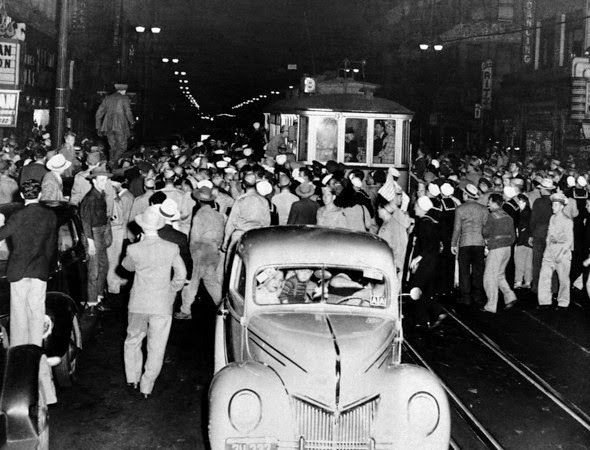
Angry sailors, citizens and Marines on the prowl,
searching for Mexican Americans to attack.
In 1943 all hell broke loose on the streets of L. A., the city of angels.  It was a time when Mexican Americans were forced into street fights with White Marines and sailors.  

“Tensions between servicemen and civilians were on the rise as thousands of military men on leave poured into Los Angeles, seeing the city as a playground for booze, women, and fights. While many civilians tolerated them because of the war effort, others did not. 

"Particularly in the segregated, ethnic enclaves of Los Angeles, unruly servicemen met stiff opposition from young men and women who refused to defer to the presumed prerogatives of white privilege. While white military men and civilian youth of all colors clashed in the streets, confrontations occurred most frequently between white servicemen and Mexican Americans, because they were the largest minority group in Los Angeles.

"White people in general, civic leaders and police departments decided among themselves that zoot suits were un-American and unpatriotic. In the midst of a global war with an uncertain outcome . . . and calls for patriotic loyalty, minimized public tolerance for expressions of soul difference--even sartorial ones-- the zoot suiter tested the political and moral expectations of the moment." kcet.org quoting from Eric Avila essay. 

Whites felt Mexican Americans should have been fighting in the war, not wearing zoot suits and flaunting their racial differences. The fact is Mexican Americans were fighting in World War ll. Racial hatred blinded White people.  The unfortunate internment of thousands of Japanese citizens saved them from experiencing the racial acrimony. America was at war with the Japanese for bombing Pearl Harbor.

“Drunken military men on their way back to base after a night of carousing were often ‘rolled’ by civilian minority youth hoping to teach them proper respect. With equal animosity the sailors would often insult Mexican Americans as they traveled through their neighborhood. In the barrios, rumors spread about sailors searching out Mexican American girls. 

"On the military bases, stories circulated about the violent reprisals suffered by sailors who dared to date Mexican American females. Sailors complained bitterly about their wives or girlfriends being subjected to the sexual taunts of young Mexican Americans. The tension continued to escalate until a street fight between sailors and Mexican American boys sparked more than a week of fighting in June of 1943 known as the Zoot Suit Riots.” The American Experience, PBS

Whites wearing zoot suits were treated differently.
None were taunted, taunted or arrested.
The media and L. A. police fanned the flames, unable or unwilling to disabuse themselves of the animosity they felt toward the zoot suit wearing Mexican Americans, all of whom were called hoodlum and criminals. 

“On the evening of Monday, May 30, 1943 about a dozen sailors and soldiers were walking on a downtown street. After spotting a group of young Mexican American women on the opposite side of the street, the sailors and soldiers changed direction and headed in the direction of the women. Between the military men and the young women stood a group of young men in zoot suits. As the two groups passed each other, Sailor Joe Dacy Coleman, fearing he was about to be attacked, grabbed the arm of one of the zoot-suited young men. Coleman's move proved to be a big mistake. He was almost immediately struck on the head from behind and fell to the ground, unconscious. 

"Other young civilians pounced on the sailors with rocks, bottles and fists. After the ferocious attack, the sailors managed to escape and carry Coleman to the safety of the Naval Armory. 
The fracas lasted little more than a few minutes, but the shock reverberated for days," wrote historian Eduardo Pagán. ‘The details of the fight grew larger and more distorted in each re-telling of the story’. It wasn’t long before sailors organized a retaliatory strike against zoot-suiters.”


Mob of angry White rioters on the loose in downtown Los Angeles, 1943


The rioting lasted a week. On June 7, a local paper wrote and printed a how- to- guide for soldiers and White citizens to follow if they decided to undress a zoot suiter in public, which was the ultimate humiliation. They were instructed to rip up or burn the zoot suits on the street.  A riot ready crowd of hundreds gathered in downtown L. A. The crowd divided up, some plodding toward Watts, an African American neighborhood, and some headed to East of L.A. where Mexican American resided. Uniformed police officers were part of the melee.
The police made arrests but the majority of those arrested were Mexican Americans.

 “After several days of rioting and assaults by servicemen, more than 150 had been injured and the police had arrested and charged more than 500 Latino youth for rioting or vagrancy, many themselves the victims. ‘Zoot Suiters Learn Lesson in Fight with Servicemen’ the Los Angeles Times wrote. The Los Angeles City Council issued an ordinance banning the wearing of zoot suits. ‘The zoot suit has become a badge of hoodlumism,’ explained Councilman Norris Nelson. 'We prohibit nudism by an ordinance and if we can arrest people for being under-dressed, we can do so for being over-dressed.


Two zoot suiters attacked by mob and stripped naked, forced to lie or sit in the street.


 “Finally, on June 7, military authorities did what civil authorities would not. Navy and Army commanders sought to get control of their men by ordering that the City of Los Angeles be declared off-limits to military personnel. Nonetheless, the official Navy position was that their sailors were acting in "self-defense against the rowdy element. Although the police accompanied the caravan of rioting servicemen, police orders were to let the shore patrol and military police deal with the military men.” Los Angeles Almanac 

Al Waxman, editor of the Eastside Journal, a small Jewish newspaper, witnessed the chaos. He describes a "mass of humanity locked in violent struggle, arms swinging, legs kicking, shrieking with anger." 

The police were arresting dozens of young Mexican Americans. "Why am I being arrested?" one of them asked. The response was a savage clubbing with a nightstick. Although the boy fell to the sidewalk unconscious, he was kicked in the face by police.” The American Experience, PBS

A special committee formed by the governor of L. A. analyzed the riots and concluded that race was not a factor. No one had discriminated against the zoot suiters, the report concluded.

(right photo) Mexican American teen held at police station, stripped down to his underwear. One cop looks amused by the smiling teen.

Wednesday, April 30, 2014

The Death Penalty in Texas: A 40-year Retrospection


Part 1

Samuel Holmes in earlier times
Before his execution, 22-year-old Samuel Holmes said he was innocent of the crime that landed him on Texas's death row, but the law did not believe him. His execution became racialized by law enforcement and the judicial system.

Death, whether natural, execution or peaceful can be traumatic for the living long after it becomes a script in history. This holds true for crime victims, their families, the individual who committed the crime. The perpetrator of a criminal act may find him/herself sitting on death row, facing a state sanctioned execution. This ultimate sentence depends on the state in which the crime was committed, and how the crime was committed. Supporters of the death penalty demand that a horrific crime can only be rectified if the killer is executed. That is especially true in Texas.

In this series on the death penalty in Texas, The Villager will tackle several issues and flaws regarding to the death penalty and executions. The 4-part series will begin with the 1960 electrocution of Austinite Samuel Morris Holmes, 22, whose controversial execution pushed the East Austin community to protest and criticize the State of Texas for its aim to kill an innocent man. Criticism of the death penalty, and how it was unevenly applied to African American men was not a first in Texas nor would it be the last.

In addition to retrieving information from the 1956-1960 editions of the American Statesman, and other sources, The Villager interviewed for this series, Arnette Holmes, Samuel Holmes' oldest brother. Confined to his bed and a wheelchair, Arnette died a year later after a long illness. Sensing his approaching demise, Arnette called The Villager and said he wanted to talk about his brother's execution. He said he lives with Samuel's execution daily. He could not stop reliving that dreadful journey that started 40 years ago. He never wavered from believing Samuel was innocent.

Protests, pleas and cries of innocence

The execution of Carla Faye Tucker, February 3, 1998, for the 1983 double pickax murders of Debroah Thorton and Jerry Dean of Houston, set the stage for anti-death penalty advocates to take to the streets, demanding that Gov. George W. Bush stop Tucker's execution. Despite him being the governor, Bush did not have the power to overrule a decision made by Texas' Board of Pardons and Paroles. A Texas governor can only grant a 30-day stay. Tucker, who found Christ and religion while on death row, said she wanted to live. Tucker turned her life around while sitting on death row. She did not deny her guilt in the pickax murders. Her accomplice died of liver disease before Texas could execute him.

Tucker was the first woman to be executed in Texas since the civil war. Her proclaimed of discovery of God was not enough to save her from her appointment with death. 

In the week before [Karla Faye Tucker’s] execution, Bush says, Bianca Jagger and a number of other protesters came to Austin to demand clemency for Tucker. “Did you meet with any of them?” I ask. Bush whips around and stares at me. “No, I didn’t meet with any of them,” he snaps, as though I’ve just asked the dumbest, most offensive question ever posed. “I didn’t meet with Larry King either when he came down for it. I watched his interview with [Tucker], though. He asked her real difficult questions, like ‘What would you say to Governor Bush?’ ” “What was her answer?” I wonder. “Please,” Bush whimpers, his lips pursed in mock desperation, “don’t kill me.” Slate Magazine, 12/2/2005

There was another nation-wide protest when Gary Graham's pending execution was hot news. Graham was a young African American man with a long criminal history. He was on a crime spree to feed his drug habit the night he allegedly shot and killed Bobby Lambert, a White man, outside a grocery store in Houston, Texas. Controversy and declarations of "not guilty" surrounded the case. Graham proclaimed to the end that he was innocent of this fatal shooting. A lone eyewitness, a woman, identified him a the shooter. She did not stagger from her testimony that Gary Graham was the man she saw shoot Lambert to death during a robbery.

The court and jurors said the woman was a credible, believable eyewitness. They did not find Graham's witnesses believable or credible. Due to the protests and doubts raised in the case, Graham escaped execution a few minutes after the 6 p.m. deadline. The Board of Pardons and Paroles had received a barrage of new information regarding Graham's case. Board members took a few hours to review the information, searching for new evidence. They concluded there was nothing new to consider. Graham was executed at 8:15 p.m.

In 1959 African Americans living in East Austin staged a different kind of protest to save the life of Samuel Holmes, a young husband and father. He was employed as a janitor at Brackenridge Hospital and Bergstrom Air Force Base. Holmes was found guilty of raping and savagely beating a 56-year-old White woman in her West Austin apartment complex in Enfield, January 19, 1959. He was 20 years old at the time of the attack.

 African Americans in East Austin refused to believe the rape and assault happened the way it was reported in the media, and finally presented in the courtroom. Some 40 years later, a number Holmes' friends and family who are still alive, have not stopped believing the truth was covered up at the trial, based on the facts that the accused was a young Black man, and the victim was a middle-aged White woman.

According to reports in the American Statesman, the victim, unnamed, provided police with a "meager description" of the man who entered her home that Monday night. A widow, she thought the person entering her apartment was her roommate. She realized it was a stranger when she saw a "black hand" reach through the door to turn off the bathroom light. Later the media reported the woman saying she "saw part of a face that looked to be that of a Negro."

Despite not seeing the intruder's face, the woman said her attacker was about 30 years old and stood about 6 feet 9 inches. Detectives said they had few clues to work with, making it difficult to initiate an investigation that would lead to a suspect and arrest.

Police said the elderly victim locked herself in the bathroom, but the attacker kicked in the door, forcing himself into the bathroom with her. Police said a "vicious struggle" apparently took place, because the bathroom was covered in blood. The victim said Holmes told her if she called the police he would come back and kill her. She called police despite the threat.

On the 20th of January police questioned the woman's neighbors. They did not see the attacker enter or leave the apartment. No one in the complex heard the woman scream for help during the "violent struggle." However, a female neighbor in the same building said she heard "a commotion" but thought nothing about it. Several more residents in the area reported seeing "a suspicious person loitering the neighborhood."

Brackenridge Hospital employee

Holmes reported to work at Brackenridge Hospital two days before he was arrested and held without bond. He was not granted bond. He had allegedly threatened to kill the victim if she called police. Before he could get an attorney, Holmes was given a lie detector test. Detectives said they obtained a full confession from him, leading to an official charge of rape and assault. Police said the polygraph test revealed that Holmes had "guilty knowledge" of the rape and assault, nothing conclusive. They said his fingerprints were found in the victim's apartment. Holmes said the test did not tell the truth about him.

On January 27 several witnesses, including residents where the woman lived, made appearances in front the grand juror to testify about what they saw and heard the night of the attack.

'They beat the hell out of my brother'

Arnette Holmes, the older brother and best friend to Samuel, said in a recent interview with The Villager that his brother wasn't guilty of the charges against him. He said he and Samuel talked about everything. There were no secrets between them. Samuel was next to him in age, and if he had done anything wrong on the night in question, "he would have told me," Arnette said with confidence. There were nine sisters and brothers in the Holmes family.

"I asked him if he did it and he said, 'No. I didn't do it, but I think I know who did.'" (Arnette gave a name that The Villager cannot reveal.) Arnette said Holmes told him to "just watch him."

"I asked him how he knew he did this. He said he had seen him several times in the community. He (Samuel) used to cut grass up there. What we used to do is go to the golf course and caddy on the weekend, and sometimes we cut grass to make some extra money," Arnette said. He said he loved playing golf, but he can no longer play because both his legs were amputated.

Arnette said when he went to the jail to see Samuel after his arrest, he was shocked by what he saw. The person he was looking at could not be his brother, he thought. "When I went up there three days later his eyes and mouth was bruised. They had beat the hell out of him! When I left, I went and got Mr. Arthur DeWitty. We went back to the courthouse. Mr. DeWitty was a big man. That big man had tears running out his eyes when he saw my brother," Arnette said, shaking his head.

"He asked the police how many times they beat him to get a confession of him. They almost killed him. He looked like somebody had him on the ground and run over him. When we went and told my mother about the condition he was in, that just killed her right then and there. Only thing is we just didn't bury her. She was dead right then and there," Arnette repeated emotionally. Although his brother was executed four decades ago, the memory and pain remain fresh on his mind.  The memory is like an annoying sore that won't completely heal.

At the trial Arnette says he was "very angry" at the attorney his mother hired. He said the case was followed all over the world. Holmes' his mother received donations from thousands of people following the case. It was with this money that she hired attorney Johnny B. Rogers, an ex-state senator from Texas.

"Most of the big time lawyers around here wouldn't take the case. So finally my mother got Johnny B. Rogers. He had Pete (Samuel's nickname) holding his head down during the whole trial. The whole six days he never held his head up. He never looked around. He'd sit six or seven hours a day looking down on the floor. I asked Johnny, 'Why are you making him do that?' He said he had his reason. I said to myself, 'Yeah, you're making him look guilty.'"

Arnette said Samuel did not have a record; had never been in trouble with the law. Holmes begged his attorney to let him testify. "Johnny B. told him 'if you testify, you're going to put yourself in the electric chair.' My brother told him, 'Man, I want to testify. How come I can't testify? Can I tell my side of the story?'"

"He told Johnny B. that he was the one accused of a crime not him. He still wouldn't let him testify. That killed my brother. They killed him in a legal way," said Arnette.

Arnette said the victim was not at the trial. "I was there from the day it started. After they gave him the death sentence, he never said a mumbling word. He just kept looking at the floor. He never showed no kind of emotion in any kind of way," Arnette recalls.

Holmes was scheduled to die in the electric chair June 15, 1960; however, on September 9th, he got an extension from Supreme Court Justice Hugo Black. Acting Gov. Ben Ramsey, following the recommendation of the Board of Pardons and Paroles, delayed Holmes' execution date until October 15. The Board said its actions were in conformance with Justice Black's recommendation.

The community protests

After the trial Mrs. Fred Godfrey called for a hearing with the Board of Pardons and Paroles to discuss commutation of Holmes' death sentence. She wanted to try and get the death sentence converted to life in prison. Rev. S. L. Davis, and Rev. R. Q. Allen, along with 100 African American citizens met with the Board in the Senate Committee Room. They had collected 1,354 signatures on a petition in support of not executing Holmes. The people who spoke-- begged and pleaded with the Board to reconsider its decision.

Holmes' mother made a tearful plea to spare her son. She told them that her son had been a "sick child since birth. There's something wrong with him," she pleaded, hoping to convince the Board that Holmes had a mental problem. The Board was not touched. The appeal for commutation was denied. Holmes was rescheduled to die in the electric chair November 30, 1960. His family was with him that November night. Arnette, who did not watch the execution, said he looked for signs of nervousness in his brother's face during their last visit.

"I talked with him about an hour before they killed him. He was calmer than I was. I was shaking like a leaf. He wasn't scared at all. He said, 'Sonny, that's what he called me--I want to ask you a favor. I want you to take care of Muhdear the best way you can cause she's gonna take this hard. And I want you to tell my kids their daddy love them.'"

Arnette said, "Down in Hunstville the night they killed him, it was the pitifullest sight I ever saw. You can tell when they get ready to execute somebody. They do it after 12. Every light in that place dimmed two times. That meant they had killed him. The warden came out and I asked him, 'How did he go?'"

He said, "I killed a lot of niggers but that boy was hard to go. I reached and grabbed for him, but Dudley (his mother's friend and APD policeman) grabbed me to keep me from getting killed. I guess he said that because, when the electricity hit him, he broke the straps on his arms and legs. They said that's the first time they had seen that happen," Arnette recalled.

American Statesman reporter Jim Berry witnessed the execution. He wrote that Holmes, strapped in the electric, continued to declare his innocence, as he had done many times before reaching the final stage of his death sentence. He said Holmes thanked God for "walking as far as you have with me." Berry wrote that Holmes' head was shaved clean; he was wearing a clean black jacket, pants and khaki shirt. He wrote that Holmes was hit with the first volt of electricity. Seconds later a second charge, and then a third.

"When the initial 1,800-volt charge hit, his body convulsed with such force that the leather strap across his waist and the one around his leg broke," wrote Berry. "Two additional shocks and four minutes later he was pronounced dead. The odor of death filled the room with the charge and lingered on."

Holmes was pronounced dead at 12:10 a.m., by a medical director for the Texas Department of Corrections. The whole process took 10 minutes. In a pre-execution news interview on Tuesday morning November 29, Holmes told reporters, " The truth has not been revealed to the people. If I die and they learn the truth, what will the people say then?"

'Old Sparky' worked extra hard in Texas

The Death Penalty in Texas: 
A 40 Year Retrospection 

Part 2: By Dorothy Charles Banks
Special to The Villager
August 2000 

Old Sparky is the common named given to electric chairs in several states. Texas's electric chair is presently housed in Prison Museum in Huntsville, Texas. The last electrocution took place in Texas July 30, 1964.
First known electrocution in the United States

"The first person sentenced to be executed by the electric chair was William Kemmer, a convicted murderer. An appeal was made to the New York Court of Appeals on the grounds that use of electricity as a means of execution constituted a cruel and unusual punishment and was thus contrary to the constitution of the United States and the state of New York. On December 30, 1889, the writ of habeas corpus  sworn out on Kemmler's behalf was denied by the court, with Judge Dwight writing in a lengthy ruling:

"We have no doubt that if the Legislature of this State should undertake to prescribe for any offense against its laws the punishment of burning at the stake, breaking at the wheel , etc., it would be the duty of the courts to pronounce upon such attempt the condemnation of the Constitution. The question now to be answered is whether the legislative act here assailed is subject to the same condemnation. Certainly, it is not so on its face, for, although the mode of death described is conceded to be unusual, there is no common knowledge or consent that it is cruel; it is a question of fact whether an electric current of sufficient intensity and skillfully applied will produce death without unnecessary suffering."

"Kemmler was executed in New York's Auburn Prison on August 6, 1890; the "state electrician" was Edwin F. Davis. The first 17-second passage of current through Kemmler caused unconsciousness but failed to stop his heart and breathing. The attending physicians, Edward Charles Spitzka and Charles F. Macdonald, came forward to examine Kemmler. After confirming Kemmler was still alive, Spitzka reportedly called out, "Have the current turned on again, quick, no delay." The generator needed time to re-charge. In the second attempt, Kemmler was shocked with 2,000 volts. Blood vessels under the skin ruptured and bled, and the areas around the electrodes singed. The entire execution took about eight minutes. George Westinghouse later commented that "they would have done better using an axe," and a witnessing reporter claimed that it was "an awful spectacle, far worse than hanging."
 

"The first woman to be executed in the electric chair was Martha M. Pease, executed at Sing Sing Prison on March 20, 1899." (Wikipedia)

From 1819 until 1923, Texas, along with several other states, hanged criminals sentenced to death. When hanging was noted as cruel and inhumane, electrocutions took its place. The State of Texas authorized use of the electric chair in 1923. All executions were performed in a designated chamber located behind the prison chapel in Huntsville, Texas. This method was supposed to take executions to a level of acceptance. The idea was sold to the public as quicker and more humane.

Prior to 1923 counties in Texas were responsible for their own execution sites. Texas executed its first condemned inmate, an African American, February 7, 1924. The same night four additional African American prisoners from various rural counties in East Texas were also electrocuted. The reason executions were scheduled for midnight was twofold: midnight left time for an 11th hour stay or commutation of sentences and leaving time for the news to reach the warden. Early morning executions were also a tool to dissuade protests. These executions began at 12:09 a.m. and ended at 2 a.m., when the last man was put to death.

In 1964 five Black men were tried and convicted and executed their crimes murder and rape in separate incidents, all were executed. These early morning executions were called the "Harvest of Death." The last inmate was in Harris County, July 1964. From 1923 to 1964 Texas electrocuted 361 male inmates; 229 were African Americans, 108 were White and 23 were Hispanic. "Old Sparky" stayed busy. and had not been abandoned by 1964. No other method of execution had been created to replace it. Texas was not ready to stop executing criminals. 

The U. S. Supreme Court ruled in 1972 that the death penalty was "cruel and unusual punishment." However, Supreme Court Justices could not unanimously decide if the death penalty was actually "cruel and unusual punishment." The same year four judges said the death penalty was not cruel and unusual punishment. Some judges agreed that the death penalty was somewhat random and disproportionately administered to African Americans and other minorities.

A court ordered moratorium from 1972 until 1973 stopped all executions nationwide. At the time Texas had 45 men on death row, and seven more in county jails. Their sentences were commuted to life in prison by Governor Dolph Biscoe. Revision of the Texas Penal Code reassessed capital punishment in 1973. The revision stipulated that executions would resume in Texas, January 1, 1974. The first condemned prisoner, a White male, was put on death row in February. He cheated the State of Texas, and the electric chair when he committed suicide. He hanged himself July 1, with bed sheets in his cell.

Texas adopted lethal injection in 1977. Charlie Brooks, a Black man from Tarrant County, was executed December 7, 1982, a few minutes after 6 p.m. He was charged with the kidnap and murder of a Forth Worth auto mechanic. In 1995 the Texas legislature passed a law making it official that all Texas prisoners were to be executed at 6 p.m.

Preparation for execution in the electric chair

As of 2000 nine states still utilized the electric chair. Preparation for an electrocution entails a last meal request that has to be eaten in 30 minutes. The inmate takes a shower.  Both requests are optional. At a specified time, the inmate's head and right leg are shaved. Electrodes moistened with saline solution are strapped to his leg. The electric chair, made of wood, usually oak, is equipped with a metal cap with one electrode fitted to the head. A second electrode is attached to the back. The condemned, with a hood over his (or her) head, is secured in the chair with leather straps across the chest, arms and legs. When the switch is thrown the first time, the prisoner's body automatically leaps forward against the straps.

The voltage of electricity released varies from state to state. It is also determined by the inmate's body weight. The first shock paralyzes the body, destroying the brain. It has been reported that some prisoners take longer to die than others. During an electrocution the inmate's body temperature elevates to 138 degrees Fahrenheit, making it too hot to touch. Body reactions include foaming of the mouth, sweating, gurgling, heaving chest and release of feces.

Deadly cocktail: A new form of execution

The three drugs used to conduct an execution by lethal injection costs $86.08. Pro-death advocates feel that executions by lethal injection affords the condemned the luxury of dying quickly, easily. On the flip side of the coin, anti-death penalty advocates reason that a lethal injection, no matter how humane, is unjustified. They compare it to putting an animal to sleep. On the surface lethal injection appears to be less grizzly than the electric chair and hanging. If the condemned has been a habitual drug user, causing severe scarring to his or her veins, that makes it hard to find a suitable vein in which to inject the needle. That temporary setback is not sufficient enough to delay the execution.

The injection concoction has been described as a "deadly cocktail" that drips from an IV into the inmate's arm. The first drug to invade the body is sodium thiopental, a barbiturate that renders the inmate unconscious. The next is pancuronium bromide, a muscle relaxant that paralyzes the diaphragm and lungs; the third is potassium chloride, which causes cardiac arrest. The complete execution takes about seven minutes, barring there are no complications. The fatal dosage depends on the inmate's body size.

Starting in 1955 close relatives and friends were permitted to witness executions. These witnesses, coming from a list composed by the condemned, are taken to the death chamber at separate times. The witnesses are searched for weapons and briefed as to what to expect from beginning to end. Only the condemned can see the witnesses in both rooms. In Texas, relatives and friends of the condemned are in a separate room.  Friends and relatives of the victim are also placed in separate a room, with a concrete wall between them.

 When the curtain is pulled back from the showcase size window, all eyes immediately fall on the condemned prisoner strapped to a gurney, partially covered with a freshly laundered white sheet, and dressed in a freshly laundered pair of white pants and shirt. An IV is attached to the left arm. A microphone is close to the inmate's mouth so that his or her last statement can be heard by witnesses. After he or she is finish talking, the warden makes sure the condemned has nothing else to say. If the answer is no, he signals to start the fatal cocktail.

Once the process is underway, sometimes the condemned makes a gurgling sound or an audible gasp. When the execution is finished, the inmate is announced dead by a prison physician. Witnesses are then escorted out of the execution chamber, returning to the waiting room in the front building at separate times.

If witnesses and family members choose to do so, they are free to talk to the media after the execution. In Texas witnesses from both sides never come in contact with each other on the prison ground. However, once they leave they can talk to each other if they choose to do so.

Sunday, February 16, 2014

Death always follows a serial killer: African Americans who commit multiple murders

When I think of serial killers I think of White males. During my research of African American serial killers I discovered that police viewed these killings as unrelated murders or killing sprees. Neither the media nor police departments connected the murders to Black killers, who, in the past, did not fit a profiler’s definition of serial killer. The mass murderers that I researched had a number of character traits in common: they were homeless, friendly, likable, manipulative, worked at odd jobs or full-times jobs. They did not draw unnecessary attention to themselves, and committed murders and rapes within their neighborhoods. Like chameleons, they blended into their surroundings. Some had criminal pasts, some did not.

The FBI describes spree killing as: “The general definition of spree murder is two or more murders committed by an offender or offenders, without a cooling-off period. According to the definition, the lack of a cooling-off period marks the difference between a spree murder and a serial murder”.

USLegal contends that, “Serial killer is a term describing a type of killer who kills a number of people over a long period of time. They are generally male and motivated by a variety of psychological urges, primarily power. The United States Bureau of Justice Statistics defines a serial killing as: "[involving] the killing of several victims in three or more separate events." They are distinguished from spree killers in that they have rest periods between killings”.

African American serial killers tended to select victims that were not part of a family structure. The majority of their victims were drug addicts, alcoholics, homeless and prostitutes, whose families did not know where they were; did not know if they are dead or alive. Because victims of mass murderers usually indulge in high risk behavior and activities, police departments do not vigorously investigate their deaths. During the time these serial killers were killing and raping, DNA testing was not available to police departments. However, when DNA was created in the 1980s it helped resolve hundreds of cold cases nationwide.

Keying in the question: “Who was the first African American serial killer?” The answer was: “Due to the fact that accurate records were not kept for Black serial killers, the earliest found was Sydney James, who was hung on June 25, 1915. Jake Bird killed at least 44 women between 1920 and 1947”. (Answers.com

Over 80 African American males have been prosecuted and listed as serial killers. Because the serial killers I have written about in this article had many news stories written about them, I had to abbreviate their profiles. I choose to write about several killers as opposed to one. In the future I will write about more African American serial killers, focusing on one at a time, allowing for more details and fuller profiles. 

Anthony Edward Sowell

A recent serial killer that attracted media and public attention was Anthony Edward Sowell, 50, who lived in Cleveland, Ohio. Sowell’s two-story white house was called the “Cleveland House of Horrors”; “The Cleveland Strangler” and “The Imperial Avenue Murderer”. Sowell was born August 19,1959, raised in East Cleveland, was one of seven children born to a single mother, Claudia "Gertrude" Garrison. Sowell enlisted in the U.S. Marines Corps in 1978, when he was 18.

In his horrific house of horror, Sowell raped and strangled to death 11 women, all of whom he lured to his den of demise and burial ground with promises of free alcohol and drugs.

Anthony Edward Dowell
On September 22, 2009, Sowell invited a woman to his house for drinks. At some point he got angry, attacked the woman, choked and raped her as she fell into unconsciousness. She survived the ordeal and reported him to police. They went to his house a month later, armed with search warrants for his arrest and to search his house.  

Police “crawled beneath the front porch and removed bricks and other debris. One day earlier, agents worked at a house next door to Sowell's, doing thermal imaging, X-rays and other tests. Police discovered the first two bodies and a freshly dug grave after officers came to investigate a woman's report that she had been raped there. Sowell had fled the home and was arrested two days later.” (CBS News)

Police found decomposed bodies in the upstairs living room. They found a skull in a basket in the basement, along with other bodies. Sowell’s victims were African American women who were homeless, prostitutes, addicted to crack cocaine and alcohol. They ranged in ages from 25 to early 50s. Nine of the women were identified through DNA and dental records. The Cuyahoga County coroner determined that six victims died of strangulation but could not tell how five other women were killed due to decomposition. Neighbors said they caught a whiff of the sickening smell coming out of Sowell’s house, but they had no idea what it was. A neighbor said it smelled like something rotting, like a dead dog.

“The three-story house with neat white siding is in a crowded inner-city neighborhood of mostly older houses, some boarded up, and small corner stores. The windows on the third floor, where the first two bodies were found, were wide open Sunday as a slight breeze blew. Some neighbors said a bad smell came from the house several months ago, but they thought then that it might be natural gas.” (CBS News)

Born August 19, 1959, Sowell had a prison record prior to becoming a serial killer. “In 1989, a woman who was three months pregnant went to Sowell’s home voluntarily. When she tried to leave, he bound her hands and feet with a tie and belt, then gagged her mouth with a rag. The victim told police: ‘He choked me real hard because my body started tingling. I thought I was going to die.’ Sowell was charged with kidnapping and attempted murder. He eventually pleaded guilty to the charge of attempted rape, and as a result he served 15 years in prison. He was released in 2005.” (Wikipedia)

According to a niece who testified at his trial, Sowell began raping her when he was 11 years old. She said his mother was very abusive and did nothing to stop him raping her. Released from prison in 2005, Sowell returned to live in the three-story house owned by two relatives who did not live with him. His prolific killing binge began in 2007, lasting until 2009.

Sowell was intimately involved with a woman named Lori Frazier, a niece of Cleveland’s mayor. “Frazier moved in with Sowell a month after he emerged from a 15-year prison sentence for attempted rape. She moved out last year. The mayor's niece said she used drugs with the convict, and that she was an addict.

“Frazier said that she noticed the foul smell of decaying bodies in the home, but the alleged serial killer told her the odor was from the sausage shop next door and his stepmother downstairs. The stench around the home returned stronger than ever Wednesday as police searched the house next door for more bodies and carried out bags of evidence.” (CBS News)

When Sowell was finally arrested in 2009, he was charged with 11 counts of rape, kidnapping and murder. At his trial Sowell, a former Marine, pleaded not guilty by reason of insanity. On July 22, 2011, two addition rapes and murders were credited to him, but were dropped due to a lack of evidence. In August a jury recommended he get the death penalty. Sowell is currently appealing his death sentence, asking the Ohio Supreme Court to commute his sentence to life in prison. 

Sowell sentenced to death and imprisoned at the Chillicothe Correctional Institution. He died at age 81, February 8, 2021, of an unspecified terminal illness.

Carl "Coral" Eugene Watts

Carl "Coral" Eugene Watts aka Carl Eugene Watts, murdered women in Houston, Texas and in Michigan. Unlike other serial
Carol Eugene Watts
killers, he did not rape his victims. Watts was raised by his mother after his parents divorced. Watts was born November 7, 1953, in Killeen, Texas.  His parents divorced when he was two years old. Watts and his mother moved from Texas to Virginia to Inkster, Michigan. His mother remarried, but Watts did not like his stepfather. He developed meningitis at age 8; his fever was so high the doctor thought he would have brain damage if he pulled through. He was eventually diagnosed as having an antisocial personality disorder, causing him to be slow mentally.

In Ann Arbor, Michigan three young women were murdered in 1980 by a faceless killer the media called “The Sunday Slasher.” 
Watts, nicknamed "Carol" killed his first victim when he was 20 years old. He did not rape any of his victims, making it difficult to track him through DNA.

Watts was questioned by the police about three murders, but they had no evidence connecting him to the triple murders. Paul Bunten, chief of police in Michigan, put a tail on Watts, watching his every move. When Watts moved back to Texas in 1981, Bunten alerted Houston police that suspected killer was coming to his state.

“We put this very large packet of information including fingerprints, photographs, photographs of his car, highlights of our reports. And I called Houston homicide and talked with the detective down there, and told him, 'I'm mailing this down. This is guy is a predator. You need to watch him.

“It was the perfect hunting ground for a serial killer. Houston was the murder capital of the United States that year, with more than 700 homicides. Police were underpaid, understaffed and overwhelmed. So, when Watts began killing young women, no one suspected that it might be the work of one man.” (CBS News)

Watts’ penchant for violence started when he was a 15-year-old having violent dreams. He did not fight the urge to act on his dreams. His first victim was 26-year-old Joan Gave, who lived in on his paper route. One day she answered a knock at her door, and there stood Watts. He pushed his way inside, beat her and left her, and continued his paper route. The victim called the police. Watts was arrested. The judge ordered him to undergo psychiatric treatment in Detroit at the Lafayette Clinic.

On October 30 Gloria Stelle opened her door to see a young Black male standing there. He pushed his way into her apartment, stabbed her 33 times, killing her. Police could not place Watts at the scene.

“Carl was arrested that December for assault and battery after two surviving women identified him in a police line-up. During questioning, Coral confessed to attacking at least a dozen more women, yet he never admitted to the murder of Gloria Steele. He was ordered to undergo psychiatric evaluation at Kalamazoo State Hospital before his court hearing.” (Crime Library)

Watts’ modus operandi was stalking, drowning, strangulation and beating. His victim’s ages varied from 13 to 34 and were predominately White. One of his victims was drowned in a swimming pool in Austin, Texas.


Watts cut a deal with prosecutors—immunity from prosecution—if he confessed to two counts of attempted murder and burglary in 1982. Asked by Houston      detectives about the murder of Steele, Watts repeated that he did not kill her. He had been arrested for breaking into the apartments of two women. The plea deal was supposed to keep Watts in prison for 60 years. A model prisoner, he was locked up for only 24 years. 

"However, shortly after he began serving time, the Texas Court of Appeals ruled that he had not been informed that the bathtub and water he attempted to drown Lori Lister in was considered a deadly weapon. The ruling reclassified had him as a nonviolent felon, making him eligible for early release". (Wikipedia)

He was sentenced December 7, 2006 to prison without the possibility of parole for the Michigan murders of Helen Dutcher, 36 and Gloria Stelle. Watts died of prostate cancer September 2017 at age 53 in a Jackson, Michigan hospital. He was the father of one child. 

Wayne Bertam Williams

Wayne Bertram Williams
Wayne Bertram Williams was born May 27, 1958 to Homer and Faye Williams, both school teachers in Atlanta, Georgia. He was raised in the Dixie Hill neighborhood in Southwest Atlanta.

Williams was not labeled the most prolific African American killer in America's history, despite being accused of killing 28 Black males. When the Atlanta child murders are mentioned, Williams’ name immediately comes to mind. The only child of working parents, he was a freelance photographer and music promoter. Some acquaintances said he was a known lair, prone to exaggerating his accomplishments.

Williams was convicted and found guilty of killing 28 boys and two adults. Victims ranged in ages from 7 to 27. The murders began in Atlanta in 1979, lasting through 1981. The majority of the victims were strangled.

Lots of doubt was cast on Williams's guilt as well as his innocence. In 1992 his attorneys Bobby Lee Cook and William Kuntler, asked for a new trial, linking the KKK to 20 of the murders. 

Billy Joe Whitaker, a police informant for 18 years, was asked to wear a “body bug” to tape phone calls between himself and KKK member Charles Sanders, who had vowed “to kill 14-year-old Lubie Geter two weeks before the child’s death. Geter disappeared January 1981. His decomposed body was discovered by a man walking his dog in the woods. The medical examiner said Geter died from manual strangulation.

“Charles Sanders, the younger brother of an alleged KKK officer, told a Georgia Bureau of Investigation informant that "the killer had wiped out a thousand future generations of niggers, which would inevitably create an uprising among Blacks, that they were killing the children, that they are going to do one each month until things blow up". 

In his article, Webber stated that the informant also "told police that Sanders had threatened to strangle one of the children, Lubie Geter, because Geter ran into Sanders' car with a go-cart". (Crime Library)

When his trial started Williams’ whereabouts at specific times was knocked out the window by witnesses. “Gino Jordon, who ran the San Souci Club, was asked if Wayne Williams had been at his club before the bridge incident, as Williams had told authorities he had been. Jordon said it was not that night of the bridge incident, but the following night that Williams came by the club to pick up his tape recorder. The club cashier confirmed Jordon's statement.

“When the man in charge of the Ben Hill Recreation Center was asked if Wayne Williams was playing basketball the evening of the bridge incident as Williams had claimed, the answer again was no. These two testimonies reflected that Wayne Williams was lying about what he did before the incident on the bridge. This lack of an alibi played right into the prosecution's theory that Williams was with Cater that evening and dropped his body off the bridge.” (The Atlanta Youth Murders and the Politics of Race by Bernard Headley)

Williams was tagged a suspect May 22, 1981, when he was seen on the Chattahoochee River around 3 a.m. A policeman, who happened to be on the bridge, stopped Williams as he got into his station wagon. He was questioned and let go. Two days later the body of Nathaniel Carter, 27, was discovered in the river. The officer testified that he heard a splash prior to confronting Williams. The medical examiner could not say exactly how Carter was killed, but he surmised that Carter may have died of “probable asphyxia.” Jimmy Payne's body was also found in the river.

According to a story in The Gadsden Times, “The sound expert, Mark Oviatt, testified for the defense that Campbell should have heard Williams’ car cross a mental expansion joint on the bridge before hearing the splash—unless he was asleep.

“Campbell testified last month that the expansion joint usually warned him of approaching traffic, but he did not hear or see Williams’ car before hearing the splash. He denied being asleep, and prosecutors contend Williams sneaked onto the bridge with his lights off to avoid detection.”

Subsequently, Williams failed three polygraph tests regarding his involvement with the Atlanta murders. Before his arrest he held a press conference at his parents' home to state his innocence. His trial started on January 6, 1982, lasting two months. 

Although he was sentenced to life in prison for the murders of Nathaniel Carter and Jimmy Ray Payne, Williams was not charged for the other murders. He testified during his trail, but the jury was not impressed with his testimony. However, not everyone believed he committed all of the murders due to the size of the of the males, especially Carter and Payne, both adults. 

To this day Williams claims that he is innocent. Now in his mid-50s, he is still appealing his sentence. It took the jury 12 hours to find him guilty. He will be eligible for parole in 2027. Years earlier he was denied. He is asking for a new trial. The murders started in 1979, ending in 1981. Williams was 23 years old. He was arrested June 21, 1981.

Chester DeWayne Turner

Chester DeWayne Turner
A high school dropout, Chester DeWayne Turner, morphed from a Domino Pizza deliveryman and cook to a 20-year-old mass murderer. In the end, Turner's downfall was his DNA. A prolific killer, Turner snuffed out the lives 13 women in South Central Los Angeles from 1987 to 1998. He raped and strangled the women, all African Americans, aged 21 to 45. One of his victims was schizophrenic and six months pregnant. The remains of Regina Washington, 27, was found in a garage behind a vacant house.

A native of Arkansas, Turner was born November 5, 1966. He and his mother moved to Los Angeles after his parents separated when he was five. His mother eventually moved to Utah, leaving Turner homeless, living in shelters and missions. 

Turner killed his first and youngest victim, 21-year-ol Diane Johnson, March 9, 1987. He dumped her partially nude body on a construction site. She had been strangled. Turner's victims were vulnerable in that they were drugs addicts, homeless and prostitutes in Southern California.

Turner "not only took pleasure in torturing and killing the women, but he apparently got pleasure from seeing the pain he caused their families to endure when he went to dinners held in the homes of the victims' families after the funerals," according to the report filed by probation officer Leon Alberts.” (Los Angeles Times)

Had it not been for the rape and murder of Paula Vance, additional murders committed by Turner might have gone unsolved. A security guard found Vance’s partially nude body behind a business in downtown L. A. The crime was caught on a surveillance camera, but it was too grainy to identify the killer. Detectives searched the video for clues to no avail. It shows Turner (then unidentified) throwing Vance to the ground, raping and choking her to death. Detectives described the assailant as a “husky, muscular man.” Turner was 6’1, weighing 200 pounds.
 

Ten of the murders took place in a four-block wide corridor spanning either side of Figueroa between Gage Avenue and 108th Street. Two murders were committed close to downtown Los Angeles. Figueroa is a street where  prostitutes and drugs addicts hangout.

"Turner was also convicted of second-degree murder in the death of the fetus of a woman who was about 6.5 months pregnant. During an automatic appeal, the State Supreme Court agreed with defense attorneys, who argued that hearsay evidence about the ability of the child to survive outside the womb undermined the second-degree murder conviction". (CBS Bay Area)

“He joins the roster of Los Angeles' most prolific serial killers, including Charles Manson, "Night Stalker" Richard Ramirez and "Freeway Killer" William Bonin. Since the early 1980s, at least five serial killers, and possibly more, were active in the South Los Angeles area. These killers targeted mostly young African American women, dumping their bodies in alleys, vacant buildings or parks.” (Los Angeles Times)
 
Detectives were so anxious to arrest someone for the first three murders, they arrested David Allen Jones, 28, who was mentally retarded, illiterate and a part-time janitor at an elementary school. He spent 11 years in prison until DNA proved that he was not the serial killer.
 
“On September 8, 2003, Cold Case Detectives Cliff Shepard and Jose Ramirez were notified of a match between the DNA recovered from Paula Vance and a known offender, Chester Turner. At that time, Turner was serving an eight-year sentence at a California State Prison for a rape conviction.

“Turner was found guilty of sexually assaulting a 47-year-old woman on March 16, 2002, on a Los Angeles Street between 6th Street and 7th Street at 11:30 p.m. Turner assaulted the victim for approximately two hours. 

"Afterward, Turner threatened to kill the victim if she told the police. The victim did report the crime and Turner was arrested and convicted. As a result, Turner was required to provide a DNA reference sample for inclusion in CODIS. It was this reference sample that ultimately led to the identification of Turner as Paula Vance’s killer.” (about.com Crime/Punishment) Turner, 44, was sentenced to death by lethal injection July 10, 2007. 

John Allen Muhammad and Lee Boyd Malvo

John Allen Muhammad, 38 and Lee Boyd Malvo, 17, could have been father and son. Instead, they had a kinship of mass murder and terrorism. Together, the snipers killed 10 people, seriously injuring three. Muhammad modified the rear his blue 1990 Chevrolet Caprice to accommodate their killings. He cut a hole above the license plate. The pair used a high-powered rifle to erase individuals at random.

For 20 days starting in October 2002, Muhammad and Malvo were the reigning captains of terror in Washington, D. C., Maryland and Prince County, Virginia. The ages of the victims ranged from 25 to 72 years.
John Allen Muhammed
Born February 18, 1985, Malvo, was a native of Kingston, Jamaica. He migrated to America in 2001with his mother when he was a young child. They lived in Miami for a while, then moved to Washington. Given they had entered the U.S. illegally, Malvo and his mother were ultimately arrested by U.S. Immigration and Naturalization Service. They were release a month later, pending a deportation hearing. 

While living at a homeless shelter in Bellingham, Washington, Malvo met Muhammad, who instantly became a father figure to him. Malvo’s mother was dating. She stopped paying attention to her son. 

Taking the teenager under his wings, John Allen Muhammad, a former military man and mechanic, taught Malvo how to be a sharp shooter. “He and Malvo worked as a team in the shootings with one man firing the rifle, while the other watched the victims. They often targeted people doing simple, everyday tasks such as pumping gas or leaving a store.” (biography.com)  

John Allen, born December 31, 1960, in Louisiana. He changed his last name in 1985 after he separated from his first wife. He also joined the Nation of Islam, the reason for his last name change.
Lee Boyd Malvo
 
When Muhammad joined the Army, he was stationed in Washington State, where he remarried. While deployed in Germany, and the Middle East during the Gulf War, he became a marksman. 

When he and his second wife separated, Muhammad kidnapped their three children and left America. When he returned to the U.S., she got full custody of the children. This enraged Muhammad. His wife got a restraining order because he threatened to kill her. She feared for her life. 

Starting in October 2002 the deadly duo's sniping was nonstop. Muhammad had a plan to kidnap his three children again, then move to Canada, taking Malvo with him. The shootings were supposed to be a distraction to take suspicions off Muhammad, leaving him clear to kidnap his children. This is what Malvo testified to during their separate trials. 

After several killings Muhammad and Malvo commenced taunting the police. They left a note on a tarot card that read: "Mister policeman, I am God" after one shooting. The police were stumped as there seemed to be no motive or pattern to the attacks. Then the snipers demanded $10 million to stop the shootings. 

A break in the case came from phone calls to a tip line, and to two priests from someone claiming to be the sniper. The stranger pointed them in the direction of an earlier Alabama shooting. At the scene of that crime, Malvo dropped a brochure that had a fingerprint on it. It matched the one on file with the immigration records. It led authorities to Malvo. 

October 24, 2002, Muhammad and Malvo were apprehended as they slept in their car. The two killers rolled on each other, each accusing the other of being the actual triggerman in the first six shootings. The first trial took place Maryland. On December 2003 Malvo was found guilty in the shooting death of Linda Franklin, an FBI analyst. 

Trials in other states got Malvo several life sentences for his participation in the self-indulgent killing spree. Being a teenager saved him from the death penalty. He is currently in a maximum security prison in Virginia.

Muhammad was sentenced to die by lethal injection for the shooting death of Dean Harold Meyers, a 72-year-old engineer in Manassas, Virginia. Myers was shot in the head as he filled his car with gas. Muhammad was executed November 2009 in Virginia. News reports said he showed no emotions as he lay on the gurney. He did not make a last statement.

Harrison Graham 

Harrison Graham
Harrison Graham, born October 9, 1958, was "mildly retarded", the oldest of five children, and a drug addict. Despite of his mental condition, Graham could function and live on his own unsupervised. He was friendly and well known in his low rent neighborhood, where everyone called him “Marty", his preferred nickname. 

Neighbors did not know that he had a big secret: Harrison "Marty" Graham was serial killer who kept decaying bodies inside his small apartment. His killing rampage lasted a year, from 1986 to 1987 in Philadelphia, Pennsylvania.

“Though police once came to his apartment when his ex-girlfriend reported Graham had a corpse on the adjoining rooftop, his corpse collection went un-detected--despite the overpowering death stench--until he killed two women within four days last August.” (philly.com)

Graham was described as six feet tall, medium brown complexion, average build, large  shoulders and big hands. Neighbors knew him because he worked as a handyman around the community. He was quiet and friendly. He allowed drug addicts to use his apartment as a shooting gallery. One day his landlord asked him to move due to the stifling stench coming from the apartment he had rented for four years. Neighbors were complaining about the smell.

“The day he moved out he put a lock on one of the bedroom doors and stated that he would be back to retrieve the rest of his items in a few days. Upon inspecting the apartment, one of the men peeked into the keyhole of the locked door at which time, he saw a woman lying there. He immediately called the police who would come in and break down the door to the room.


“The whole apartment was nasty. There were maggots, moldy dog feces, nasty left-over food, and stacks of newspaper. Upon opening the door, they found the body of a woman who had been dead for a few days. In this 10x 12 room, they would by the end of the day discover 5 more bodies, one more in the closet, and another one on the roof on the outside of the bedroom window. The police went on a manhunt, but Marty continually eluded the police. However, his mother urged him to turn himself in and on August 17, 1987, he did just that.” (Serial Killer Series: Article 6)
 

“The fifth body was found around 5:30, pulled out of another area of debris, but the peculiar detail about this one was that he or she (they couldn't tell) had been sandwiched between two mattresses and clearly had been there a long time. The searchers wondered if the evicted tenant had actually slept on the top mattress with the victim underneath.” (crimelibrary.com)

At the police station detectives vigorously interrogated Graham. He confessed to the murders, saying he was high on drugs. He wrote a long confession, telling how he killed the women while having sex. “During breaks, Graham would sketch the faces of women. The detectives were surprised to find that Graham was articulate, was a talented artist, and was not, as they had assumed, totally illiterate. He was deemed mentally retarded by neighbors.
 

“In the end, the detectives had Graham's 10-page statement, which included details about each murder, and his feelings about what he'd done. He insisted many times that he hadn't meant to kill anyone, and to him, the deaths were accidental. They were due to his sexual technique: He'd held them around the neck and had probably pressed too hard.” (Crime Library)
 

At his trial December 2003, Graham’s court appointed attorney said he was too incompetent to be executed for his crimes. As reported in local papers, Graham pleaded not guilty to the charges against him. Judge Charles Durham asked if he understood the proceedings, and Graham just said, 'Nope.' He banged his fingers on the bar, mumbled to himself and swayed on his feet. He also claimed he didn't know where he was. His attorney reiterated that Graham was not competent to continue. Graham just said he wanted to go home.
 

"Do you know why you're here?" Durham asked.
"I have no idea."
"Can you understand?"
"Nope." (crimelibrary.com)  


The district attorney did not fall for the “I’m crazy as a loon” bit, and neither did the judge who sentenced the 29-year- old killer to life in prison with no possibility of parole.