 |
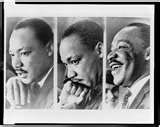
| Dr. Martin Luther King, Jr. |
Because there are no magical time or travel machines, and no way to communicate with the deceased or historical notables–except in the movies and on TV–I had to find a way to bring Dr. King to me for an interview. Jesus is too large for me to imagine what he would say to direct questions.
I racked my brain about 10 minutes, maybe 15, trying to make magic
happen without abracadabra incantations that would not solve my dilemma.
Then lightning struck. My brain jumped into action. My plan: Read Dr. King’s speeches and quotes to fit the questions I
want him to answer. Using his own words, I prepared my chance of a lifetime
“interview” with Dr. Martin Luther King, Jr.
The more things change, the more they stay the same. That adage is true. Forty-four years after he was assassinated, Dr. King's words are just as relevant and forceful today as they were when he first spoke them during his lifetime. Even though he is gone his words are still repeated and recited by the young and old, Blacks and Whites, Americans and foreigners.
Dr. Martin Luther King, Jr. was born January 15, 1929. He was fatally shot by James Earl Ray as he and a few friends stood on the balcony of the Lorain Hotel in Memphis, Tennessee, April 4, 1968. He was in Tennessee to march with sanitation workers, whose incomes and working conditions were far below those of Whites working the same jobs. The workers and supporters carried signs that said: I AM A MAN TOO! For clarity, this "interview" will not focus on the protest in Memphis.
Dorothy: Dr. King if you could step back into history, mentally or physically, what time period or time periods would you return to?
Dr. King: I would take my mental flight by Egypt through, or rather across the Red Sea, through the wilderness on toward the promised land. And in spite of its magnificence, I wouldn't stop there. I would move on by Greece, and take my mind to Mount Olympus. And I would see Plato, Aristotle, Socrates, Euripides and Aristophanes assembled around the Parthenon as they discussed the great and eternal issues of reality.
But I wouldn't stop there. I would go on, even to the great heyday of the Roman Empire. And I would see developments around there, through various emperors and leaders. But I wouldn't stop there. I would even come up to the day of the Renaissance, and get a quick picture of all that the Renaissance did for the cultural and esthetic life of man. But I wouldn't stop there. I would even go by the way that the man for whom I'm named had his habitat. And I would watch Martin Luther as he tacked his ninety-five theses on the door at the church in Wittenberg.
But I wouldn't stop there. I would come on up even to 1863, and watch a vacillating president by the name of Abraham Lincoln finally come to the conclusion that he had to sign the Emancipation Proclamation. But I wouldn't stop there. I would even come up the early thirties, and see a man grappling with the problems of the bankruptcy of his nation. And come with an eloquent cry that we have nothing to fear but fear itself.
But I wouldn't stop there. Strangely enough, I would turn to the Almighty, and say, "If you allow me to live just a few years in the second half of the twentieth century, I will be happy." Now that's a strange statement to make, because the world is all messed up. The nation is sick. Trouble is in the land. Confusion is all around. That's a strange statement. But I know, somehow, that only when it is dark enough, can you see the stars.
Dorothy: When did you decide the direction your life might go?
Dr. King: I decided early to give my life to something eternal and absolute. Not to these little gods that are here today and gone tomorrow; but to God who is the same yesterday, today, tomorrow and forever.
Dorothy: How would you, a widely known leader, measure the spirit of man, being a spiritual man yourself?
Dr. King: The ultimate measure of a man is not where he stands in moments of comfort and convenience, but where he stands in times of challenge and controversy.
Dorothy: Can what affects one race of Americans, not affect another race, especially in the realm of justice?
Dr. King: Injustice anywhere is a threat to justice everywhere. We are caught in an inescapable network of mutuality, tied in a single garment of destiny. Whatever affects one directly, affects all indirectly.
Dorothy: Politicians talk a lot about science and its relationship to religion. What is your opinion? Are the two connected?
Dr. King: Science investigates, religion interprets. Science gives man knowledge, which is power; religion gives man wisdom, which is control. Science deal mainly with facts, religion deals mainly with values. The two are not rivals. They are complimentary. Science keeps religion from sinking into the valley or crippling irrationalism and paralyzing obscurantism. Religion prevents science from falling into the marsh of obsolete materialism and moral nihilism.
Dorothy: Dr. King, everyone is aware that you are nonviolent. But realistically, wouldn’t you achieve your goal for justice much faster by employing a hint of violence?
Dr. King: Violence as a way of achieving racial justice is both impractical and immoral. It is impractical because it is a descending spiral ending in destruction for all. It is immoral because it seeks to humiliate the opponent, rather than win his understanding. It seems to annihilate rather than to convert. Violence is immoral because it thrives on hatred rather than love. At the center of non-violence stands the principle of love. Love is not emotional bash; it is not empty sentimentalism. It is the active outpouring of one's whole being into the being of another.
Dorothy: How do you feel about discrimination?
Dr. King: Discrimination is a hellhound that gnaws at Negroes in every waking moment of their lives to remind them that the lie of their inferiority is accepted as truth in the society dominating them.
Dorothy: Once again America is at war after the 9/11 terrorists strike. We went to war in Iraq and Afghanistan, where we still are fighting. But these wars are different from Vietnam. Will there ever be peace in the world?
Dr. King: Sooner or later all the people of the world will have to discover a way to live together in peace, and thereby, transform this pending cosmic elegy into a creative psalm of brotherhood. I refuse to accept the view that mankind is so tragically bound to the starless midnight of racism and war that the bright daybreak of peace and brotherhood can never become a reality.
I refuse to accept the cynical notion that nation after nation must spiral down a militaristic stairway into the hell of nuclear annihilation. I believe that even amid today's mortar bursts and whining bullets, there is still hope for a brighter tomorrow. I still believe that one day mankind will bow before the altars of God and be crowned triumphant over war and bloodshed.
Dorothy: Did America damage its image with its involvement in the Vietnam war?
Dr. King: It is curious that Americans who calculate so carefully on the possibilities of military victory, do not realize that in the process, they are incurring deep psychological and political defeat. The image of America will never again be the image of evolution, freedom and democracy, but the image of violence and militarism.
Dorothy: How do you feel about defense spending as opposed to spending on programs to help America’s poor?
Dr. King: A nation that continues year after year to spend more money in military defense than on programs of social uplift is approaching spiritual death. The curse of poverty has no justification in our age. It is socially as cruel and blind as the practice of cannibalism at the dawn of civilization, when men ate each other because they had not yet learned to take food from the soil or to consume the abundant animal life around them. The time has come for us to civilize ourselves by the total, direct and immediate abolition of poverty.
Dorothy: Today many people appear to be brain dead, and willing to accept whatever is told to them without question. Why do you think that is?
Dr. King: Nothing in all the world is more dangerous than insincere ignorance and conscious stupidity.
Dorothy: Explain what the "drum major instinct" means.
Dr. King: Now the presence of the drum major instinct is why so many people are "joiners." You know, there are some people who just join everything. And it's really a quest for attention and recognition and importance. And they get names that give them that impression. So you get your groups, and they become the "Grand Patron" and the little fellow who is henpecked at home needs a chance to be the "Most Worthy of the Most Worthy" of something. It is the drum major impulse and longing that runs the gamut of human life. And so we see it everywhere, this quest for recognition. And we join things, over join really, that we think that we will find that recognition in.
Dorothy: How can America reroute the revolution of values in the midst of war?
Dr. King: America, the richest and most powerful nation in the world, can well lead the way in this revolution of values. There is nothing except a tragic death wish to prevent us from reordering our priorities so that the pursuit of peace will take precedence over the pursuit of war. There is nothing to keep us from molding a recalcitrant status-quo with bruised hands until we have fashioned it into a brotherhood.
Dorothy: In Birmingham you decided to take nonviolent "direct action". What was the purpose?
Dr. King: Nonviolent direct action seeks to create such a crisis and foster such a tension that a community which has constantly refused to negotiate is forced to confront the issue so that it can no longer be ignored. My citing the creation of tension as part of the work of the nonviolent--resister may sound rather shocking. But I must confess that I am not afraid of the word tension. I have earnestly opposed violent tension, but there is a type of constructive, nonviolent tension which is necessary for growth.
Dorothy: Were any of your direct-action campaigns ever well timed? Many Whites feel they were not.
Dr. King: Frankly, I have yet to engage in a direct-action campaign that was well timed in the view of those who have not suffered unduly from the disease of segregation. For years now I have heard the word ‘wait.’ It rings in the ear of every Negro with piercing familiarity. This ‘wait’ has almost always meant ‘never.’
Dorothy: In your own words, describe what is it like to be Black and living in America.
Dr. King: Being a Negro in America means trying to smile when you want to cry. It means trying to hold on to physical life amid psychological death. It means the pain of watching your children grow up with clouds of inferiority in their mental skies. It means having your legs cut off, and then being condemned for being a cripple. It means seeing your mother and father spiritually murdered by the slings and arrows of daily exploitation, and then being hated for being an orphan.
Dorothy: When you hear people say you are breaking the law in some instances when you hold demonstrations or marches, what is your response?
Dr. King: The answers lies in the fact that there are two types of laws: just and unjust. One has not only a legal but a moral responsibility to obey just laws. Conversely, one has a moral responsibility to disobey unjust laws. I would agree with St. Augustine that an unjust law is a human law that is not rooted in eternal law and natural law. Any law that uplifts human personality is just. Any law that degrades human personality is unjust.
Dorothy: During the early days of the bus boycotts, you received a threatening call around midnight, in which the caller said, ‘Nigger, we are tired of you and your mess now. If you don’t get out of town in three days, we’re going to blow up your house.’ Was that frightening for you and your family?
Dr. King: I could hear an inner voice saying to me, ‘Martin Luther, stand up for justice. Stand up for truth. And lo I will be with you, even until the end of the world.’
Dorothy: Does the prospect of death frighten you?
Dr. King: Death comes to every individual. There is an amazing democracy about death. It is not aristocracy for some of the people, but a democracy for all of the people. Death is the irreductible common denominator of all men.
Dorothy: How do you want to be remembered? What do you people to say at your funeral?
Dr. King: If any of you are around when I have to meet my day, I don’t want a long funeral. And if you get somebody to deliver the eulogy, tell them not to talk too long. And every now and then I wonder what I want them to say. Tell them not to mention that I have a Nobel Peace Prize—that isn’t important. Tell them not to mention that I have three or four hundred other awards—that’s not important. Tell them not to mention where I went to school. 'd like somebody to mention that day that Martin Luther King, Jr., tried to give his life serving others. I'd like for somebody to say that day that Martin Luther King, Jr., tried to love somebody.
Dorothy: If I was slated to speak at your funeral, what would you like me to say?
Dr. King: I want you to say that day that I tried to be right on the war question. I want you to be able to say that day that I did try to feed the hungry. And I want you to be able to say that day that I did try in my life to clothe those who were naked. I want you to say on that day that I did try in my life to visit those who were in prison.
I want you to say that I tried to love and serve humanity. Yes, if you want to say that I was a drum major, say that I was a drum major for justice. Say that I was a drum major for peace. I was a drum major for righteousness. And all of the other shallow things will not matter. I won't have any money to leave behind. I won't have the fine and luxurious things of life to leave behind. But I just want to leave a committed life behind. And that's all I want to say.
Dorothy: Thank you, Dr. King. I enjoyed the interview.
Dr. King: You're quite welcome.
The more things change, the more they stay the same. That adage is true. Forty-four years after he was assassinated, Dr. King's words are just as relevant and forceful today as they were when he first spoke them during his lifetime. Even though he is gone his words are still repeated and recited by the young and old, Blacks and Whites, Americans and foreigners.
Dr. Martin Luther King, Jr. was born January 15, 1929. He was fatally shot by James Earl Ray as he and a few friends stood on the balcony of the Lorain Hotel in Memphis, Tennessee, April 4, 1968. He was in Tennessee to march with sanitation workers, whose incomes and working conditions were far below those of Whites working the same jobs. The workers and supporters carried signs that said: I AM A MAN TOO! For clarity, this "interview" will not focus on the protest in Memphis.
Dorothy: Dr. King if you could step back into history, mentally or physically, what time period or time periods would you return to?
Dr. King: I would take my mental flight by Egypt through, or rather across the Red Sea, through the wilderness on toward the promised land. And in spite of its magnificence, I wouldn't stop there. I would move on by Greece, and take my mind to Mount Olympus. And I would see Plato, Aristotle, Socrates, Euripides and Aristophanes assembled around the Parthenon as they discussed the great and eternal issues of reality.
But I wouldn't stop there. I would go on, even to the great heyday of the Roman Empire. And I would see developments around there, through various emperors and leaders. But I wouldn't stop there. I would even come up to the day of the Renaissance, and get a quick picture of all that the Renaissance did for the cultural and esthetic life of man. But I wouldn't stop there. I would even go by the way that the man for whom I'm named had his habitat. And I would watch Martin Luther as he tacked his ninety-five theses on the door at the church in Wittenberg.
But I wouldn't stop there. I would come on up even to 1863, and watch a vacillating president by the name of Abraham Lincoln finally come to the conclusion that he had to sign the Emancipation Proclamation. But I wouldn't stop there. I would even come up the early thirties, and see a man grappling with the problems of the bankruptcy of his nation. And come with an eloquent cry that we have nothing to fear but fear itself.
But I wouldn't stop there. Strangely enough, I would turn to the Almighty, and say, "If you allow me to live just a few years in the second half of the twentieth century, I will be happy." Now that's a strange statement to make, because the world is all messed up. The nation is sick. Trouble is in the land. Confusion is all around. That's a strange statement. But I know, somehow, that only when it is dark enough, can you see the stars.
Dorothy: When did you decide the direction your life might go?
Dr. King: I decided early to give my life to something eternal and absolute. Not to these little gods that are here today and gone tomorrow; but to God who is the same yesterday, today, tomorrow and forever.
Dorothy: How would you, a widely known leader, measure the spirit of man, being a spiritual man yourself?
Dr. King: The ultimate measure of a man is not where he stands in moments of comfort and convenience, but where he stands in times of challenge and controversy.
Dorothy: Can what affects one race of Americans, not affect another race, especially in the realm of justice?
Dr. King: Injustice anywhere is a threat to justice everywhere. We are caught in an inescapable network of mutuality, tied in a single garment of destiny. Whatever affects one directly, affects all indirectly.
Dorothy: Politicians talk a lot about science and its relationship to religion. What is your opinion? Are the two connected?
Dr. King: Science investigates, religion interprets. Science gives man knowledge, which is power; religion gives man wisdom, which is control. Science deal mainly with facts, religion deals mainly with values. The two are not rivals. They are complimentary. Science keeps religion from sinking into the valley or crippling irrationalism and paralyzing obscurantism. Religion prevents science from falling into the marsh of obsolete materialism and moral nihilism.
Dorothy: Dr. King, everyone is aware that you are nonviolent. But realistically, wouldn’t you achieve your goal for justice much faster by employing a hint of violence?
Dr. King: Violence as a way of achieving racial justice is both impractical and immoral. It is impractical because it is a descending spiral ending in destruction for all. It is immoral because it seeks to humiliate the opponent, rather than win his understanding. It seems to annihilate rather than to convert. Violence is immoral because it thrives on hatred rather than love. At the center of non-violence stands the principle of love. Love is not emotional bash; it is not empty sentimentalism. It is the active outpouring of one's whole being into the being of another.
Dorothy: How do you feel about discrimination?
Dr. King: Discrimination is a hellhound that gnaws at Negroes in every waking moment of their lives to remind them that the lie of their inferiority is accepted as truth in the society dominating them.
Dorothy: Once again America is at war after the 9/11 terrorists strike. We went to war in Iraq and Afghanistan, where we still are fighting. But these wars are different from Vietnam. Will there ever be peace in the world?
Dr. King: Sooner or later all the people of the world will have to discover a way to live together in peace, and thereby, transform this pending cosmic elegy into a creative psalm of brotherhood. I refuse to accept the view that mankind is so tragically bound to the starless midnight of racism and war that the bright daybreak of peace and brotherhood can never become a reality.
I refuse to accept the cynical notion that nation after nation must spiral down a militaristic stairway into the hell of nuclear annihilation. I believe that even amid today's mortar bursts and whining bullets, there is still hope for a brighter tomorrow. I still believe that one day mankind will bow before the altars of God and be crowned triumphant over war and bloodshed.
Dorothy: Did America damage its image with its involvement in the Vietnam war?
Dr. King: It is curious that Americans who calculate so carefully on the possibilities of military victory, do not realize that in the process, they are incurring deep psychological and political defeat. The image of America will never again be the image of evolution, freedom and democracy, but the image of violence and militarism.
Dorothy: How do you feel about defense spending as opposed to spending on programs to help America’s poor?
Dr. King: A nation that continues year after year to spend more money in military defense than on programs of social uplift is approaching spiritual death. The curse of poverty has no justification in our age. It is socially as cruel and blind as the practice of cannibalism at the dawn of civilization, when men ate each other because they had not yet learned to take food from the soil or to consume the abundant animal life around them. The time has come for us to civilize ourselves by the total, direct and immediate abolition of poverty.
Dorothy: Today many people appear to be brain dead, and willing to accept whatever is told to them without question. Why do you think that is?
Dr. King: Nothing in all the world is more dangerous than insincere ignorance and conscious stupidity.
Dorothy: Explain what the "drum major instinct" means.
Dr. King: Now the presence of the drum major instinct is why so many people are "joiners." You know, there are some people who just join everything. And it's really a quest for attention and recognition and importance. And they get names that give them that impression. So you get your groups, and they become the "Grand Patron" and the little fellow who is henpecked at home needs a chance to be the "Most Worthy of the Most Worthy" of something. It is the drum major impulse and longing that runs the gamut of human life. And so we see it everywhere, this quest for recognition. And we join things, over join really, that we think that we will find that recognition in.
Dorothy: How can America reroute the revolution of values in the midst of war?
Dr. King: America, the richest and most powerful nation in the world, can well lead the way in this revolution of values. There is nothing except a tragic death wish to prevent us from reordering our priorities so that the pursuit of peace will take precedence over the pursuit of war. There is nothing to keep us from molding a recalcitrant status-quo with bruised hands until we have fashioned it into a brotherhood.
Dorothy: In Birmingham you decided to take nonviolent "direct action". What was the purpose?
Dr. King: Nonviolent direct action seeks to create such a crisis and foster such a tension that a community which has constantly refused to negotiate is forced to confront the issue so that it can no longer be ignored. My citing the creation of tension as part of the work of the nonviolent--resister may sound rather shocking. But I must confess that I am not afraid of the word tension. I have earnestly opposed violent tension, but there is a type of constructive, nonviolent tension which is necessary for growth.
Dorothy: Were any of your direct-action campaigns ever well timed? Many Whites feel they were not.
Dr. King: Frankly, I have yet to engage in a direct-action campaign that was well timed in the view of those who have not suffered unduly from the disease of segregation. For years now I have heard the word ‘wait.’ It rings in the ear of every Negro with piercing familiarity. This ‘wait’ has almost always meant ‘never.’
Dorothy: In your own words, describe what is it like to be Black and living in America.
Dr. King: Being a Negro in America means trying to smile when you want to cry. It means trying to hold on to physical life amid psychological death. It means the pain of watching your children grow up with clouds of inferiority in their mental skies. It means having your legs cut off, and then being condemned for being a cripple. It means seeing your mother and father spiritually murdered by the slings and arrows of daily exploitation, and then being hated for being an orphan.
Dorothy: When you hear people say you are breaking the law in some instances when you hold demonstrations or marches, what is your response?
Dr. King: The answers lies in the fact that there are two types of laws: just and unjust. One has not only a legal but a moral responsibility to obey just laws. Conversely, one has a moral responsibility to disobey unjust laws. I would agree with St. Augustine that an unjust law is a human law that is not rooted in eternal law and natural law. Any law that uplifts human personality is just. Any law that degrades human personality is unjust.
Dorothy: During the early days of the bus boycotts, you received a threatening call around midnight, in which the caller said, ‘Nigger, we are tired of you and your mess now. If you don’t get out of town in three days, we’re going to blow up your house.’ Was that frightening for you and your family?
Dr. King: I could hear an inner voice saying to me, ‘Martin Luther, stand up for justice. Stand up for truth. And lo I will be with you, even until the end of the world.’
Dorothy: Does the prospect of death frighten you?
Dr. King: Death comes to every individual. There is an amazing democracy about death. It is not aristocracy for some of the people, but a democracy for all of the people. Death is the irreductible common denominator of all men.
Dorothy: How do you want to be remembered? What do you people to say at your funeral?
Dr. King: If any of you are around when I have to meet my day, I don’t want a long funeral. And if you get somebody to deliver the eulogy, tell them not to talk too long. And every now and then I wonder what I want them to say. Tell them not to mention that I have a Nobel Peace Prize—that isn’t important. Tell them not to mention that I have three or four hundred other awards—that’s not important. Tell them not to mention where I went to school. 'd like somebody to mention that day that Martin Luther King, Jr., tried to give his life serving others. I'd like for somebody to say that day that Martin Luther King, Jr., tried to love somebody.
 |
| The Lorain Hotel turned into a Civil Rights Museum |
Dr. King: I want you to say that day that I tried to be right on the war question. I want you to be able to say that day that I did try to feed the hungry. And I want you to be able to say that day that I did try in my life to clothe those who were naked. I want you to say on that day that I did try in my life to visit those who were in prison.
I want you to say that I tried to love and serve humanity. Yes, if you want to say that I was a drum major, say that I was a drum major for justice. Say that I was a drum major for peace. I was a drum major for righteousness. And all of the other shallow things will not matter. I won't have any money to leave behind. I won't have the fine and luxurious things of life to leave behind. But I just want to leave a committed life behind. And that's all I want to say.
Dorothy: Thank you, Dr. King. I enjoyed the interview.


