These critics say that President Obama refuses to address the twin evils sitting on Americans’ dinner tables--race and racism--alongside the apple pie and whipped cream. If truth be told, which I intend to do, Barack Obama is not responsible for high unemployment among Blacks. He has no magic wand to eradicate racism, bigotry, racial hatred, discrimination. Only carriers of these diseases can eradicate their existence.
Had these accusatory African Americans and White critics stepped back to re-exam America’s history they would think twice before talking about high unemployment among African Americans and racism, both of which were deliberately created by the U. S. government to enrich White people. Racism was, and still is, the government's well paid mistress.
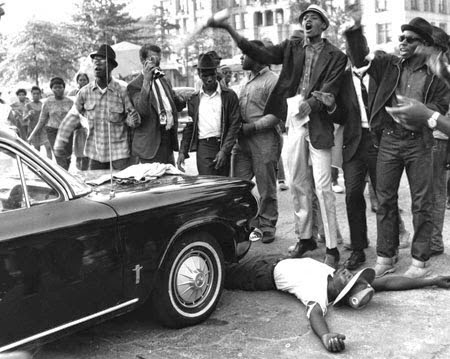
TV viewers who watched the recent riots in Ferguson and Baltimore did not make the governmental connection to what was occurring in those states. Prior riots initiated by disenfranchised African Americans in various states were born out of racism and all that's akin to it. African Americans could not acquire bank loans to purchase homes in their neighborhoods, or to move into all White neighborhoods, that led to white flight.
In areas often designated as neighborhoods for minorities there was a lack of adequate schools, leaving Black students to obtain inadequate educations. There were/are no grocery markets, shopping centers, pharmacies, quality restaurants, movie theaters.
The seasons for riots, both past and present, were due to the myriad of opportunities that White folks take for granted every day. None of these career leading opportunities are available to African Americans no matter their qualifications or education. These factors remain true in 2015.
The government was not a friend to Black folks: Redlining and other sanctioned impediments
The Federal Housing Administration (FHA) was established by the National Housing Act (NHA) in 1934. All subsequent umbrella agencies established thereafter deliberately colluded with White landlords to hold on to housing segregation and discrimination. Redlining was one of many mechanisms employed to hinder African American home ownership. Banks used red relining to deny mortgages and loans to minorities living in all Black or Latino neighborhoods, both of which were considered high risk and low income. In the early 1930s the FHA established standards that significantly discriminated against minorities and minority neighborhoods.
Redlining is the practice of denying or limiting financial services to certain neighborhoods based on racial or ethnic composition without regard to the residents’ qualifications or creditworthiness. The term “redlining” refers to the practice of using a red line on a map to delineate the area where financial institutions refused to invest financially.
“Ferguson is a prime, and egregious, example of discriminatory housing policies and segregation. Out of 50 metro areas across the country, the St. Louis area is where Ferguson is located, is the ninth most segregated between Whites and Blacks. That fact is a result of both White flight and public policy working in tandem. St. Louis began redlining with a ballot measure in 1916, which was won by a substantial majority, creating an ordinance that designated some areas as ‘Negro blocks.’ While it was struck down a year later when a similar ordinance in another area was ruled against by the Supreme Court, realtors were undeterred". (Think Progress, 8/14/2014)
“Returning World War II veterans spurred a population and housing boom driven in part by benefits from the GI bill. The economic demands of the post-war boom and the burgeoning Civil Rights movement led to conflicts over discrimination in housing, jobs and education. The Federal Housing Administration, which instituted policies that reinforced patterns of segregation, routinely denied low-interest loans to non-Whites.
“The experience of fighting for freedom in Europe and then returning to a country where discrimination and opportunities were limited fostered discontent for returning Black GIs. The legacy of post-war economic discrimination contributed to the wealth gap between Whites and non-Whites that we see today. One of the most important factors that contributed to the wealth gap was the federal housing policy. This policy endorsed redlining and discrimination in sales, financing and homeowners insurance, is reflected in the unequal rates of home ownership even today". (understandingrace.org)
Levittown was the first of its kind in Long Island, New York. The pristine suburbs were a phenomenon at the time. Abraham Levitt, a Jew, admitted that he would not sell or rent to African Americans and Jews. The government, in conjunction with banks, gave concession loans to builders like Levitt. Interest rates were low and sealed with a guarantee.
"In some ways, Levittown resembled the ethnic composition of the military during World War ll: Jews Italians, Irish and Poles living side-by-side. But also like most of the military, African Americans were not allowed to enter this melting pot. As with many homebuilders in his era, William Levittt didn't question the demands of his financial backers, the FHA, which supported nationwide racial covenants and redlining, or devaluing racially mixed communities". (History Net)
The American Project reveals that “If a Black family could afford to buy into a White neighborhood without government help, the FHA would refuse to insure future mortgages even to Whites in that neighborhood, because it was now threatened with integration. The federal government was determined to prevent school integration as well".
The Stepford type homes (rentals with the option to buy) were affordable and identical in appearance. Monthly mortgages were around $60.00; eligible home owners were given 30 year mortgages, and a five percent down payment. Levitt replicated his success in two more states. He stuck to his rule not to rent or sale to African Americans and Jews. He knew if his homes were sold to Blacks and Jews the property values would drop significantly. Whites would refuse to rent or purchase the homes. Levitt justified his racism by declaring that White folks would move rather than live in segregated neighborhoods. And he was right. There were instances when Levittown residents went into a rage upon hearing that Black families might move into their neighbors.
“In the second Levittown, near Philadelphia, angry White mobs threw rocks in 1957 to protest the prospect of Blacks moving in. In response back then, the Levittown Democrats, Jewish War Veterans and a Protestant minister all spoke up for open housing.” (New York Times, 1997)
A hunt for jobs and opportunities
“Southern migrants did not always find the 'promised land' they envisioned. They frequently endured residential segregation, substandard living conditions, job discrimination, and in many cases, the hostilities of White residents. Older Black residents sometimes resented the presence of the new migrants as neighborhoods became increasingly overcrowded and stigmatized as ghettos". (Africana Age)
Southern Whites, dependent on Blacks to sharecrop their land, predicted the migrating Blacks would fall on their faces in the North. European immigration had dwindled greatly because of the war, leaving open the door of employment opportunities for African Americans. However, the competition for study employment was tough for women seeking domestic work. Black employees were underpaid and overworked compared to White employees. Black women and men, no matter their educational status, were stuck with specific occupations. Many of the became teachers in all-Black schools. They could not teach in all-White schools.
“Aside from competition for employment, there was also competition for living space in the increasingly crowded cities. While segregation was not legalized in the North (as it was in the South), racism and prejudice were widespread. After the U.S. Supreme Court declared racially based housing ordinances unconstitutional in 1917, some residential neighborhoods enacted covenants requiring white property owners to agree not to sell to blacks; these would remain legal until the Court struck them down in 1948.” (History Channel)l)
The notorious discrimination convenant
The covenants were advanced notices to realtors not to sell or rent to Blacks. The practices were, and still are, practiced nationwide. Today it’s called “White flight.” When White home owners feel that too many African Americans and other minorities are moving into their neighborhoods they immediately relocate, rather than live in desegregated neighborhoods. According to a Supreme Court decision the racial covenants were unenforceable. Nevertheless, landlords, developers and realtors managed to hoola hoop around the language in the covenants. They circumvented the laws and the rules.
A typical covenant included the following clause: “… hereafter no part of said property or any portion thereof shall be… occupied by any person not of the Caucasian race, it being intended hereby to restrict the use of said property … against occupancy as owners or tenants of any portion of said property for resident or other purposes by people of the Negro or Mongolian race.
“The practice of using racial covenants became so socially acceptable that in 1937 a leading magazine of nationwide circulation awarded 10 communities a ‘shield of honor’ for an umbrella of restrictions against the ‘wrong kind of people’. The practice was so widespread that by 1940, 80% of property in Chicago and Los Angeles carried restrictive covenants barring Black families". (The Fair Housing Center of Boston)
“FHA insurance often was isolated to new residential developments on the edges of metropolitan areas that were considered safer investments, not to inner city neighborhoods. This stripped the inner city of many of their middle-class inhabitants, thus hastening the decay of inner-city neighborhoods. Loans for the repair of existing structures were small and for short duration, which meant that families could more easily purchase a new home than modernize an old one, leading to the abandonment of many older inner-city properties”. (FHC)
Minority Disadvantages
A) Minorities were shown fewer homes and told about fewer listings.
B) They were asked more questions about their qualifications.
C) They were steered to lower priced homes or houses in minority communities.
D) They were required to provide 24 to 48 hour notices before viewing houses.
E) Realtors quoted higher loan rates and offered fewer discounts on closing costs.
White Advantages
A) Whites were automatically presumed to be qualified.
B) Whites were given greater access to properties.
C) Whites were given more information.
D) Whites got lower loan rates, better discounts.
E) Whites were more likely to succeed in home buying.
Neighborhood Classifications: Home Owner’s Loan Coalition (HOLC) appraisers divided neighborhoods by categories that included occupation, income and ethnicity in an attempt to eliminate subjectivity of appraisers:
A (Green) were new, homogenous areas--American business and professional men--in demand as residential location in good times and bad.
B (Blue) were still desirable areas that had reached their peak but were expected to remain stable for many years.
C (Yellow) were neighborhoods that were definitely declining. Generally sparsely populated fringe areas that were typically bordering on all Black neighborhoods.
D (Red) Black and low income neighborhoods were considered to be the worst for lending. There is a general consensus that the HOLC maps set the original precedent for racial discrimination and allowed for it to be an institutional practice.
“President Roosevelt had launched a federal agency called the Home Owners Loan Corporation (HOLC), meant to protect struggling homeowners from losing their homes. The HOLC later implemented a system of rating neighborhoods with letter grades to help more systematically discern property values.
"While racially homogenous and primarily White neighborhoods generally received higher grades, the agency deemed those neighborhoods housing minorities or, “an undesirable element,” in the official language, with its lowest ratings. Later, the Federal Housing Authority continued to use those HOLC standards when issuing mortgages". (ushistoryscene.com/Levittown)
President John F. Kennedy, through an Executive Order in 1962, prohibited racial discrimination in housing developments built or bought with the assistance of the federal government.
2015 Baltimore riots and public housing
African American residents were expected to pull themselves up by their bootstraps and stop complaining. White communities in the same state thrived, pulling themselves up through gainful employment and, in some cases, government assistance. Businesses constantly builds in all White suburban areas, where schools are superior to schools in Black communities.
The American Prospect explained that in the event Black families were financially capable of purchasing homes in all White neighborhoods, the FHA continued its goal of keeping Blacks and Whites living in separate areas. And there was a price to pay if this covenant was broken by landlords.
“ . . . [t]he FHA would refuse to insure future mortgages even to Whites in that neighborhood, because it was now threatened with integration. The federal government was determined to prevent school integration as well. Whole neighborhoods could be deemed ineligible for mortgage guarantees because, as the FHA underwriting manual stated, where children are compelled to attend school where the majority or a goodly number of the pupils represent a far lower level of society or an incompatible racial element, the neighborhood under consideration will prove far less stable and desirable than if this condition did not exist.
“Although the Supreme Court ruled in 1948 that racial restrictions were legally unenforceable, the FHA and VA continued to insure such mortgages. By 1950, the federal agencies were insuring half of all new mortgages nationwide. Many White families, who before the postwar housing boom lived in urban neighborhoods in proximity to African Americans, were relocated to more isolated White racial enclaves, created and promoted by government policy. Thus the racial and social-class homogeneity of Joel Klein's schools in Queens-Public School 151, Junior High School 10, and Bryant High-was created in good measure by public-housing and federal mortgage-guarantee policies that isolated the poor.” (The American Prospect)
The Dallas Morning News, in 1984, dispatched a number of reporters to 47 cities to write about America’s public housing projects. What they found is ten million residents segregated by ethnicity. Public housing occupied by Whites had “superior facilities, amenities, services and maintenance compared to predominately Black projects.”
“The result was a one-two punch. With public housing, federal and local governments increased the isolation of African Americans in urban ghettos, and with mortgage guarantees, the government subsidized Whites to abandon urban areas for the suburbs. The combination was largely responsible for creating the segregated neighborhoods and schools we know today, with truly disadvantaged minority students isolated in poor, increasingly desperate communities where teachers struggle unsuccessfully to overcome their families' multiple needs. Without these public policies, the racial achievement gap that has been so daunting to Joel Klein and other educators would be a different and lesser challenge.” (The American Prospect)
In 1973 President Richard Nixon described public housing as “monstrous, depressing places, run down, overcrowded, crime ridden.”
In Austin, Texas evidence of the indifference was exposed in 1997 in a Housing and Community Development (HUD) audit. “Even though Projects in general bear the scars of generations of tenant abuse, much of the decrepitude on display was caused by HACA itself. At the Booker T. Washington public housing in East Austin, residents lived for months with gaping holes in their ceilings.
“Other residents heated their units with the kitchen stoves because the furnaces didn't work. Because the back doors had been improperly installed, residents at Booker T., HACA's largest project, had to leave their homes unlocked in a neighborhood filled with crime and vice -- much of it based at Booker T. itself.” (Austin Chronicle)
Congressman Lyndon Johnson was instrumental in getting the first public housing project built in Austin. He did not have an easy road to walk in his effort to get it built. Johnson had to appease local businessmen and strict segregationists.
“Johnson persuaded the United States Housing Authority administrator Nathan Strauss and President Roosevelt that Austin should be the site of the first housing development under the 1937 Housing Act. Only with the support of White business leaders like E. H. Perry, and after contentious town meetings, and an impassioned radio address did Johnson secure enough political support to move forward with the project.
“To accommodate local segregationist desires the first project was actually 3 projects: one for Whites, one for African Americans and one for Hispanics. Each project was located in an existing segregated neighborhood. The housing project for Hispanics-- Santa Rita Courts-- was the first public housing development completed under the 1937 housing act and opened in Austin in 1938.”
The Rosewood Projects in East Austin was the first to be built for African Americans in the United States.
“More than one million Texans have lived in public housing over the past sixty years. Most public housing developments were built in low income, minority neighborhoods, and contribute to the concentration of poor and minority families. Public housing in Vidor, Texas was ordered desegregated to permit Black families to move in. The Ku Klux Klan responded with threats and intimidation which made national news.
“A federal judge ruled that housing authorities and city governments in more than thirty East Texas counties engaged in systematic racial discrimination in the operation of public housing. A federal court in Dallas ordered the Dallas Housing Authority, in response to years of racial segregation in public housing, to build new public housing developments in all White, middle income Dallas suburbs. This court order has resulted in a firestorm of White resistance.” (The Public Housing Debate)
President Obama, earlier this year, addressed fair housing and discrimination in his Weekly Address to the country. He said the work of the Fair Housing Act remains unfinished. He said in some cities kids living just blocks apart lead “incredibly different lives”. He further stated that the Affirmatively Furthering Fair Housing rule will make it easier for communities to implement the Fair Housing Act.
HUD Secretary of State Julian Castro, and former mayor of San Antonio, Texas, said, “I know firsthand that strong communities are vital to the well being and prosperity of families. Unfortunately, too many Americans find their dreams limited by where they come from and by zip codes should never determine a child’s future. The important step will give local leaders the tools they need to provide all Americans with access to safe, affordable housing in communities that are rich with opportunity.”
“With public housing, federal and local government increased African Americans’ isolation in urban ghettos. And with mortgage guarantees, the government subsidized whites to abandon urban areas for suburbs. The combination contributed heavily to the creation of the segregated neighborhoods and schools we know today, with truly disadvantaged minority students isolated in poverty-concentrated schools where teachers struggle unsuccessfully to overcome families’ multiple needs.
“Without these public policies, the racial achievement gap that has been so daunting to educators would be a very different, and lesser, challenge. That gap can’t be addressed by nostalgia for a fanciful past when whites grew up in public housing and succeeded solely by benefiting from good teachers.” (Economic Policy Institute, 2012)
According to the National Fair Housing Alliance, “The Fair Housing Act has two goals: to end housing discrimination and to promote diverse, inclusive communities. The second goal is referred to as Affirmatively Furthering Fair Housing (AFFH), and it embodies our strongly-held American values of fair access and equal opportunity.
"Diverse, inclusive communities with access to good jobs, schools, health care, transportation, and housing are crucial to our nation’s prosperity in the 21st century. A hard-learned lesson from the recent economic crisis is that when some of the communities are targeted for discriminatory practices, all of our communities are harmed. Our global competitiveness is challenged when all of our communities do not have the opportunity to succeed together".
The American Prospect explained that in the event Black families were financially capable of purchasing homes in all White neighborhoods, the FHA continued its goal of keeping Blacks and Whites living in separate areas. And there was a price to pay if this covenant was broken by landlords.
“ . . . [t]he FHA would refuse to insure future mortgages even to Whites in that neighborhood, because it was now threatened with integration. The federal government was determined to prevent school integration as well. Whole neighborhoods could be deemed ineligible for mortgage guarantees because, as the FHA underwriting manual stated, where children are compelled to attend school where the majority or a goodly number of the pupils represent a far lower level of society or an incompatible racial element, the neighborhood under consideration will prove far less stable and desirable than if this condition did not exist.
“Although the Supreme Court ruled in 1948 that racial restrictions were legally unenforceable, the FHA and VA continued to insure such mortgages. By 1950, the federal agencies were insuring half of all new mortgages nationwide. Many White families, who before the postwar housing boom lived in urban neighborhoods in proximity to African Americans, were relocated to more isolated White racial enclaves, created and promoted by government policy. Thus the racial and social-class homogeneity of Joel Klein's schools in Queens-Public School 151, Junior High School 10, and Bryant High-was created in good measure by public-housing and federal mortgage-guarantee policies that isolated the poor.” (The American Prospect)
The Dallas Morning News, in 1984, dispatched a number of reporters to 47 cities to write about America’s public housing projects. What they found is ten million residents segregated by ethnicity. Public housing occupied by Whites had “superior facilities, amenities, services and maintenance compared to predominately Black projects.”
“The result was a one-two punch. With public housing, federal and local governments increased the isolation of African Americans in urban ghettos, and with mortgage guarantees, the government subsidized Whites to abandon urban areas for the suburbs. The combination was largely responsible for creating the segregated neighborhoods and schools we know today, with truly disadvantaged minority students isolated in poor, increasingly desperate communities where teachers struggle unsuccessfully to overcome their families' multiple needs. Without these public policies, the racial achievement gap that has been so daunting to Joel Klein and other educators would be a different and lesser challenge.” (The American Prospect)
In 1973 President Richard Nixon described public housing as “monstrous, depressing places, run down, overcrowded, crime ridden.”
Public housing in Austin, Texas
“Other residents heated their units with the kitchen stoves because the furnaces didn't work. Because the back doors had been improperly installed, residents at Booker T., HACA's largest project, had to leave their homes unlocked in a neighborhood filled with crime and vice -- much of it based at Booker T. itself.” (Austin Chronicle)
Congressman Lyndon Johnson was instrumental in getting the first public housing project built in Austin. He did not have an easy road to walk in his effort to get it built. Johnson had to appease local businessmen and strict segregationists.
“Johnson persuaded the United States Housing Authority administrator Nathan Strauss and President Roosevelt that Austin should be the site of the first housing development under the 1937 Housing Act. Only with the support of White business leaders like E. H. Perry, and after contentious town meetings, and an impassioned radio address did Johnson secure enough political support to move forward with the project.
“To accommodate local segregationist desires the first project was actually 3 projects: one for Whites, one for African Americans and one for Hispanics. Each project was located in an existing segregated neighborhood. The housing project for Hispanics-- Santa Rita Courts-- was the first public housing development completed under the 1937 housing act and opened in Austin in 1938.”
The Rosewood Projects in East Austin was the first to be built for African Americans in the United States.
“More than one million Texans have lived in public housing over the past sixty years. Most public housing developments were built in low income, minority neighborhoods, and contribute to the concentration of poor and minority families. Public housing in Vidor, Texas was ordered desegregated to permit Black families to move in. The Ku Klux Klan responded with threats and intimidation which made national news.
“A federal judge ruled that housing authorities and city governments in more than thirty East Texas counties engaged in systematic racial discrimination in the operation of public housing. A federal court in Dallas ordered the Dallas Housing Authority, in response to years of racial segregation in public housing, to build new public housing developments in all White, middle income Dallas suburbs. This court order has resulted in a firestorm of White resistance.” (The Public Housing Debate)
President Obama, earlier this year, addressed fair housing and discrimination in his Weekly Address to the country. He said the work of the Fair Housing Act remains unfinished. He said in some cities kids living just blocks apart lead “incredibly different lives”. He further stated that the Affirmatively Furthering Fair Housing rule will make it easier for communities to implement the Fair Housing Act.
HUD Secretary of State Julian Castro, and former mayor of San Antonio, Texas, said, “I know firsthand that strong communities are vital to the well being and prosperity of families. Unfortunately, too many Americans find their dreams limited by where they come from and by zip codes should never determine a child’s future. The important step will give local leaders the tools they need to provide all Americans with access to safe, affordable housing in communities that are rich with opportunity.”
“With public housing, federal and local government increased African Americans’ isolation in urban ghettos. And with mortgage guarantees, the government subsidized whites to abandon urban areas for suburbs. The combination contributed heavily to the creation of the segregated neighborhoods and schools we know today, with truly disadvantaged minority students isolated in poverty-concentrated schools where teachers struggle unsuccessfully to overcome families’ multiple needs.
“Without these public policies, the racial achievement gap that has been so daunting to educators would be a very different, and lesser, challenge. That gap can’t be addressed by nostalgia for a fanciful past when whites grew up in public housing and succeeded solely by benefiting from good teachers.” (Economic Policy Institute, 2012)
According to the National Fair Housing Alliance, “The Fair Housing Act has two goals: to end housing discrimination and to promote diverse, inclusive communities. The second goal is referred to as Affirmatively Furthering Fair Housing (AFFH), and it embodies our strongly-held American values of fair access and equal opportunity.
"Diverse, inclusive communities with access to good jobs, schools, health care, transportation, and housing are crucial to our nation’s prosperity in the 21st century. A hard-learned lesson from the recent economic crisis is that when some of the communities are targeted for discriminatory practices, all of our communities are harmed. Our global competitiveness is challenged when all of our communities do not have the opportunity to succeed together".